
While the Indian edtech startup ecosystem moved towards what some might call a recovery phase in 2024, with a surge in private investments as well as the first edtech startup listing in the form of PhysicsWallah, the momentum was all but fleeting.
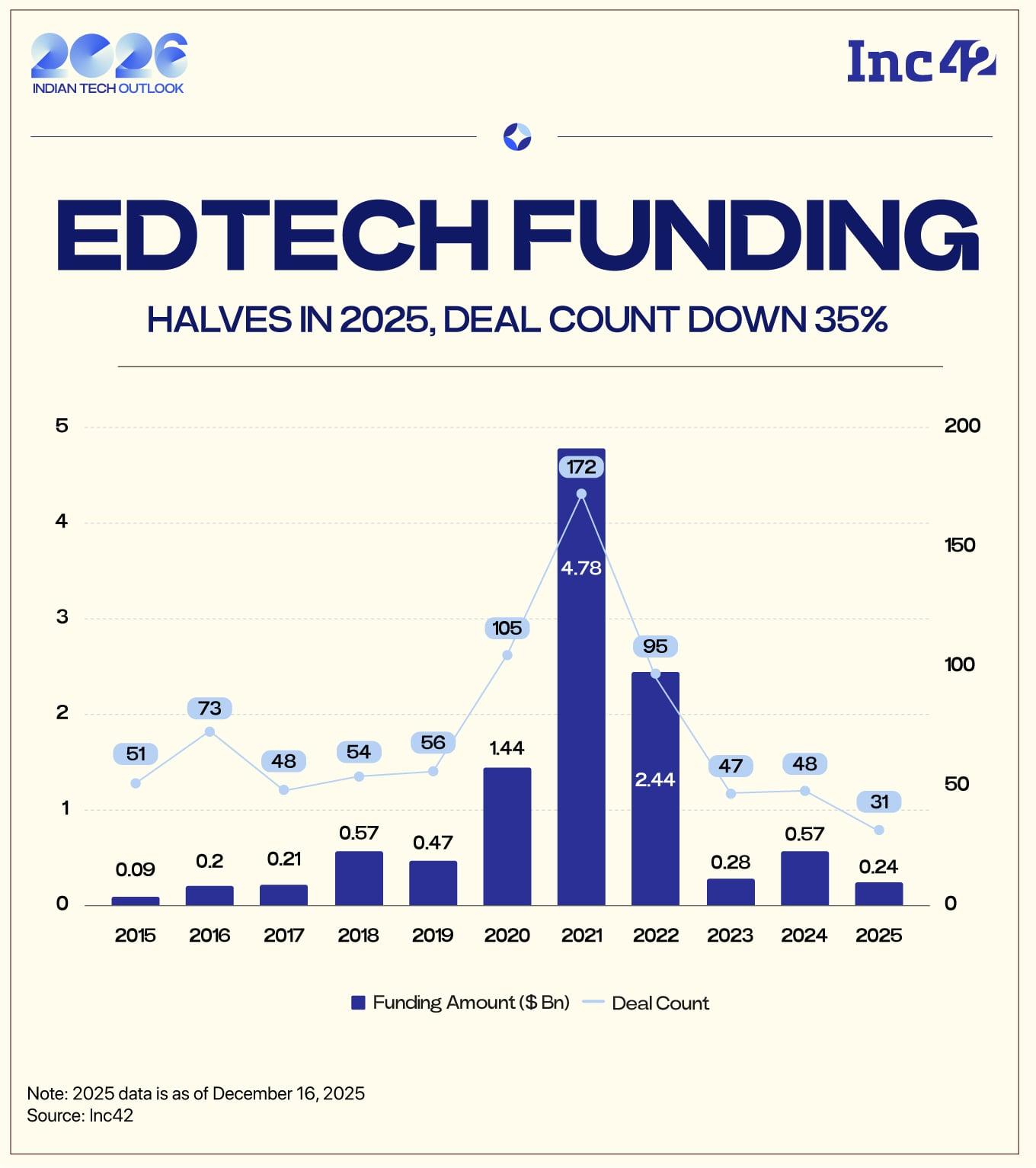
Edtech startup funding plummeted by 56% year-on-year to $249 Mn from $572 Mn invested in 2024, as per Inc42’s Annual Indian Startup Trends Report, 2025. Funding for the sector, once the poster child of India’s burgeoning startup ecosystem, dropped to an 8-year low in the previous year.
Deal count in the sector also took a major hit in 2025, down 35% to 31 deals closed in the year under review from 48 in 2024. In comparison, 172 deals were closed in the edtech industry during its 2021 boom.
At the same time, M&As held comparatively steady at a mere five acquisitions in 2025, similar to the year prior.
It won’t be unfair to say that the ecosystem is yet to recover from the funding winter that rocked it in 2022. The same year marked the start of the series of troubles that led to the fall of edtech’s biggest unicorn, BYJU’S, which continues to grapple with troubles ever since. Issues also began piling up for other edtech majors like Unacademy and Vedantu.
The issues for major edtech names have had far-reaching implications for the sector as a whole. Coupled with a back-to-school mandate, many startups in the space struggled to find a footing amid growing irrelevancy and competition. These have contributed to the diminishing investor interest in the space.
“There seems to be a lot of apprehension against the sector because investors had already lost their hands in BYJU’S and Unacademy, companies had very large valuations, but there were no good solutions, because the model was inherently flawed,” early stage edtech startup Dalvoy AI cofounder Ritik Agrawal told Inc42.
So, is there a revival on the horizon for the industry? Let’s find out.
Seed Funding Saving Grace For Edtech
With the troubles from earlier years still fresh, mega edtech deals are now becoming a thing of the past. As per industry stakeholders Inc42 spoke with, mature startups in the edtech space remain overvalued, owing to investor confidence back in the day, and raising fresh rounds in the current environment would mean taking a haircut in their valuation.
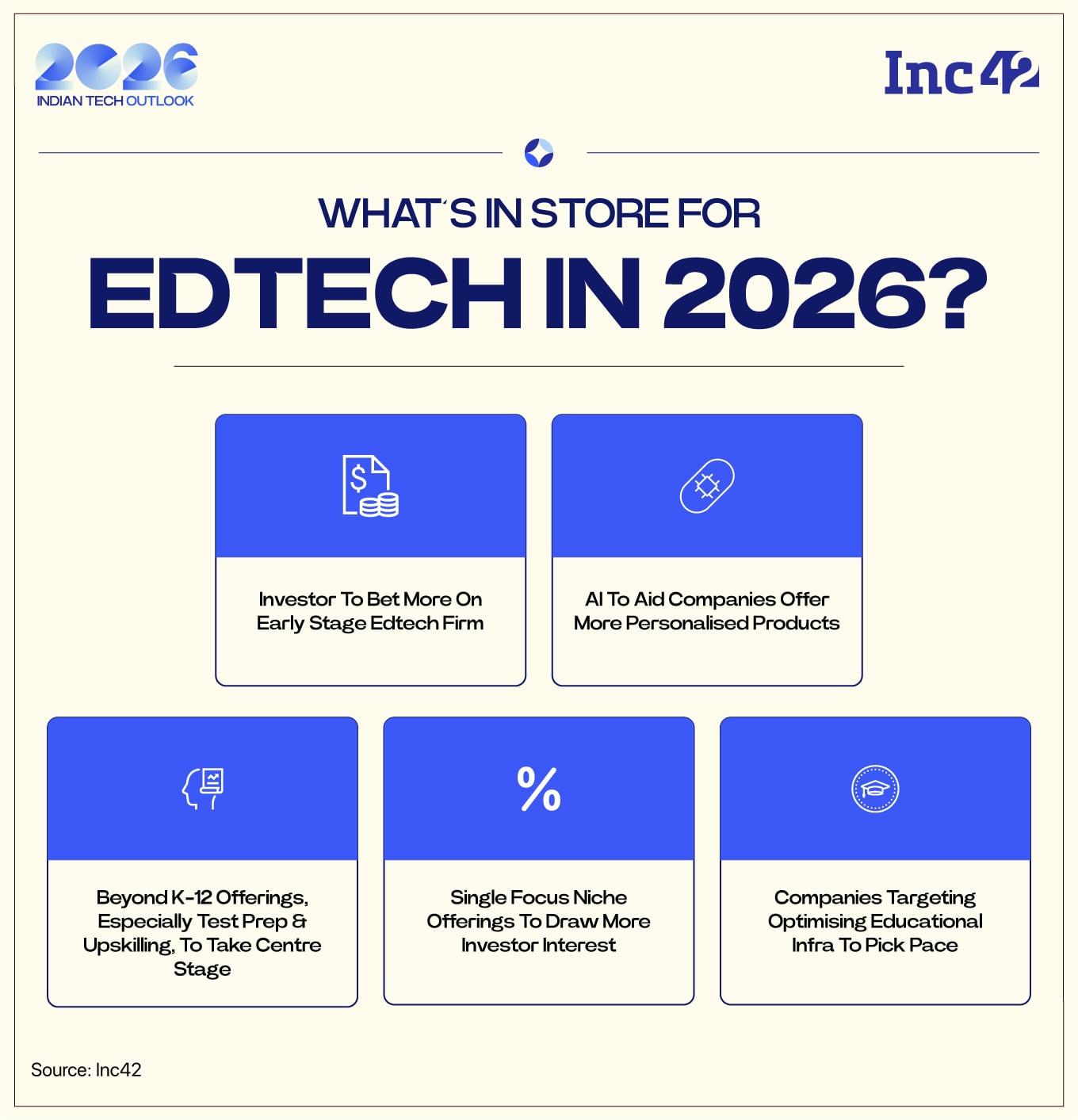
Hence, it might not make sense for new investors to come in during late stage rounds for edtech startups while they still figure out their unit economics. But for early stage edtech startups, investors have a better say in the valuation and can unlock a bigger piece for themselves. However, clear revenue models and the path to profitability are still key factors deciding investor interest.
“As investors we feel that the growth alone is no longer enough; we want to see clear revenue models, strong retention, and a path to profitability. For founders who have built sustainable businesses, I do see funding opportunities opening up in 2026,” VC firm IvyCap Ventures’ founder and managing partner Vikram Gupta said.
He noted that edtech startups focussing on sustainable growth, unit economics, learner outcomes and operational efficiency are being preferred over the growth at all costs mentality during the sector’s boom years.
Further, investor interest is also dictated by founder background, the market opportunity for the startup as well as the ability to roll out the product. Early stage companies are also not under pressure to build multiple products, but build a niche that they can double down on, VC firm 247VC’s founder and general partner Shashank Randev noted.
“There is still abundant opportunity in the space, and we don’t have a lot of players left, it remains wide open. So investors are not looking for growth at all costs now, but instead waiting to see if products have stickiness,” he added
This is where AI has come in, aiding startups to not only build smarter products but also leaner business models.
AI To Take The Edtech Cake
In the segment, K-12 has been the most preferred destination for investors to park their cash since inception, seeing a significant growth spurt during the Covid-19 lockdown when schooling was completely remote.
With that no longer being the case, newer segments have now come to the forefront. This trend was visible even in 2024, when just over 9.4% of the total capital raised by the sector went to K-12, while segments like test prep and online certification registered the bulk of the investments.
“There is a growing demand for test prep, professional upskilling, vocational courses, and outcome-driven learning. Parents and learners are now far more result-oriented. So rather than large, horizontal platforms, I think we will see more startups that will go deep into specific subjects, skill sets, or learner profiles shine,” IvyCap’s Gupta noted.
Startups looking to survive in the maturing K-12 segment will need clear differentiation, as customer expectations have become more defined. Many players are turning to AI-led products that prioritise personalisation and adaptive learning.
Advances in AI since 2025 have improved contextual understanding and reasoning, making it easier for startups to build higher-quality learning experiences and rapidly develop simulations, games, code and interactive interfaces.
At the same time, K-12 offerings are also evolving to integrate AI models into their teaching, offering personalised education to school students.
“No business can flourish without investing in AI technology and customisation. Back in the day, teachers would treat all students equally. But the individual needs of students are being highlighted now, and if institutions don’t pay heed to personalisation, it will be difficult to scale exponentially,” said ODA Class cofounder and director Vedant Hamirwasia.
Apart from integrating AI into their solutions, edtech startups are also leveraging the technology to cut operational costs, especially in areas like marketing to establish better control over their unit economics.
Edtech To Bounce Back In 2026?
The sector is down, but not completely out, with investors and founders bracing for a more optimistic 2026 that features edtech in VC funding pipelines.
Leaner business models, niche offerings, AI integration, clear paths for revenue and profitability achievement, and an ability to stand out will all play a vital role in the success of edtech businesses and investors that bet on them.
Investors also seem more optimistic about the rise of new founders in the space, who are adhering to tighter unit economics while building their products and leveraging the ever-evolving tech to build new niches within the sector. Evolving technology also means that upskilling for college graduates and professionals is increasingly in demand, an avenue startups have been quick to grab.
While monetisation, rising customer acquisition costs, and building trust in a crowded market remain hurdles to success for many companies, the fall of companies like Byju’s and Unacademy has been instrumental in the current pivot away from models that actually work.
Edtech founders are now educated on the dos and don’ts of this industry, and many investors are optimistic about how the sector will be shaped now that its biggest failures move away from the spotlight.
[Edited by: Akshit Pushkarna]
Source link