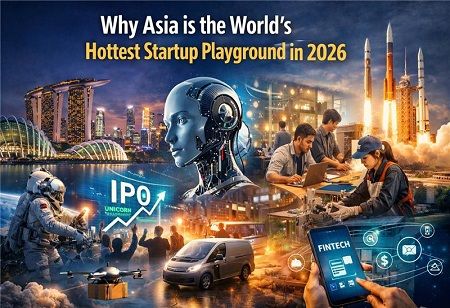
Asia’s startup ecosystem in 2026 is no longer an emerging story, it’s the main event. From sovereign AI and deep tech innovation to fintech 3.0 and cross-border digital infrastructure, the region is rapidly redefining how startups are built, scaled, and monetized.
Once seen as a follower to Silicon Valley, Asia is now setting the pace with localized innovation, cost-efficient talent, and government-backed growth engines. What makes this transformation especially compelling is its diversity.
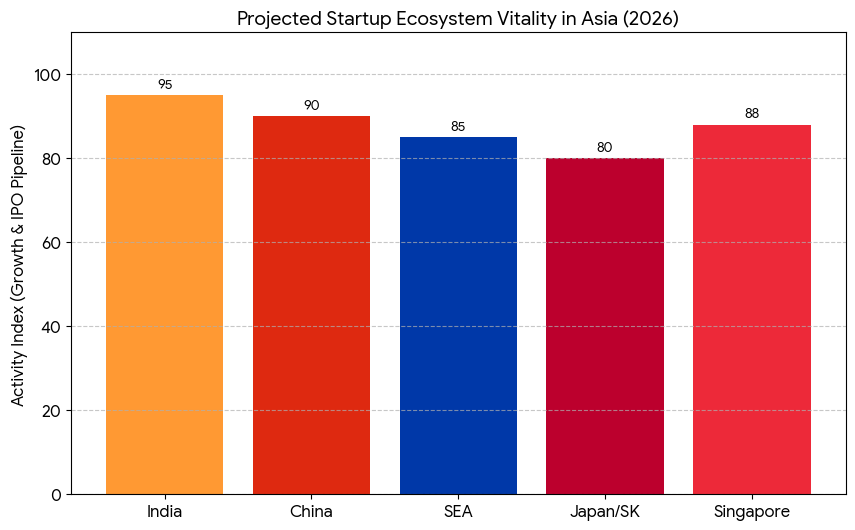
While Singapore is cementing its role as a Pan-Asia deep tech and fintech hub, India is witnessing a massive IPO surge and B2B SaaS expansion, and China is doubling down on AI sovereignty and hard-tech leadership.
At the same time, Southeast Asia, particularly Vietnam is emerging as a tech-enabled manufacturing and fintech powerhouse, while Japan and South Korea continue to institutionalize innovation in robotics and space technology.
For founders, investors, and operators alike, this raises critical questions: How do you scale a B2B SaaS startup in India in 2026? Is Vietnam the next global manufacturing-tech hub? What are the most promising AI and fintech trends shaping Asia’s future?
This article breaks down the top startup ecosystems, hottest sectors, venture capital trends, and the talent-policy backbone driving Asia’s rise, along with a curated look at the top startups leading this transformation in 2026.
Top Startup Ecosystems & Emerging Hubs
Singapore: The Pan-Asia Deep Tech & Fintech Hub
- Remains the region’s top global connector, with Budget 2026 increasing grants for international expansion to 70% for SMEs. The government has also committed a S$1 billion top-up to Startup SG Equity under the RIE2030 plan, expanding co-investment into growth-stage deep-tech startups.
- The SGInnovate and Startup SG initiatives have pivoted heavily toward frontier technologies, positioning Singapore as the #1 hub for trusted AI and cross-border fintech, supported by dense innovation clusters like One-North and national AI programs.
India: Maturity & The IPO Surge
- The unicorn count has surpassed 125 as of early 2026, with recent additions like KreditBee ($1.5B) and Neysa ($1.4B), alongside a strong pipeline of soonicorns in B2B and SaaS.
- 2026 is projected as a record year for exits, with a ₹50,000 crore ($6B+) IPO pipeline featuring giants like Flipkart, PhonePe, and Zepto, expected to unlock major liquidity across the ecosystem.
- Over 50% of new startups now emerge from Tier-II and Tier-III cities, with regions like Jaipur, Coimbatore, and Lucknow driving decentralized growth through lower costs, local talent, and policy support.
- This also highlights how to scale a B2B SaaS startup in India in 2026—leveraging cost-efficient talent, Tier-II expansion, and strong enterprise demand.
China: Hard-Tech & The 15th Five-Year Plan
- The 15th Five-Year Plan (2026–2030) has institutionalized “New Quality Productive Forces,” prioritizing semiconductors, AI hardware, humanoid robotics, and 6G innovation.
- Key ecosystems in Shenzhen, Shanghai, and Beijing (Zhongguancun) are undergoing a strategic reset toward profitability and hard tech, with Beijing alone hosting over 40,000 high-tech startups and 100+ unicorns.
- AI deployment is rapidly shifting from consumer chatbots to industrial-scale applications, including hyper-automated factories and sovereign AI infrastructure powered by domestic chip ecosystems—highlighting how Chinese startups are leading the way in building sovereign AI in 2026.
Southeast Asia & East Asia
- Vietnam has emerged as a tech-enabled manufacturing and AI adoption hub, with strong momentum in logistics SaaS, factory automation, and semiconductor ambitions driven by players like Viettel and FPT.
- This raises a critical question for global investors: Is Vietnam the new tech-enabled manufacturing hub of Asia? Increasingly, the answer lies in its cost advantage, policy support, and rapid AI integration.
- Across Southeast Asia, markets like Indonesia and the Philippines are advancing in vertical fintech and agri-tech, addressing SME financing gaps and accelerating digital inclusion.
- Japan and South Korea continue to lead in institutionalized deep tech, with companies like Astroscale and Mujin gaining global traction in space infrastructure, robotics, and intelligent manufacturing.
Also Read: Singapore Startups: Funding Deals, Key M&A, Corporate Actions & More
Source link