

The rush to buy AI compute has started to look a lot like a land grab. Companies are locking in GPUs wherever they can find them, often years in advance, afraid they’ll miss the next wave.
Then they turn them on… and most of that power just sits there.
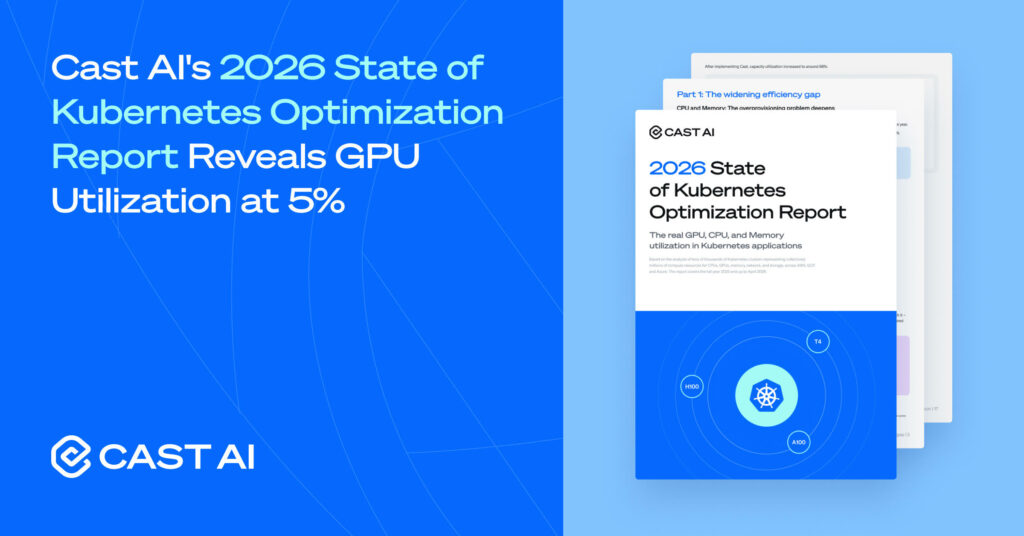
“The percentage of utilization is 5%. Can you imagine?” Cast AI co-founder and president Laurent Gil told Refresh Miami, citing a figure from the company’s recently-released State of Kubernetes Optimization Report. “Everybody is desperate because they cannot find them, but then when they have them, they don’t use it.”
That gap – between urgency and actual usage – is where Cast AI has found its footing.
The company, which crossed a $1B valuation earlier this year, has positioned itself as a kind of traffic controller for AI infrastructure. Not building models or selling GPUs but making sure the expensive machines companies already bought actually get used. The company now has roughly 300 to 320 employees, a number that has grown alongside demand for its platform.
Ahead of Google Cloud Next, the company analyzed more than 23,000 Kubernetes clusters across AWS, Azure, and Google Cloud. What they found was that GPU usage averaged just 5%, while CPU and memory utilization also dropped year over year.
“These are not survey responses or estimates,” Gil said. “They come from direct measurements of production clusters.”
The implications are blunt. Companies are spending millions on compute that is idle most of the time. “You need 1,000 of those, and it’s $30 million a year,” Gil said.
That mismatch is fueling Cast AI’s momentum.
The company’s newer GPU-focused products, rolled out late last year, are already driving its biggest deals. “Our first deal for GPU management was the biggest deal in the company’s history,” Gil said. “And the second largest deal is another enterprise customer.”
“It’s not a science experiment,” Gil said. “These are things that are being used already at scale.”
Those companies are all asking the same questions: “Do you have GPUs? How much do they cost? How many do I need?” Gil said.
Cast’s answer is software that acts like an automated engineer, sourcing compute and optimizing how it’s used. In practice, that means taking systems running at 5% utilization and pushing them much higher.
That shift changes the economics of AI.
“There’s no denial,” Gil said. “Productivity has increased. Developers don’t code anymore. They use coding agents. But we are just developing a lot more than before.”
AI isn’t shrinking teams, it’s raising expectations. And that puts more pressure on infrastructure.
“If you don’t increase your productivity, but your competitor is doing it, it’s existential,” Gil said.
There’s a strange irony here. The AI boom is framed as a race for more: more models, more compute, more spend.
Cast AI is growing by pointing out how much of that is going to waste.
Or, as Gil put it: before you buy more GPUs, “look at your utilization and you’ll have a shock.”
Pictured above: Cast AI co-founders (left to right) Laurent Gil, President, Leon Kuperman, CTO, and Yuri Frayman, CEO.
READ MORE IN REFRESH MIAMI:
I am a Miami-based technology researcher and writer with a passion for sharing stories about the South Florida tech ecosystem. I particularly enjoy learning about GovTech startups, cutting-edge applications of artificial intelligence, and innovators that leverage technology to transform society for the better. Always open for pitches via Twitter @rileywk or www.RileyKaminer.com.
Source link