Silicon Valley startup accelerator Y Combinator has released its latest “Request for Startups” list for Summer 2026 — and it may be one of the clearest signals yet about where the AI economy is heading next.
The list spans everything from AI-native hedge funds and spatial reasoning models to semiconductor supply chains and AI operating systems for enterprises. But beneath the ambitious categories lies a more important shift: AI is no longer being viewed merely as software. It is becoming operational infrastructure for entire industries.
Among the 15 startup themes YC says it wants to fund, three stand out as especially consequential for founders, operators, and investors trying to understand the next decade of technology.
And the startup ecosystem is already debating what these themes really mean.
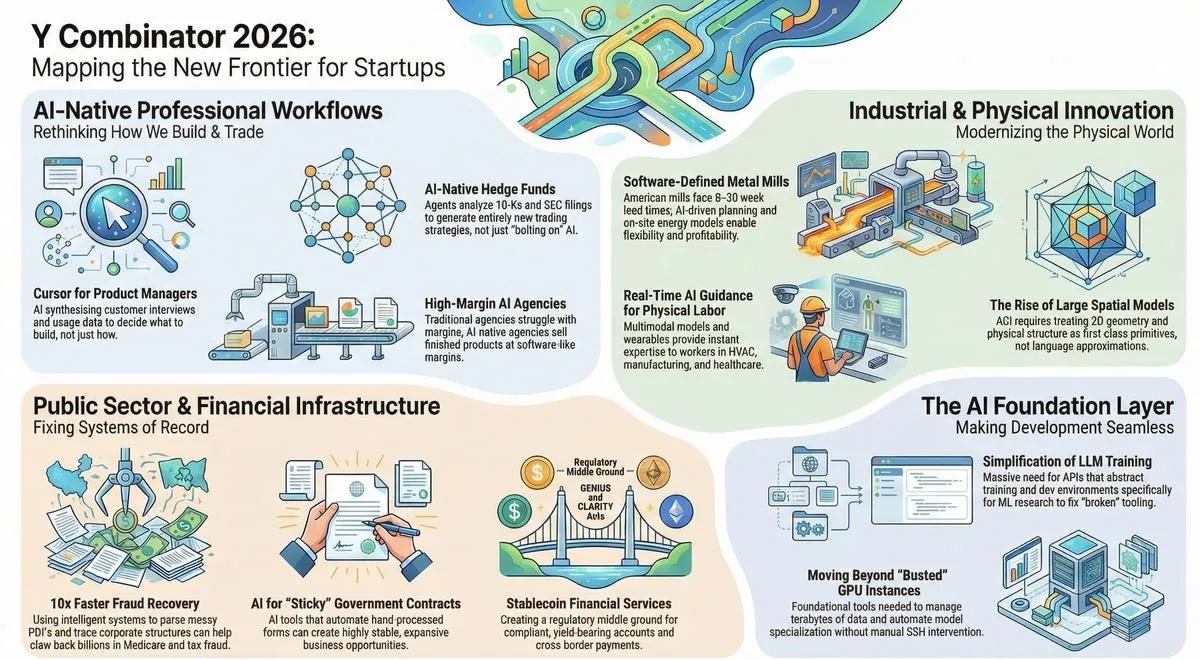
AI-Native Services Companies: The SaaS Era Is Evolving
YC’s second category — “AI-Native Services Companies” — may end up defining the next generation of venture-backed businesses.
For nearly two decades, Silicon Valley rewarded pure SaaS models: scalable software with minimal human involvement and recurring subscriptions. But AI is beginning to blur the line between software and services.
The future may not belong to software companies alone. It may belong to businesses that combine AI systems, automation, and human expertise to directly deliver outcomes.
Instead of selling workflow tools to agencies, accounting firms, recruiters, or healthcare providers, these companies may actually execute the work themselves — faster, cheaper, and at software-like margins.
That shift is already visible across industries like customer support, recruiting, legal operations, logistics, design, and financial services.
Interestingly, some founders believe the biggest winners in this category may not be AI researchers at all.
As one operator observed in response to YC’s list:
“The edge isn’t the model. It’s knowing which 50 unsexy workflows to point it at.”
That insight may capture the next AI opportunity better than most technical discussions.
The coming generation of AI-native companies could be built not by people chasing the best models, but by operators who deeply understand messy industries, fragmented processes, compliance burdens, and real-world execution.
In that world, domain expertise becomes the moat.
AI Personalised Medicine Could Reshape Healthcare
Another standout theme is “AI Personalized Medicine.”
Modern healthcare still largely operates on population averages. Patients with the same diagnosis are often prescribed similar treatments, despite vast differences in biology, genetics, lifestyle, and long-term health conditions.
That model increasingly looks outdated in an AI-driven world.
Machine learning systems are now capable of integrating genomics, biomarkers, medical imaging, behavioural patterns, and longitudinal patient data to generate highly individualised care recommendations.
The implications are transformative.
A 60-year-old woman and a 25-year-old man with the same diagnosis may no longer receive the same treatment protocol simply because traditional medicine lacks personalised precision.
By 2030, today’s standardised healthcare approach could appear deeply primitive — a system designed around averages rather than individuals.
For startups, this creates opportunities far beyond diagnostics. The real infrastructure play may emerge in patient modelling, healthcare data systems, AI-native clinical workflows, predictive therapeutics, and personalised care engines.
YC’s emphasis on the category suggests growing confidence that personalised medicine is moving from research ambition to commercial reality.
The “Company Brain” May Become Every Enterprise’s Core Infrastructure
YC’s fourth category — “Company Brain” — may be the most underestimated opportunity on the list.
Every business runs on institutional context: internal language, workflows, tribal knowledge, decision-making patterns, customer history, and operational nuance accumulated over years.
Without that context, AI agents remain limited. They can automate tasks, but they cannot truly understand how organisations function.
The “Company Brain” concept points toward a future where businesses build persistent intelligence layers that continuously ingest and operationalise institutional knowledge for AI systems.
In practice, companies may eventually maintain multiple specialised “brains” — one each for sales, HR, finance, operations, legal, and product teams.
As AI agents become more capable, context may become the ultimate competitive advantage.
The infrastructure opportunity here is enormous. Every enterprise will need systems that make organisational knowledge searchable, queryable, secure, and usable by AI agents in real time.
In many ways, this could become the cloud infrastructure story of the AI era.
But Founders Are Also Warning About Lock-In and Regulation
While YC’s thesis has generated excitement, it has also triggered caution across the startup ecosystem.
Some operators argue that many of these AI-native opportunities will only scale if regulations and foundational infrastructure evolve alongside them.
Privacy laws such as Europe’s GDPR and India’s DPDP framework were not originally designed for persistent AI agents that continuously process memory, behaviour, inference patterns, and autonomous workflows.
As AI systems move deeper into healthcare, finance, government services, and enterprise operations, questions around compliance, explainability, and data ownership will become central.
Others worry that the AI ecosystem could become saturated with layers of “agentic frameworks” and middleware built on top of a handful of dominant model providers.
The concern is that startups may spend billions building abstractions while remaining dependent on the same underlying infrastructure — inference engines, token economies, memory systems, and foundational LLM providers controlled by a small number of global players.
That creates the risk of a new era of platform lock-in disguised as AI innovation.
Still, even sceptics acknowledge that the shift underway is real.
Why YC’s List Matters
YC’s annual “Request for Startups” list is not just a collection of speculative ideas. It is effectively a directional map from one of the world’s most influential startup ecosystems.
The accelerator gets early visibility into founder behaviour, infrastructure bottlenecks, emerging technologies, and shifting venture capital priorities across Silicon Valley and beyond.
Not every category on the list will succeed.
But the broader message is difficult to ignore: the AI economy is moving beyond copilots and chatbots.
The next wave will likely be built around operational intelligence, domain-specific infrastructure, personalised systems, autonomous workflows, and AI-native businesses designed to deliver outcomes — not just software.
And for founders and investors trying to understand where the next decade of startup value will emerge, YC’s latest thesis may be worth studying very carefully.