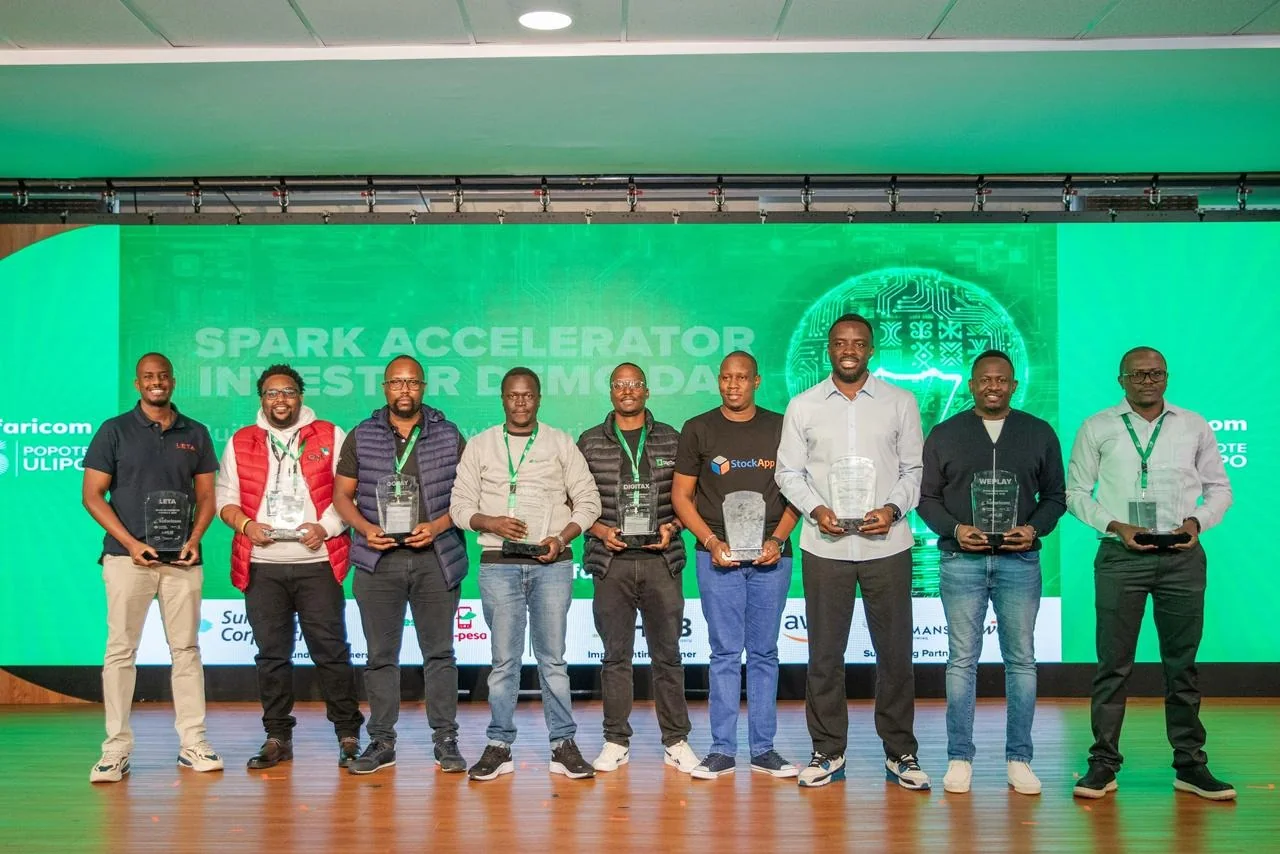
Startups have been urged to sharpen their focus on solving clearly defined problems, build for scale from the outset, and strengthen their business models if they are to succeed in an increasingly competitive innovation landscape.
The message dominated discussions at a Safaricom-hosted innovation accelerator forum showcasing emerging tech trends shaping economic transformation.
The event brought together founders, investors and ecosystem partners under the Spark Accelerator Program, a platform designed to help early-stage startups access funding, mentorship, markets and technical support.
The programme, run in partnership with M-PESA Africa, Sumitomo Corporation and iHub, has already supported 18 startups across two cohorts.
Speaking during the forum, Safaricom Chief Financial Services Officer Esther Waititu stressed that clarity of purpose remains the foundation of any successful startup.
“Always be clear as a leader what problem you’re looking to solve. The technology comes in the back of that,” she said.
Waititu cautioned founders that innovation alone is not enough unless solutions are designed to handle scale and real-world usage patterns.
She pointed to recurring failures where systems performed well in pilot phases but collapsed under heavy demand or failed to match customer usage cycles.
“So as we’re building together, we think about all these things and look at behavioural patterns aside from the solution and the tech that then enable us to scale,” she noted.
She further highlighted that weak business models and unclear intellectual property arrangements continue to undermine promising innovations.
According to her, startups must define ownership structures, cost-sharing models and regulatory implications early in the development process.
Regulatory compliance and data protection were also identified as major challenges facing startups, particularly those integrating into large platforms.
Waititu warned that customer data security, privacy laws and cross-platform integration risks are becoming more stringent as digital ecosystems expand.
“So how do we keep their data safe?” she asked, noting that “we have to always continuously work and manage our customers’ data and make sure that we’re not in breach.”
She also underscored the rising importance of digital identity systems and stronger Know Your Customer (KYC) frameworks in combating fraud driven by social engineering.
At the same time, she pointed to cross-border interoperability as a growing regulatory challenge as digital transactions increasingly transcend national borders.
Investor attention at the forum was largely drawn to high-growth sectors identified in the second cohort of the accelerator, including fintech, smart logistics, digital content creation, online gaming, public transport solutions and SME-focused platforms.
The Spark Accelerator itself, now heading toward its third cohort, is positioning startups for scale through structured training, mentorship, funding access and go-to-market support.
As Safaricom pushes deeper into open innovation ecosystems, Waititu urged founders to remain adaptable.
“Let’s be agile, let’s be flexible, let’s be iterative in terms of the solution that we’re building,” she said.