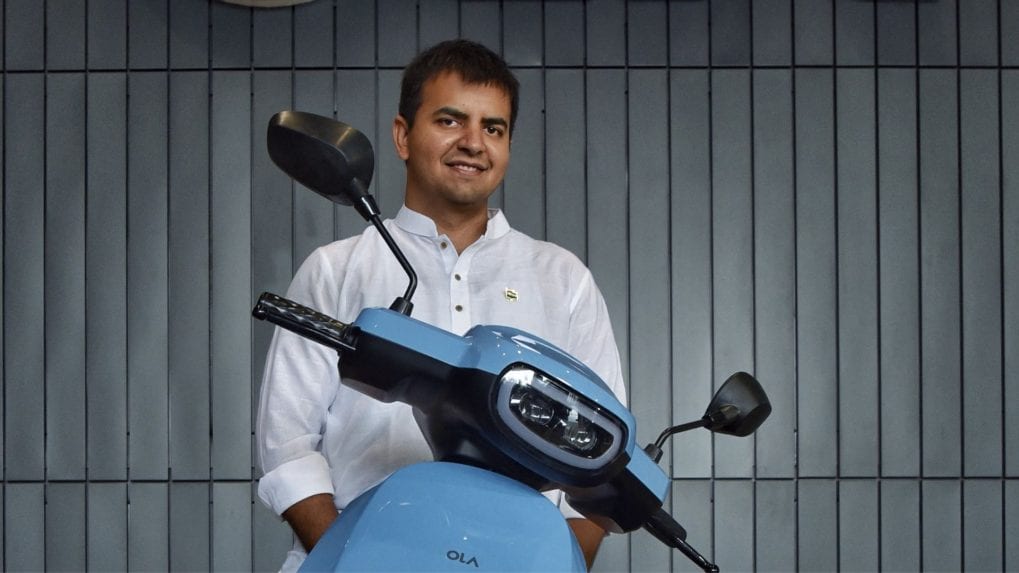
For much of the past year, Ola Electric’s biggest challenge was not persuading Indians to buy electric scooters. It was persuading them to trust the company’s ability to service them. That operational strain — from delayed repairs to spare-part shortages — dented volumes and intensified scrutiny of India’s most closely watched electric-vehicle startup. Yet even as customer complaints spread online and competitors sought to capitalize on the turbulence, Ola Electric’s founder, Bhavish Aggarwal, argued that the company’s brand remained unusually resilient.
Speaking during the company’s fourth-quarter earnings call, Aggarwal framed the last year less as a demand crisis and more as an execution reset. The company, he said, had spent the quarter rebuilding backend systems, rationalizing service operations and tightening supply-chain management while preparing for what it believes will be the next phase of India’s electric mobility expansion.
At the center of Ola’s recovery narrative is an unusually aggressive claim: that it can scale its business without significantly increasing either advertising spending or capital expenditure.
A Brand Built Without Traditional Advertising
In an industry increasingly crowded with incumbents and startups competing for visibility, Ola Electric has taken a notably contrarian stance on marketing.
“We don’t even do TV actually,” Aggarwal said during the call. “You will not see us sponsor any IPL team or any boardings or anything because our product is so far ahead of competitor products, it delivers great word of mouth.”
That philosophy has become a defining part of Ola’s identity. Unlike many automotive brands that rely heavily on celebrity endorsements, sports sponsorships and mass-media campaigns, Ola has largely leaned on product-led virality, digital attention and brand recall generated organically through consumer conversation.
The company claimed its EV brand remained the most searched in India’s electric two-wheeler market, even during periods when service complaints proliferated online. Aggarwal pointed to internal brand-tracking metrics and third-party surveys that showed high recall and improving net promoter scores among customers who did not experience service delays.
Still, the company acknowledged that perception management may now require more active intervention.
Aggarwal said Ola could begin advertising more aggressively in coming months — not only to educate consumers about the economics of EV adoption, but also to communicate that many of the company’s operational problems have been addressed.
“We might do some advertising in the coming months,” he said, particularly around “how our brand has turned around from some service challenges in the past.”
Service Challenges Become a Growth Constraint
The operational issues themselves reflected a deeper challenge inside Ola’s direct-to-consumer retail model.
Traditional automakers rely on dealer networks that independently manage spare-parts inventory and local servicing. Ola, by contrast, operates a centralized system in which parts flow directly from the company into service centers.
As volumes expanded rapidly, that model created bottlenecks.
“Even for a brake pad replacement, the guy had to wait 10 days,” Aggarwal admitted, explaining that the company previously procured many parts only after service requests were raised. In some cases, that stretched repair timelines to nearly a month.
The company has since shifted to stocking parts directly inside service centers and forecasting procurement needs in advance. According to management, service metrics have improved sharply, with service backlog falling 88 percent and same-day resolution rates climbing to roughly 87 percent.
Ola executives repeatedly linked the operational recovery to the rebound in registrations and orders now visible across several regions, especially northern India, where the company sees strong demand for electric motorcycles.
The company said April registrations rose 20 percent month-on-month even as the broader electric two-wheeler industry declined more than 22 percent.
Competition Moves Beyond Scooters
The next competitive battleground, Ola believes, may no longer be scooters.
Electric motorcycles — still a small segment in India — are becoming a strategic focus for the company as adoption begins accelerating from a low base. Ola said its Roadster bike lineup now commands more than 50 percent market share in India’s electric motorcycle category.
Aggarwal described the category as being where electric scooters were “five years ago” before mass adoption accelerated.
The company believes rising fuel prices, improving range capabilities and consumer familiarity with EVs could help motorcycles emerge as the industry’s next major growth engine. Ola’s Roadster models, powered increasingly by the company’s own battery cells, promise certified ranges approaching 500 kilometers.
That capability is part of a larger competitive strategy centered on vertical integration.
Betting on Batteries as India’s Next Strategic Industry
While many EV makers still depend heavily on imported battery cells, Ola is attempting to build a domestic manufacturing ecosystem around what it calls its “Bharat Cell” program.
The company said roughly 15 percent of its current orders already use its in-house battery cells and that it plans to transition the full portfolio by September 2026. Aggarwal argued that manufacturing cells internally now costs less than importing them, even before the factory reaches full scale.
That supply-chain control has become increasingly important as global commodity prices fluctuate and geopolitical disruptions affect logistics. During the quarter, Aggarwal said shipments tied to the company’s Gigafactory expansion were delayed because of the Iran conflict, slowing the commissioning of additional capacity.
Yet the company sees batteries not merely as a component business, but as the foundation of a broader energy-storage platform extending beyond mobility.
Ola executives outlined ambitions spanning backup-power products, telecom infrastructure, retail energy storage and eventually grid-scale battery systems. The company argued that India’s accelerating solar rollout would ultimately require large-scale storage deployment, creating a second long-term growth category adjacent to EVs.
A More Disciplined Growth Story
Perhaps the most notable shift in Ola’s messaging was tonal rather than financial.
For years, the company embodied India’s startup-era preference for rapid expansion over operational discipline. This quarter’s earnings call emphasized the opposite: lower operating expenses, tighter governance, reduced cash burn and measured product rollouts.
Executives repeatedly highlighted that most major automotive capacity investments were now complete. The company said it could scale toward one million vehicles annually without substantial new spending.
That matters in a market where many EV startups are still struggling to balance growth ambitions with capital intensity.
Ola’s challenge now is whether operational improvements can arrive fast enough to preserve its lead as competition deepens and traditional automakers expand their own electric offerings.
For Aggarwal, however, the larger wager remains unchanged: that India’s transition toward electric mobility and domestic battery manufacturing will create an industrial shift large enough for Ola to emerge not just as an automaker, but as an energy company.
And increasingly, the company appears to believe that brand strength alone will not be enough. Execution, service reliability and supply-chain control may ultimately matter more than marketing spectacle.
First Published on