SINGAPORE – Singapore’s start-ups continue to face funding challenges with a drop in deals and amount of venture capital (VC) raised in 2025, as investors shun riskier early-stage deals in favour of safer bets with more established outfits.
This shift could further strain smaller start-ups who are just starting out, industry observers told The Straits Times.
Total VC raised by Singapore start-ups in 2025 fell 34 per cent on a yearly basis to $5.9 billion, according to a report released on May 29 by strategy consulting firm EY-Parthenon in partnership with Enterprise Singapore (Enterprise SG).
The number of deals also went down by 35 per cent from 2024 to 472.
This continues a downtrend in recent years, with yearly declines recorded from at least 2022, which is the earliest year reflected in the report.
But despite the funding winter, investors were still keen on artificial intelligence and deep tech, given that the two sectors attracted more capital in 2025 compared to the previous year.
Singapore’s AI deal value grew 28 per cent to exceed $1.8 billion, while deep tech’s share of total deal value increased from 11.1 per cent in 2022 to 24.7 per cent in 2025, amounting to $1.5 billion.
Altogether, they comprised more than half of total deal value in Singapore’s start-up scene in 2025.
The Republic’s case was not unique – the five other largest ASEAN countries also saw a decline in funding, with both deal volume and deal value falling to a four-year low. Contraction was also observed in major cities such as London and Shanghai.
The top four industries that drew the most funding in Singapore are fintech, enterprise software and data infrastructure, healthcare and biomedical, and advanced manufacturing.
Capital is being concentrated into a smaller pool of “high-conviction start-ups” with stronger technical differentiation and clearer commercialisation pathways, and AI has emerged as the primary capital driver, said the report.
Growth in deep tech deals also reflected sustained investor conviction in technologies “underpinned by defensible intellectual property, long-term strategic relevance, and global scalability”, it added.
In particular, the sector continues to attract interest from international investors and globally oriented technology companies, reinforcing Singapore’s role as a regional hub for deep-tech innovation, translation and commercialisation, supported by strong institutional capabilities and cross-border connectivity.
The increased focus on AI and deep tech raises the question on whether start-ups in other sectors could potentially miss out on funding opportunities.
Mr Bingxun Seng, partner at EY-Parthenon, told ST that funding cycles may shift attention between sectors in the short term, which is reflective of broader market dynamics rather than structural displacement.
“Areas such as biotech remain supported by dedicated funding pools and strategic priorities, given their importance to innovation and economic resilience.”
He added that it may be too early to be concerned about a bubble forming in the AI sector, as technology is still in the early stages of development. Furthermore, investors are making disciplined investments by closely evaluating every start-up’s business case before funding decisions are made.
Mr Alex Ng, honorary treasurer of SGTech, a trade association for Singapore’s tech industry, said early AI investors are taking long shots in a space when valuations are very high, with very low or no revenue.
Investors would therefore need to look at the start-ups’ fundamentals, pathways to profitability and realistic exit valuations, he said.
Mr Ng added that while Singapore realistically would not be able to compete with China and the US given the sheer size of their talent pool and markets, the Republic could be positioned to leverage the AI growth for the region as a trusted and strategic hub to commercialise and extract value across the region.
Amid global economic uncertainty, investors also preferred to put their money on later stage start-ups that displayed clearer commercial outcomes.
Typically, these start-ups have proven that their product or service is viable – for example, it can be scaled up and there is already strong customer demand. Some of these companies may have even started to turn a profit, or are close to doing so.
Late-stage deals in Singapore accounted for 33.3 per cent of total deal volume, up from 26.9 per cent in 2024, amounting to $3.4 billion. Meanwhile, early-stage deals contracted, with such start-ups raising $2.5 billion in 2025 compared to $4.3 billion in the previous year.
“This reflected ongoing investor caution through the year, driven by diminished risk appetite, subdued consumer confidence and challenges among early-stage firms in articulating credible paths to profitability in a higher-cost capital environment,” the report said.
Muted activity in terms of initial public offerings (IPOs) as well as mergers and acquisitions (M&As) in Singapore further amplified this effect, with start-ups taking longer to find suitable exits.
This led to VC firms being constrained in their ability to divest their assets and free up capital, reinforcing investor caution and slowing the pace of new deal formation across the year, particularly at the early stage.
The report added that market discipline is reinforced across the ecosystem, as investors become more selective about choosing start-ups that are strong operators with a healthy revenue-and-cost model and an ability to maintain their competitive advantage.
“Over time, this recalibration of the market would support the emergence of stronger companies and a more resilient, sustainable venture ecosystem.”
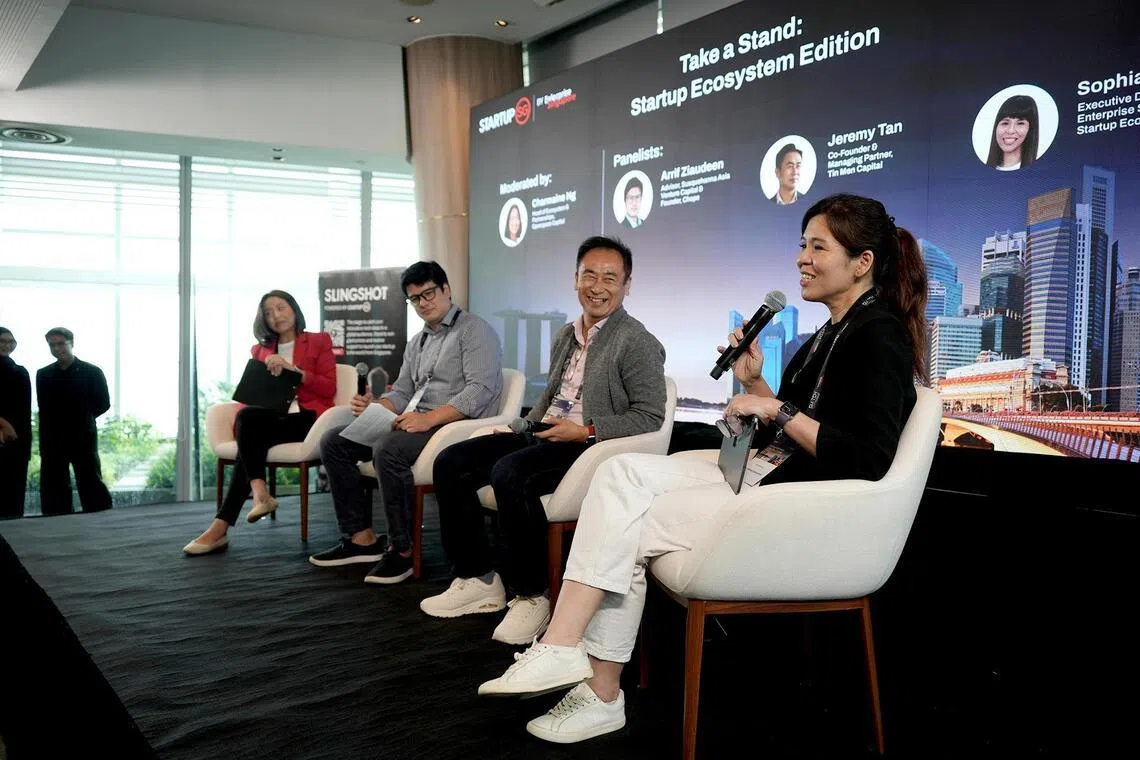
“The days of growth at all costs is behind us now,” said Jeremy Tan, co-founder and partner of VC firm Tin Men Capital.
Speaking at a panel session comprising VC fund managers at the launch of EY’s report, he noted that Singapore is still playing a leading role in deploying capital in the region despite the volatility.
But he noted that the impact of the shifting trend towards late-stage VC funding could be more keenly felt in three to four years, which could see the pipeline of early-stage VC funding drying up.
Some VC firms may not survive as a result, he warned, and therefore policies will be even more crucial to ensure “continuity in the capital stack and make sure that the momentum we built from the last 10 years gets carried forward”.
Ms Sophia Ng, executive director of start-up ecosystem at Enterprise SG, said on the same panel that capital flows are moving towards global demand and Singapore’s strengths, which are positive signs.
But she cautioned that it is still too early to say that the worst of the funding winter is over, as Singapore’s start-up scene will still be affected by ongoing geopolitical uncertainties and investor activity in emerging markets.
“The good thing is the fundamentals have been set, so once this discipline has been instilled, I think we are set on a good foundation to move forward.”
The shifting focus towards proven start-ups could have an impact on Singapore’s start-up incubator programmes and their effectiveness in helping early-stage start-ups grow and scale.
One potential challenge would be the emergence of a funding gap, where fewer start-ups get funding after the incubator programmes or at seed to pre-Series A stages, said SGTech’s Mr Ng.
Seed funding is the first official equity-based investment that a start-up raises, with Series A being the first round of funding after the seed stage. This is when VC firms would typically start investing in start-ups.
“While the incubator programmes could run effectively, one of the measures of the success of incubator programmes is the number of start-ups getting funded post-programme,” he said.
“So even if the programmes are well executed, the gap and lack of funding will deem the programme ineffective.”
EY’s Mr Seng said the funding trend does not necessarily signal a structural retreat from early-stage investing or the diminished role or impact of incubator programmes.
“A healthy innovation ecosystem requires a continuous pipeline of early-stage ventures that these programmes contribute significantly to. Continued public and private support for early-stage development will remain important to ensure that Singapore sustains a robust pipeline of start-ups capable of scaling into the next generation of growth-stage companies.”
At Budget 2026, Prime Minister Lawrence Wong announced that $1 billion will be set aside to enhance the Startup SG Equity scheme, which provides initial capital to catalyse private sector investments for promising start-ups.
Enterprise SG’s Ms Ng told ST the authorities take a deliberate approach in growing a vibrant start-up ecosystem, balancing the push for innovation while maintaining strong safeguards and accountability.
This includes stringent eligibility checks, milestone-based disbursements, verification of grant deliverables and auditor verification of expenses.
For each programme, EnterpriseSG also tracks the progress of supported start-ups, including outcomes such as partnerships, market access and growth milestones.
“This ensures that supported start-ups receive the necessary resources to build their capabilities, while ensuring that there is tangible progress,” she said.