Africa’s urban transport runs on motorcycles. From Nairobi’s boda bodas to Lagos’ okadas, two-wheelers are the nervous system of daily mobility for hundreds of millions of people — and almost all of them run on petrol.
Spiro, the continent’s most ambitious electric vehicle platform, wants to change that, and it just secured the capital to try.
The company announced a $215 million equity raise backed by Impact Fund Denmark and Equitane, marking one of the largest clean mobility investments in African history. The round signals that global institutional capital is no longer treating African EV infrastructure as speculative — it’s treating it as an asset class.
The Battery-Swap Model
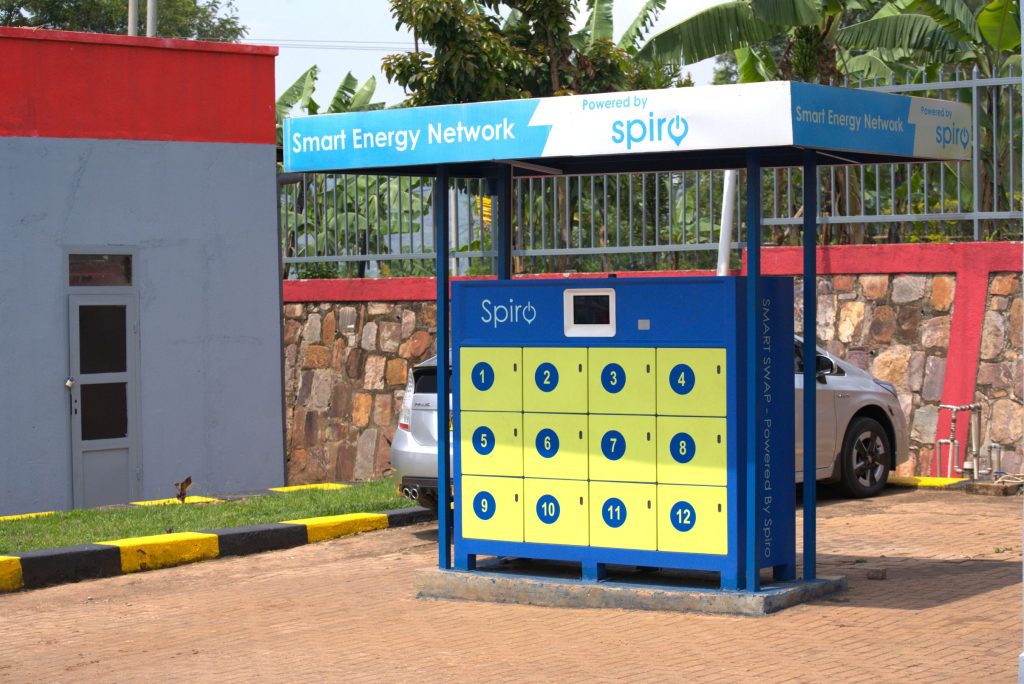
Spiro’s core proposition is not the electric motorcycle itself — it’s the swap station. Rather than waiting hours for a battery to charge, a Spiro rider pulls into one of the company’s IoT-enabled stations and exchanges a depleted battery for a fully charged one in under a minute.
It’s a model borrowed loosely from early thinking around electric cars, but far better suited to Africa’s infrastructure realities, where grid reliability is inconsistent, and riders operate on daily earnings they cannot afford to lose to downtime.
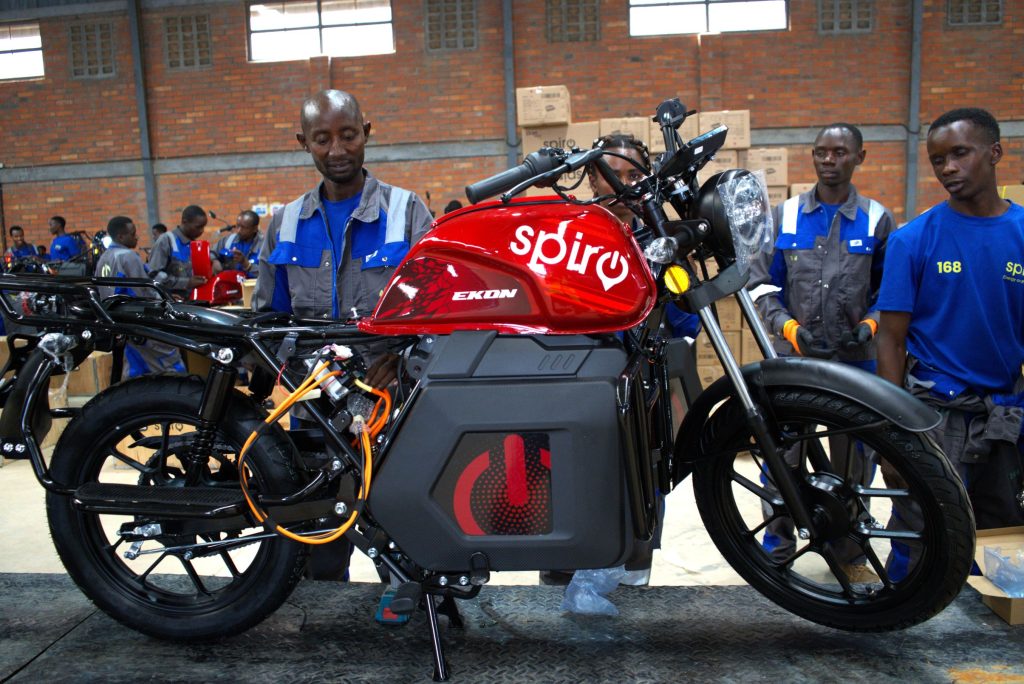
The company says it has deployed over 100,000 electric vehicles and 2,500 smart-swap stations across seven markets: Kenya, Rwanda, Uganda, Togo, Benin, Nigeria, and Cameroon.
The new capital will fund expansion into the Democratic Republic of Congo and Ethiopia, and deepen its industrial footprint — which already includes manufacturing plants in Kenya, Rwanda, and Uganda, and a battery recycling facility in Nigeria.
For riders, the economics are direct. Spiro says operating one of its electric motorcycles can cut daily mobility costs by up to 40%, equivalent to roughly $2 saved per day compared to running a fossil-fuel equivalent. On an annual basis, that is a material income shift for low-margin operators.
The Environmental Case
A third-party lifecycle assessment conducted on Spiro’s Kenya operations found that its electric bikes produce 72% less climate impact than fossil-fuel motorcycles — the equivalent of approximately 19 tonnes of CO₂ avoided per vehicle over its lifespan.
The study also reported an 80% reduction in ozone depletion potential and a 20% drop in particulate matter emissions.
Those figures carry weight in the context of African cities, where rapid urbanisation is compounding air quality challenges. Clean two-wheelers may not solve urban pollution alone, but they represent one of the most scalable near-term levers available, given how dominant motorcycles already are in the transport mix.
Beyond Mobility: A Distributed Energy Play
What distinguishes Spiro’s ambition from a straightforward fleet electrification story is what the company intends to do with its swap station network over time. The stations are solar-powered and IoT-enabled — infrastructure that can, with the right software layer, become nodes in a distributed renewable energy grid.
Spiro is also developing secondary-life applications for its used batteries, targeting stationary energy storage for homes and businesses that lack reliable grid access.
This positions Spiro not just as a transport company but as a potential clean-energy utility, one built from the bottom up on the economics of motorcycle riders rather than top-down grid investment. Whether that vision is realisable at scale remains to be proven, but it is the framing that global investors are buying into.
Lars Bo Bertram, CEO of Impact Fund Denmark, described the investment as offering both commercial growth potential and measurable climate impact — the dual mandate that has become the calling card of serious emerging-market infrastructure capital.
What Comes Next
Spiro has 150-plus engineers and more than 30 proprietary patents backing its technology platform. The company says it supports 6,000 direct and indirect jobs across its markets, a figure that will grow as it enters new geographies.
The harder question is whether the battery-swap model can maintain its unit economics as it scales beyond its current strongholds, and whether the regulatory environments in DRC and Ethiopia will prove as hospitable as those in Rwanda and Kenya.
Learn more about other African tech startups on Labari Insights, our data repository for tech in Africa: insights.techlabari.com
Related
Source link
![Slate emerges with customizable EV pickup available for under $20k [Video]](https://newsx.io/wp-content/uploads/2026/01/1768285064_Slate-emerges-with-customizable-EV-pickup-available-for-under-20k.jpg)