ROCHESTER — “A City on the Verge.” That is how Rochester was described for years in relation to its oft-repeated goal of becoming economically diverse with a collection of medical and technology companies to keep employment healthy and to grow local wealth.
“On the verge is probably the right characterization,” said Gary Smith, then-president of Rochester Area Economic Development Inc. in 2007 in response to a “Fast Company” magazine list that included Rochester. “This acknowledges we’re getting to a point where we’re more than IBM, more than Mayo. We’re not there yet.”
Almost two decades later, Rochester and the surrounding area have logged a lot more miles on their economic journey, despite some unexpected curves and bumps in the road. Billions of dollars in private, state and Mayo Clinic investment have fueled the trip. More infrastructure, like the Minnesota BioBusiness Center and the Discovery Square complexes, has been built. Access to funding from local investors, like the Southeast Minnesota Capital Fund in Rochester, has developed over the years.
Area community and business leaders pitched the vision of Rochester fostering an ecosystem of related businesses with initiatives like “Future Scan 2000,” “JOBZ,” “Destination Medical Center” and “Journey to Growth” to create an economic “hub” with a “sticky factor.” It started as a way to attract and grow technology firms, which then shifted to genomics. The genomics hub idea evolved into a regenerative medicine hub, which became a biotech ecosystem.
While the trendy terms changed over the years, the goal of growing a group of local companies to employ people in Southeast Minnesota stayed the same. The idea was to create some economic balance in an area dominated by Mayo Clinic, the largest private employer in Minnesota.

John Wade, the current president of RAEDI and who led the Rochester Area Chamber of Commerce for years, characterized the shifting terms as adapting and building something that could accommodate a variety of businesses.
“We may not have known exactly who was coming to dinner, but we knew we had to sit at a pretty substantial table,” he said. “Today, it feels like all of the cylinders are firing. Mayo is not only a remarkable health care provider, but they’re also heavily engaged and involved in companies and technology that is going to support that core effort. It has taken a very active role in supporting businesses that are starting and growing here. That’s a beautiful thing.”
For many years, few companies “stuck” with the Rochester area after launching here. The big one that got away was Exact Sciences. As a startup, the company licensed technology from Mayo Clinic based on research by Dr. David Ahlquist. That research became the blockbuster colorectal cancer test called Cologuard.
Exact Science was originally based in Boston. Rochester officials attempted to recruit the company to move here. However, Madison, Wis., outmaneuvered Rochester by enticing the Cologuard maker with $1 million to move its headquarters there in 2009.
That company has grown to employ more than 3,600 people in Wisconsin and contributes an estimated $6 billion to $7 billion per year to the Badger State’s gross domestic product. Abbott Laboratories purchased Exact Sciences for $21 billion earlier this year.
While it is too early to know if any will grow into an economic powerhouse like Exact Sciences, efforts by the city of Rochester, RAEDI, DMC and others are seeing success with several companies investing in employees and facilities here.
Michael Flynn, DMC’s senior director of economic development, recently estimated that southeastern Minnesota currently has between 60 to 100 “health science” companies employing 200 to 300 employees.

Joe Ahlquist / Post Bulletin
Here’s a look at just a handful of those companies:
- Vyriad and its sister company, Imanis Life Sciences, occupy 55,000 square feet of lab space on the Rochester Technology Campus, the former IBM campus, at 3605 U.S. Highway 52 N. The pair of companies had 20 employees in 2020. By the start of 2026, they had grown to 120 employees on staff.
- Cytotheryx, co-founded by Mayo Clinic and Iowa-based Exemplar Genetics to develop treatments for liver disease, has grown to 13 employees and two facilities in Rochester. The company expects to add another 10 to 12 positions over the course of 2026.
- Rion, which launched under Mayo Clinic’s Employee Entrepreneurship Program, has grown from six employees in 2020 to about 40 now. It plans to add 22 more employees within the next year or two. In addition to space in the One Discovery Square complex, Rion is also building out facilities on the Rochester Technology Campus, like Vyriad has.
- Minnesota Medical Technologies Corp., a local company in nearby Stewartville that makes silicone devices to treat fecal incontinence, has grown to 30 employees following a 2023 expansion that more than doubled the size of MMT’s facility. It is manufacturing 24 hours a day, five days a week, with three shifts of employees.
- Maryland-based United Therapeutics Corp. is also investing in Stewartville. It is building a $110 million pathogen-free facility to raise gene-edited pigs to harvest kidneys and hearts for transplantation into humans. Once the facility is up and running, it is expected to have 20 employees. UT also recently paid $8.566 million for an additional 207 acres of open farmland along Interstate 90, U.S. Highway 63 and 90th Street Southwest with the goal of building future facilities to support its organ manufacturing program.
The One Discovery Square and Two Discovery Square complexes are “ground zero” for much of the health science growth in Rochester. DMC’s Flynn estimates that the pair of connected commercial buildings are about 70% occupied, combined.
While the University of Minnesota Rochester, Cambridge, Mass.-based BioLabs early-stage business incubator and others have projects underway in the downtown facilities, the current high-profile project is Nucleus RadioPharma.
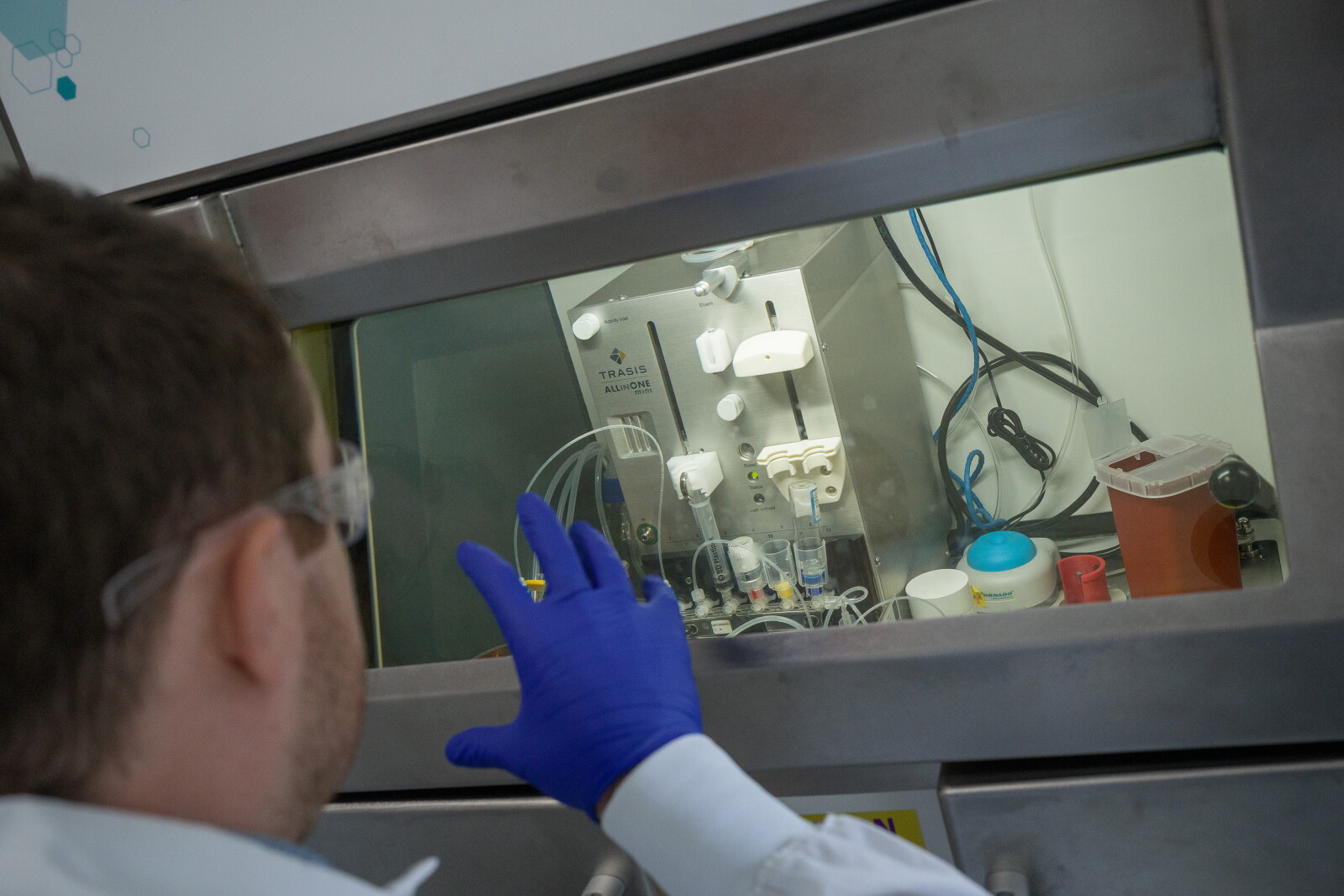
Nucleus RadioPharma, which is a contract manufacturer of time-sensitive radiopharmaceutical drugs, recently opened its 5,000-square-foot research and development lab on the second floor of Two Discovery Square. It is also almost ready to put its 7,000-square-foot manufacturing facility on the first floor, directly under its lab, into operation. Nucleus is also building complexes in Arizona and Pennsylvania, though Rochester is the headquarters of the start-up company.
In Rochester, the second-floor lab recently started working on projects and the manufacturing section is expected to start making radiopharmaceutical drugs this summer or early fall.
Dr. Geoff Johnson, Nucleus RadioPharma’s chief science officer and a Mayo Clinic physician, is enthusiastic about growing the company for many reasons.
“Obviously, we’re benefiting from DMC and the infrastructure. We have Minnesota state and local grants to help with training of individuals,” said Johnson. “Mayo Clinic being a founder and being the world’s largest center for this kind of therapy are huge draws to have this be here. Having the brain trust communicating back and forth for me as an individual working at both Mayo and here, I can walk back and forth on a daily basis.”
Nucleus RadioPharma is a new kind of drug maker. It works with very time-sensitive radioactive materials to make injectable medicines that target cancer cells in a specific patient.
Senior Radiopharmaceutical Chemist Zack Rosenkrans compared the process of creating a dose of radioactive medicine to working with an ice cube. The radioactive material is shipped into Nucleus RadioPharma. Once the scientists start working with the material, the clock starts ticking as the radioactive material immediately starts degrading.
“We like to think of the drug as like an ice cube. There’s no way to stop the melting,” he said.

Contributed
The process works like this. A doctor at Mayo Clinic or another hospital prescribes a drug for a cancer patient. The team at Nucleus RadioPharma creates the dose. After it is completed, the countdown continues. The medicine needs to be used within a few days or, in cases, just hours to be effective.
“Bringing the drugs closer to the patient has lots of long-term benefits. This facility is going to ship out to the University of Minnesota, University of Iowa … all over the country, depending on what kind of drugs we manufacture,” said Johnson. “The manufacturing has to be local. It’s on-shoring manufacturing. And it’s very, very highly technical.”
Nucleus RadioPharma, which was formed in 2022, employs more than 50 people in the U.S., with about 34 working at its new Rochester site. Johnson hopes to grow the Rochester workforce soon, possibly up to 60, once the facility is fully up and running.
However, finding people with the very specific and currently rare combination of skills and experience that Nucleus RadioPharma needs is challenging. Radiochemistry, nuclear physics, pharmaceutical manufacturing, radiation safety, and clinical oncology must all align to bring a program forward. Building a workforce with that combination of skills is becoming a bottleneck for the new radiopharma industry.
Attracting and/or creating a workforce with the skill sets needed to drive the growth of a varied collection of health tech companies in Rochester is an obstacle, but not an insurmountable one, according to DMC Executive Director Patrick Seeb.
“I think our relationship with UMR and with Medical Alley is an accelerant that is helping with that,” he said.
Despite the remaining challenges, Bobbie Dressen, the president and CEO of the Medical Alley industry group as well as a member of the DMC Economic Development Agency, is very optimistic about the growth of the health tech industry in Rochester.
“The evolution of innovation in general was put in place by Mayo Clinic, which then developed a corporate business development office… You can see what has happened over the last 10 years has been what I call a build-out of the different components of infrastructure … The building blocks are now in place for Rochester to start to thrive, not only on the health and life science side, but I’d say as a community,” she said.
From his perspective, Wade of RAEDI believes that the economic foundation that has been under construction for decades is now stable for others to build more floors on top of it.
“Now it’s not just one business or two, but it’s growing to five and then 10 and to 15 and 20 businesses that work with and support each other. The elements are all there. It’s a culture of innovation now,” he said. “There are always areas we can work on, but the fundamentals are very good.”