


AI is taking on many of the lower levels of legal work like visa applications, and expanding the areas — like HR — where legal analysis can be embedded.
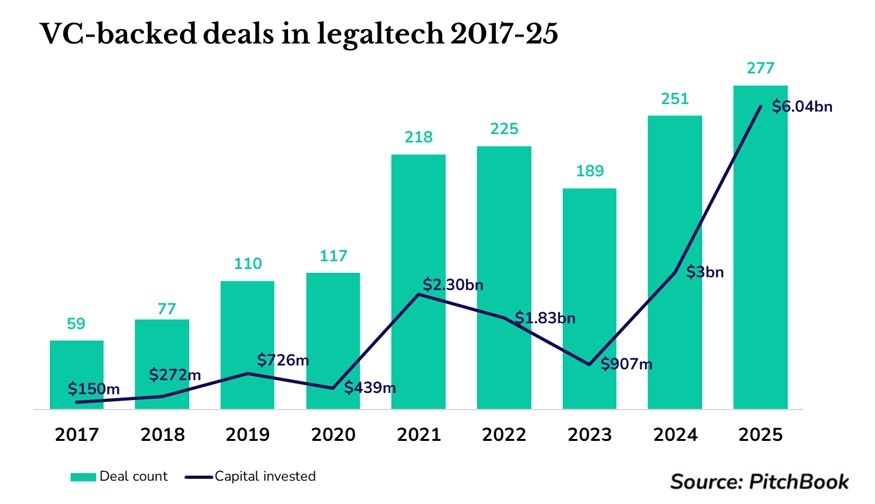
Artificial intelligence has turbocharged the legal tech startup market, but it isn’t just a matter of streamlining work – the technology has the capacity to expand the sector in general, says Joe Dormani, a partner at analytics software provider Thomson Reuters’ corporate venture arm.
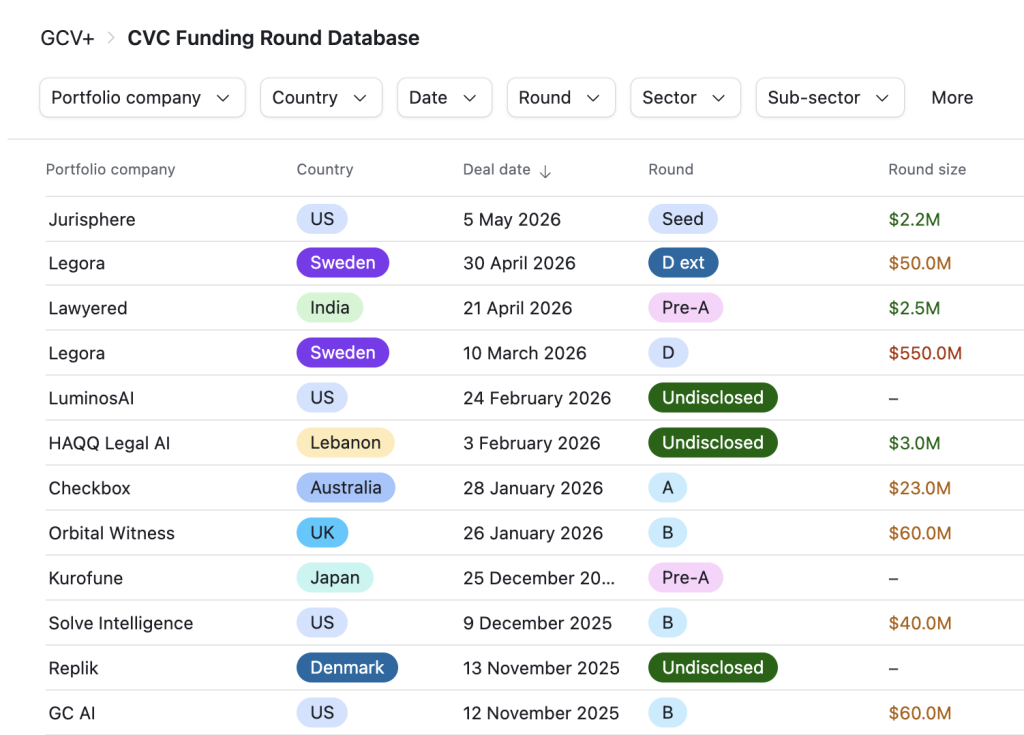
Startup funding in the sector is up across the board as a wider range of corporate investors are taking part. Nvidia, Barclays and project management software provider Atlassian recently helped legal management software company Legora boost its series D round to $600m at a $5.6bn valuation, while peers Harvey and Clio have racked up multibillion-dollar valuations in recent months having collected backers like OpenAI and Google owner Alphabet.
A key reason for increasing interest is that AI has expanded the scope of the total addressable market (TAM) in legal tech, Dormani explains. Before, a legal software startup was constrained by the fact there were only so many lawyers to pay for seats through a traditional software-as-a-service model. Now, elements of legal work can be accessible to a wider range of users.
“In the US, there are about 1.3 million lawyers, Brazil has about 1.3 million and I think the UK has roughly half of that. From a total seat perspective, that had always been the TAM constraint,” he says.
“But if you broaden out the applicability of where legal analysis can be done, augmented by these AI models, you can really broaden the addressable market. I think that’s the fundamental driver of venture capital interest in these types of markets.”
AI may still struggle to take on the lion’s share of legal work, especially with the element of risk involved. Financial law firm Sullivan & Cromwell, for instance, recently got into trouble when ‘hallucinations’ were discovered in a high-profile bankruptcy filing.
Dormani says the technology makes more sense in lower-level areas such as visa applications, where much of the work involves forms being filled. When it comes to more serious legal work, Thomson Reuters’ clients still want to know a human expert has looked at the situation in depth and can advise them accordingly.
“If you’re filling out, say, an H-1B visa it’s just a form and some research, and there’s a much higher degree of what can be automated in that type of type of work,” he adds.
“If you’re doing the company litigation, or really large-scale M&A transactions, you are happy AI has done maybe the first layer of analysis and is preparing a contract or identifying issues that need to be negotiated. But you still want that human expert in the loop to be able to advise you on how to position yourself and what your expectations should be, based on the standards that exist in the market.”
Legal tech startups have more exit routes – but they need the right approach
The expansion of the legal tech market doesn’t just mean more investors, it also increases the opportunity to exit, because there are now more potential buyers.
Take an HR and finance management software vendor like Workday – five years ago, it would not have been viewed as a legal technology buyer. But if AI can help automate visa applications or other elements of the compliance or regulatory process, that could make a legal tech startup in that area an acquisition target for a Workday.
There is another side to the legal tech boom, however. There are suddenly a lot of startups with legal software products, and valuations are skyrocketing, particularly at the top of the market – Harvey was a $1.5bn company when it raised series C funding less than two years ago; its recent series G valued it at $11bn.
“The dynamics we are talking about have driven a lot of venture capital interest into a market, and that has led to a lot more companies being created,” says Dormani (right). “Those dollars essentially need a place to go, and there are only so many good companies that can be funded.
“If you have a constraint on the supply side and exponentially increasing demand, that dynamic is driving up valuations and what is being paid for exposure to…the market.”
As one of the biggest players in the legal software market, Thomson Reuters has a wider remit than most investors when looking for startups, but there are some specific characteristics it values. One is verticality, the ability to address one specific part of law. As big general AI operators like OpenAI and Anthropic expand what they can do, legal startups need a point of difference.
That point cannot just be access to data. It is harder to create data lakes in law than it is in an area like healthcare, where it’s possible to access large, personalised, siloed datasets. An attractive startup is one that has a specific focus area as well as technology that is well suited to working with that data source, so it can come up with high-level analytic reasoning.
“A company that is focused on a very specific area like intellectual property, or a specific type of transaction or personal injury, these market niches where you can build a lot of focus and unique types of insight and data sources to derive a differentiated set of outputs – that vertical specificity helps create that edge and advantage,” Dormani says.
Companies in the Thomson Reuters Ventures portfolio that operate in those kinds of areas include personal injury specialist Supio, intellectual property-focused Solve Intelligence and Noetica, which primarily works in corporate debt and M&A transactions and which Thomson Reuters acquired in February.
Vertical specificity can also be a route to expansion. Dormani says he almost thinks of it as a wedge, enabling a startup to get traction and build value in a specific area before moving into adjacent areas. Supio, for example, started in personal injury but has since moved into mass torts, a type of case where many litigants sue one or few defendants.
“We’re very big believers in the vertical focus thesis,” he says. “But it is also something you would want to see there being some expansion on, and there are many different ways to expand.
“There are different types of firms that have to do different types of analysis, because people have different expertise, and they’ve taken 20 years to build that expertise. But AI doesn’t have that limitation, it can go across fields.”
See all the recent corporate-backed funding rounds for legal tech startups in the CVC Funding Round Database
Source link