
The trend has been particularly strong in the consumer and retail segment, where Marico snapped up premium popcorn brand 4700BC and plant-based nutrition brand Cosmix earlier this year. Previously, the FMCG giant had bought majority stake in nutritional supplement brand Plix (2023) and breakfast foods brand True Elements (2022).
Besides Marico, pharma major USV bought Wellbeing Nutrition in February, and Gurugram-based beauty and healthcare firm Puresta acquired skincare brand SkinQ. In fintech, Pine Labs bought ecommerce enabler Shopflo for Rs 88 crore, while Oxyzo Financial Services, the financial arm of OfBusiness, said it will buy online bond distribution platform GoldenPi. More recently, value-commerce unicorn Meesho said it will buy B2B commerce startup Kirana Club for Rs 202 crore.
 ETtech
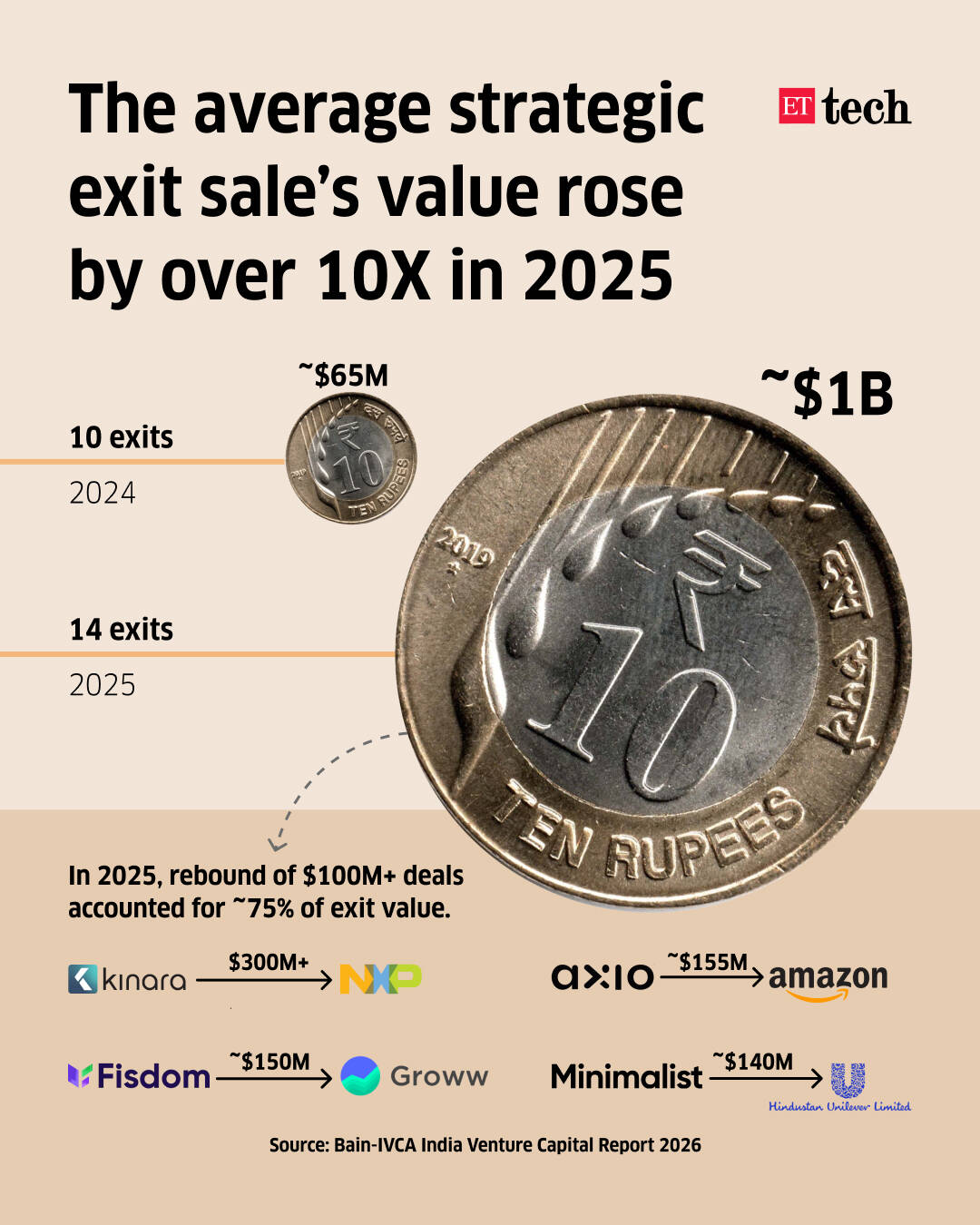
This marks a sharp turnaround from 2024, when strategic sales had nearly vanished as a liquidity route for venture investors amid muted dealmaking and the absence of large-ticket exits.
But things rebounded sharply in 2025, with strategic exit value rising to more than $1 billion from about $65 million the year before, accounting for about 15% of overall exits last year, according to the Bain-IVCA India Venture Capital Report 2026. The recovery was driven by four deals valued at more than $100 million each, including Kinara AI’s sale to global chipmaker NXP Semiconductors for over $300 million.
This momentum appears to be carrying into 2026.
“The interest among strategic acquirers in new-age consumer brands is at an all-time high,” confirmed Neeraj Shrimali, managing director and head, digital, tech & consumer investment banking, at Avendus Capital. “We’re seeing a renewed willingness among both global and Indian buyers to invest in or acquire these companies,” he added.
Industry executives say the revival reflects both a maturing startup ecosystem and a growing appetite among strategic buyers looking to acquire capabilities rather than build them from scratch.
“We’re seeing a staged exit structuring, where minority stakes are taken first, with founders retaining control and an option for a full buyout later,” noted Shuchi Pandya, principal at Fireside Ventures, one of the investors of Wellbeing Nutrition. “It’s a very sophisticated, clean M&A structure that could become a default template going forward. This structure de-risks the acquirer’s bet on founder-led execution,” she added.
According to Pandya, in some cases, strategic exits help investors start showing DPI (Distributed to Paid-In Capital) earlier because they begin to see some form of liquidity earlier in the company’s journey. DPI measures cash returned to limited partners.
What also helps is the speed at which startups are scaling. Industry executives note that companies are reaching scale much faster than they did three or four years ago. Not only are some consumer brands reaching Rs 100 crore in revenue within 12 to 15 months, they are doing so profitably or with far lower cash burn. Meanwhile, the universe of buyers is also expanding. Beyond global investors and large Indian incumbents, listed new-age companies are increasingly turning to acquisitions to secure products, capabilities, and market access.
Shrimali expects the size and frequency of these deals to increase meaningfully over the next few years. “India is only beginning to see the scale of strategic deals that are common in more mature markets,” he said.
Auxano Capital, which saw one of its portfolio companies, Milkbasket, a grocery delivery startup, get acquired by Reliance Retail in 2021, also expects strategic sales to gather pace across sectors in the coming quarters. “We’re seeing increasing interest from domestic buyers, many of whom are led by a new generation of promoters, who want to grow faster and are using acquisitions as a way to scale,” said managing partner Brijesh Damodaran.