Public health, explained: Sign up to receive Healthbeat’s free New York City newsletter here.
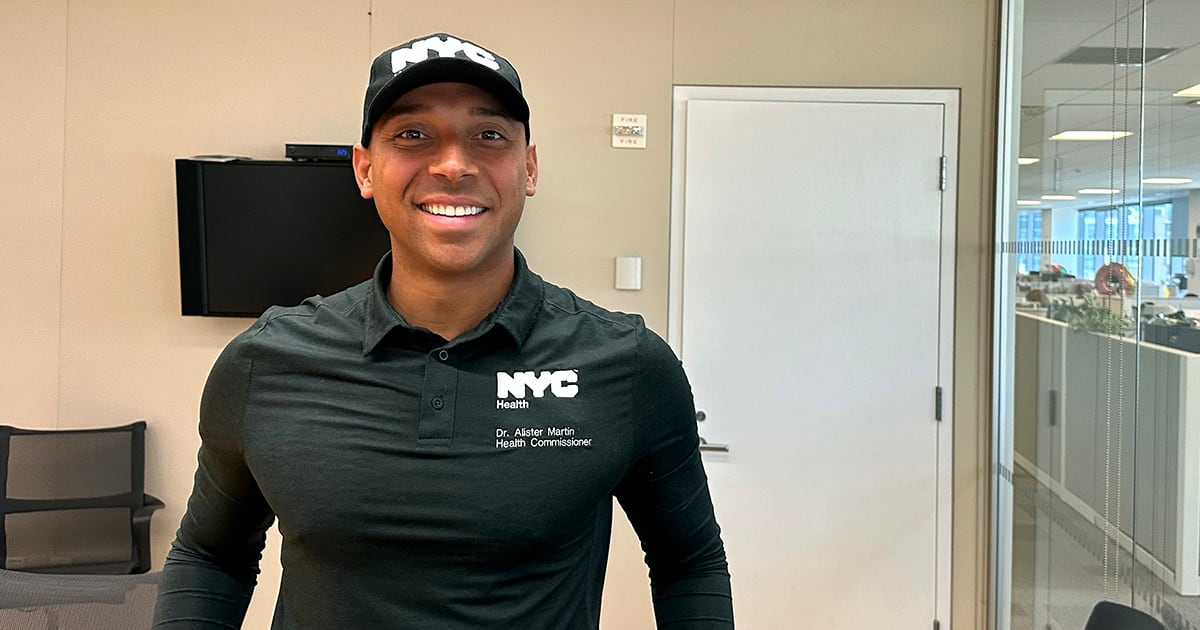
Before becoming New York City’s top health official in February, Dr. Alister Martin juggled being a busy emergency room doctor in a Boston hospital and an entrepreneur focused on remedying inequities in public health.
One widely adopted initiative of his, Vot-ER, introduced the novel idea of registering patients as voters in a healthcare setting.
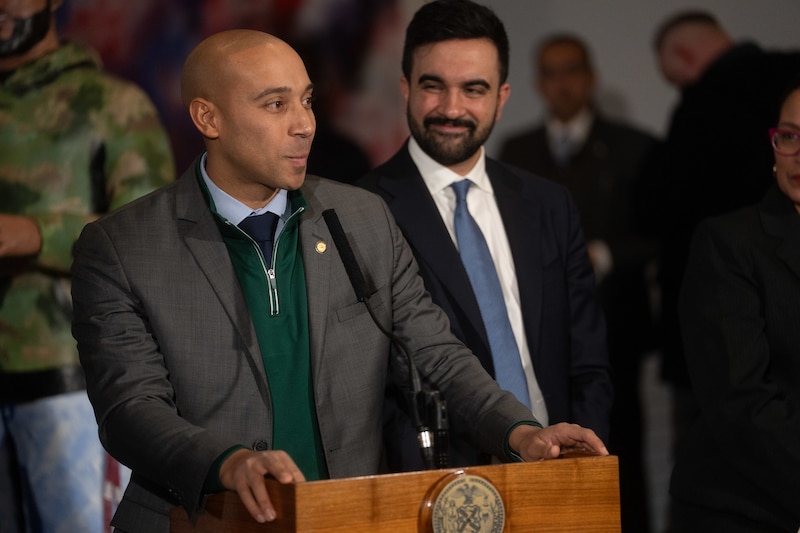
Martin recently told a group of health policy leaders in Manhattan that his philosophy is simple: “In this country, if you’re not at the table politically, you’re on the menu.”
In some ways, Martin was an unusual choice for the commissioner of the city’s Department of Health and Mental Hygiene. The nonprofit he founded to oversee the voter registration startup employs a staff of fewer than 60. In his new role, he oversees more than 7,000 employees across the city’s five boroughs.
Much like Mayor Zohran Mamdani, his 34-year-old boss, Martin at age 37 is a relative political outsider with an interest in tackling the challenges faced by underserved communities and leveraging his position to increase civic participation. In Martin’s case, he used his skills and access as a physician to do that by building startups with a social justice agenda, such as Vot-ER, and collaborating on journal articles arguing for doctors to encourage their patients to vote.
“I think that might have been one of the reasons Dr. Martin might have appealed to the mayor, despite the fact that he didn’t really have a direct New York City health experience or New York City government experience before he was appointed as the commissioner,” said Jean Bae, a professor at New York University’s School of Global Public Health who has worked as a policy analyst at the city’s health department.
Martin launched Vot-ER as a nonprofit in 2019, built around the idea that civic engagement can improve the overall health and well-being of patients. The group enlists volunteer doctors, nurses, and other healthcare professionals to ask patients about their voter registration status. If the patients aren’t registered, they are encouraged to scan a QR code worn by the doctor or nurse and enter their personal information, after which they receive notices of their nearest voting center or reminders prompting them to register. They can also request an absentee ballot.
The effort has received support from those in the medical establishment who champion the need for civic participation in unconventional corners. According to Vot-ER, more than 2,000 healthcare institutions have registered to use its tools, like the voter registration app. Vot-ER also says it has helped more than 650,000 people by showing their closest voting center and sending reminders to register.
Some observers of the program, however, have questioned the ethics of mixing civic activism with medical care.
“There shouldn’t be anything going on there except efforts to maintain or improve the patient’s health,” said Arthur Caplan, a professor of bioethics at New York University’s Grossman School of Medicine.
Conservative groups have accused Vot-ER of bringing politics into healthcare settings. The Republican National Committee sent letters in 2024 to the secretaries of six swing states urging them to monitor Vot-ER, citing what it saw as the group “weaponizing the healthcare system… across the nation for partisan political purposes.”
Vot-ER officials defend their work as “rigorously nonpartisan.”
Registering voters has become a crowded field. Taylor Swift has encouraged her millions of social media followers to register to vote with the click of an Instagram post. Republicans held registration drives at gas stations in the 2022 midterm elections to stress the rising cost of living.
Though Martin stepped away from Vot-ER in February when he became health commissioner, the program may offer clues on how he might lead one of the biggest health agencies in the world.
“I learned so much through the Vot-ER era of my life,” Martin said in a recent interview at the health department’s headquarters in Long Island City, Queens.
“What I want is for someone to have their life be meaningfully different because of the action that we took. That’s going to look a little different than maybe how other health commissioners have intervened, but that’s what I think public health needs to move toward — meaningfully — to impacting people’s lives.”
Martin’s ventures burnished his reputation as civic innovator
Born in New York City, Martin grew up in New Jersey and graduated from Rutgers, where he played on the tennis team. He later earned his medical degree from Harvard Medical School, while also getting a master’s from the Harvard Kennedy School.
“Alister in grad school was someone who was absolutely hungry to learn and understand how the world works and how power works, how to navigate organizations and systems,” said Tim McDonald, a close friend who met Martin at the Kennedy School and became roommates with him.
After graduation, Martin put those skills into practice, launching several health-related startups while working in a hospital. In 2016, Martin developed the first of several startups: an AI tool that helped healthcare providers take notes. Later, he came up with an idea to deliver COVID-19 vaccines during the thick of the pandemic to elderly and disabled residents in some of the low-income neighborhoods of Boston.
In 2017, when Martin was chief resident at Massachusetts General Hospital, he noticed that many of his ER patients were struggling with homelessness, opioid addiction, and poverty — all issues that shape health outcomes. Voting, he realized, could help change such circumstances to possibly prevent future emergency room visits.
After starting Vot-ER in 2019, he continued working on voting rights issues as an adviser in 2021 and 2022 to then-Vice President Kamala Harris; later he joined the U.S. Department of Health and Human Services advisory panel on outreach and education.
The idea of registering voters in a medical setting took on even greater importance after thinking about the Department of Motor Vehicles, which began offering voter registration in 1993 with the National Voter Registration Act, known as the Motor Voter law.
“What the hell does voting have to do with driving? Aren’t voting and health more related than voting and driving?” Martin recounted in a 2023 story in ACEP Now, a publication of the American College of Emergency Physicians. “We want to create that same kind of connection between health and voting.”
Vot-ER started as an iPad on a kiosk in the waiting room of the emergency department at Massachusetts General. Martin got permission from hospital administrators and agreed to keep the effort nonpartisan and not compromise care. He expanded by installing software on iPads affixed to lecterns he had bought online, according to a 2020 story in The New York Times.
In 2020, during the COVID outbreak, the group shifted its focus from emergency rooms and more broadly toward academic medical centers and community health clinics.
Sandra Pimentel, a clinical psychologist and professor at the Montefiore Medical Center and Albert Einstein College of Medicine in the Bronx, set up Vot-ER tables in hospital lobbies to greet visitors.
“It was saying, ‘Hey, are you registered to vote? Are you sure? Here’s how to do it. It’s very simple,’” Pimentel recounted from her early days volunteering with Vot-ER.
In some hospitals, Vot-ER offers guidance on how best to approach patients. A Vot-ER training video offers suggestions.
“One way to introduce these tools to patients is during the social history portion of their visit. While asking other questions, such as, ‘do you smoke, do you drink, are you safe at home?’” Vot-ER Senior Field Director Bianca Navarro said in a training video. “You could add, also, ‘are you registered to vote?’”
If the answer is no, the patient is urged to use their smartphone to scan a QR code on a badge provided by the health professional. Clicking on the code, the patient’s smartphone opens to a page and is invited to enter their name, date of birth, and residential address. The app determines the voter’s eligibility by checking with a national database of registered voters.
How voting enters healthcare relationship
Vot-ER staff have described its interaction with patients as “streamlined.”
Bianca Navarro of Vot-ER wrote in an email that asking a patient if they are registered to vote takes less than two minutes. “Healthcare professionals who participate in our work also report reduced burnout and increased hopefulness. This work strengthens the provider-patient relationship rather than detracting from it.”
Sally Satel, a Yale-affiliated psychiatrist and resident scholar at the center-right American Enterprise Institute, argued that the trust patients place in doctors is precisely what Vot-ER threatens to exploit, and that physicians are “guardians of physical, not civic, health.” She said if a doctor raises the subject of voting patients may suspect an ulterior motive and worry that their care could be affected by how they respond.
“It is completely inappropriate for a physician to bring partisan politics directly into patient care,” Satel said in an email. “Even broaching the issue of voting itself in a patient visit is a bizarre distraction from the true issue — the health of the patient.”
Dr. Jennifer Caputo-Seidler is an internist and professor at the University of South Florida in Tampa, Florida, who learned about Vot-ER on social media because she was interested in advocacy and medicine and became a Vot-ER fellow.
“The number one question I always get is like, ‘Do patients give you pushback?’ said Caputo-Seidler. “I’ve never had an upset or angry response from a patient.”
The aim is for Vot-ER volunteers to add questions about voter registration status along with the other standard questions they ask patients during an annual check up.
“Their drug use, their sexual habits, what their bowel movements look like,” Caputo-Seidler said. “Asking somebody if they’re registered to vote is by far not the most invasive question I’m asking them.”
If she were to receive a testy response, she said she would move on.
Vot-ER is gearing up for the 2026 midterms, while Martin has officially left the startup and is turning his attention to his new job.
Martin told Healthbeat he didn’t think the voter initiative played a major role in his winning over Mamdani. It was his interest in focusing on the broader question of affordability and trying to help a patient, for example, who has diabetes but no refrigerator for the insulin, he believes.
“I don’t know if the mayor knew about Vot-ER — maybe he did, maybe he didn’t — that’s certainly not what our conversations were about,” Martin said.
Martin said that his work has aimed to address financial instability in the lives of his patients. “Ultimately what the data shows us is that it’s poverty that makes people sick.”
Trenton Daniel is a reporter covering public health in New York for Healthbeat. Contact Trenton at [email protected] or on the messaging app Signal at trentondaniel.88.