East Africa raised more startup funding than any other region on the continent in 2025; $865 million between January and August alone, ahead of Southern Africa’s $845 million, according to Briter Bridges. But healthtech’s share of that continent-wide total was a modest $150 million, dwarfed by fintech’s $1 billion and cleantech’s near-$950 million. That gap is the real story of healthtech in East Africa in 2026: a sector with genuine, measurable impact on maternal deaths, diagnostic access and medicine distribution, that has still not become a magnet for capital the way payments and climate infrastructure have.
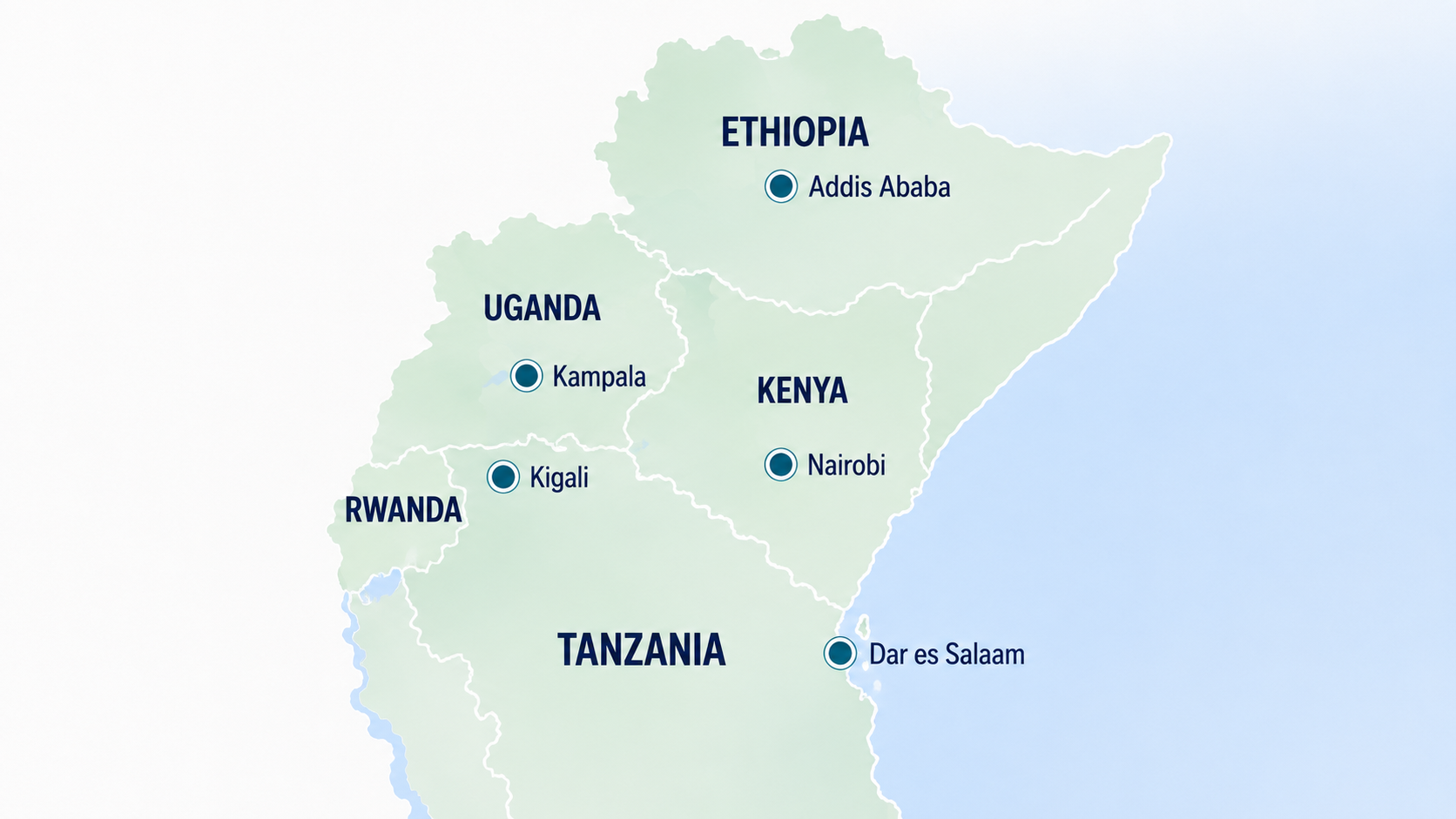
Which countries are leading, and why
Kenya remains the region’s deepest market. It has the most startups, the most mobile-health adoption in maternal care, HIV treatment and reproductive health, and the base for Ilara Health, MYDAWA, Jacaranda Health and much of mPharma’s East African footprint.
But Kenya’s flagship digital health reform, the Social Health Authority (SHA), illustrates the gap between ambition and execution: since replacing the National Hospital Insurance Fund in October 2024, SHA’s digital claims platform has been dogged by chaotic rollout, a March 2026 nationwide outage that froze hospital pre-authorisations, and an Auditor-General finding that flagged roughly KSh104.8 billion deployed into the system with inadequate accountability. By mid-2025, only about 4 million of over 18 million registered contributors were actively paying premiums, and a provider survey found more than half of primary-care facilities went months without payment.
Rwanda takes the opposite approach: state-led, top-down digitisation rather than market-led experimentation. Its fifth Health Sector Strategic Plan (2025–2029) targets universal coverage by 2030, backed by near-universal Mutuelle de Santé community insurance, a new Health Intelligence Center launched in April 2025, and a push to fully digitise public health records (e-Ubuzima) nationwide.
Rwanda also hosts HealthTech Hub Africa, a Kigali-based pan-African accelerator, and in 2025 signed a three-year memorandum with Anthropic to embed AI across its health, education and public-sector systems positioning the country as the region’s policy laboratory.
Uganda sits between the two: less funded than Kenya, but home to Rocket Health, the region’s most established telemedicine operator, which has used a 2022 $5 million Series A to expand from Kampala into Kenya. *
Tanzania and Ethiopia remain earlier-stage. Tanzania’s ecosystem is thin but not empty — dialysis-chain operator AAIC runs across Rwanda, Tanzania, Kenya and Zambia, and 3D-printing startup Roverlabs is building affordable prosthetics locally.
Ethiopia, with the region’s largest population, has the least mature startup layer: mPharma only entered via a 2022 partnership bringing its Haltons pharmacy brand to Addis Ababa, and Ethiopian insurtech HuluCares was still an early-stage accelerator participant as of 2025.
The fastest-growing segments
Pharmacy and health-product distribution has consolidated the most capital and attention. MYDAWA has raised a cumulative $48 million and used a 2023 investment from Alta Semper Capital to acquire Guardian Health, a ten-outlet Ugandan pharmacy chain — moving from pure e-commerce into physical retail.
Kasha, headquartered in Rwanda, built its business on discreet delivery of women’s health and reproductive products and has since become one of the region’s largest digital wholesale distributors of health and household goods, operating across Kenya, Uganda, Tanzania, DRC and Burundi; its $21 million Series B in 2024 was the largest funding round ever raised by a woman-led African health startup, and in 2025–2026 it began delivering public health commodities for Rwanda’s national medical supplier and enabling e-commerce for national insurance scheme members.
mPharma, the pan-African operator behind the Mutti pharmacy brand, spent 2023–2025 restructuring away from direct multi-country retail toward a partnership model with existing pharmacies — a pivot that included roughly 150 layoffs and, in late 2025, a leadership change from founder Gregory Rockson to former COO Kwesi Arhin.
AI-enabled maternal health is the segment with the clearest population-level evidence. Jacaranda Health’s PROMPTS platform, an AI-triaged two-way SMS service available in English and seven local languages, had reached 3.8 million women in Kenya as of 2025, with 700,000 enrolled that year alone, for under $1 per mother. Ninety percent of high-risk cases the system flags reach hospital care in time, directly addressing a leading cause of Kenyan maternal deaths, delayed care-seeking, which contributes to roughly a third of them.
Diagnostics-as-a-service has struggled more visibly: Ilara Health, which leases portable diagnostic devices and now digitises operations for over 3,000 clinics across 46 of Kenya’s 47 counties, raised $4.2 million in early 2024 but announced significant restructuring and job cuts by September 2025, citing challenging operating conditions even as its core clinic network kept growing.
Read also: $20M and Counting: Salient Advisory’s Five-Year Impact in Accelerating African Healthtech
Government support, and its limits
Rwanda and Kenya represent two models of state involvement; Rwanda’s centralised digital-first strategy versus Kenya’s more market-driven, currently troubled insurance digitisation.
Regionally, the picture is shaped by frameworks rather than enforcement: the WHO’s Global Strategy on Digital Health, the African Union’s Digital Health Strategy 2020–2030, and the Smart Africa Digital Health Blueprint all call for shared data standards (chiefly HL7 FHIR), but a 2026 scoping review found interoperability adoption highly uneven, hindered by limited technical capacity and fragmented regulatory support even in relatively advanced markets like Kenya and Uganda.
HealthTech Hub Africa, backed by the Novartis Foundation and implemented with Jhpiego and Villgro Africa, has become the region’s most consistent capacity-builder, having supported 68 organisations across 17 African countries since 2022.
The biggest barriers to scale
Four constraints recur across every country in this analysis. First, fragmented and largely paper-based health records make interoperability a genuine technical bottleneck, not just a policy aspiration.
Second, procurement and claims systems — even well-funded ones like Kenya’s SHA — struggle with payment delays and administrative capacity, discouraging private facility participation.
Third, financing sustainability remains unresolved: Rwanda’s own strategic plan carries a 21–32% funding gap despite strong insurance coverage, and Kenya’s SHIF depends on informal-sector contributions that have been slow to materialise.
Fourth, basic infrastructure — unreliable power and patchy rural connectivity — continues to cap how far cloud-based and mobile-first tools can reach, a constraint that shows up repeatedly in GSMA and APHRC’s regional research.
How AI is actually being used for healthtech in East Africa
The most credible AI applications in the region are narrow and workflow-embedded rather than diagnostic showpieces. PROMPTS uses a Swahili-language large language model to classify and triage tens of thousands of maternal-health messages daily, escalating danger signs to human responders.
Ilara Health’s diagnostic devices pair hardware with software that flags results for clinicians rather than replacing them. Rwanda’s 2025 AI-powered training platform personalises curricula for over 58,000 community health workers, cutting training costs by up to half. This pattern — AI as a triage and efficiency layer for over-stretched human systems, not a replacement for clinical judgment, is likely to define the region’s approach for the next several years.
Where the opportunity lies
For founders, the clearest white space is B2B infrastructure: claims and payment rails for public insurance schemes, interoperability tooling, and financing products for the clinics and pharmacies that make up the region’s real care backbone. This is exactly what Ilara Health and mPharma have targeted, with mixed results that underline how hard the unit economics still are.
For investors, healthtech’s underfunding relative to fintech and cleantech suggests room to grow, provided returns come from B2B recurring revenue rather than pure consumer subscription models. For healthcare providers, the partnership-based models now favoured by mPharma and Kasha — technology and financing layered onto existing facilities rather than parallel infrastructure — appear more durable than the direct-ownership expansion strategies several companies have already pulled back from.
The next five years
Expect continued consolidation toward asset-light, partnership-based models; deeper AI integration in maternal health, triage and community health worker training rather than diagnostics replacing physicians; Rwanda’s government-led digitisation approach gaining regional influence as a template; and a widening gap between Kenya/Rwanda and Tanzania/Ethiopia unless infrastructure and financing catch up.
Funding will likely stay selective rather than abundant but the underlying evidence, particularly from maternal health, suggests East Africa’s healthtech sector is proving its impact well ahead of proving its investability.