For generations of Indians, fluency in English has functioned as a kind of social currency. It has opened doors to jobs, education, migration, or mobility. But while the aspiration has always existed at enormous scale, building profitable businesses around that demand can get notoriously difficult.
However, the challenge was never demand. India has millions of people willing to pay to improve their spoken English. The difficulty was in delivering personalised instruction affordably and at scale, making it a problem Arpit Mittal believes artificial intelligence (AI) is helping solve today.
“In India, many people want to learn spoken English. But most companies could not earn well because they needed human teachers,” Mittal, founder and CEO of SpeakX, told ETEntrepreneur.
The challenge, he argued, was that every additional student added to the cost of delivering education.
“More learners meant more teacher hours, so costs kept going up. With AI, this changes. AI can teach and practice with many users at the same time. This lets us serve large demand, keep prices affordable for Tier-II and Tier-III users, and still maintain good margins because we don’t need to keep hiring teachers to grow,” he added.
Founded in 2023, SpeakX today positions itself as a GenAI English learning platform focused on helping non-native speakers build fluency and confidence through AI tutors, speech technology, and personalized coaching.
Learning led by LLMs
Today, the company’s primary audience comprises learners from non-metro and price-sensitive markets.
Moving away from replicating classroom instruction online, SpeakX has built an AI-led model centred around conversational practice, personalised coaching, and real-time feedback powered by speech technology and large language models (LLMs).
That strategy has also shaped its pricing approach.
“In non-metro areas, a simple monthly plan works best at around ₹199 per month. We put it in terms of a daily cost of about ₹6, which makes it seem more reasonable,” Mittal said.
The company has also experimented with low-cost trial offerings, discovering that immediate engagement plays a crucial role in conversion.
“Small trials like ₹19 also work, but only if users start talking on Day 0,” he added.
According to Mittal, one of the company’s biggest learnings has been that affordability and willingness to pay are not mutually exclusive.
“We found out that being price sensitive doesn’t mean you don’t want to pay. Many users are willing to pay for speaking practice that doesn’t require them to worry about what others think, but they won’t pay for just videos or too many extra features,” he explained.
Engineering better learning outcomes
While generative AI has dramatically lowered the cost of delivering personalized education, SpeakX argues that simply replacing teachers with AI does not automatically improve learning outcomes.
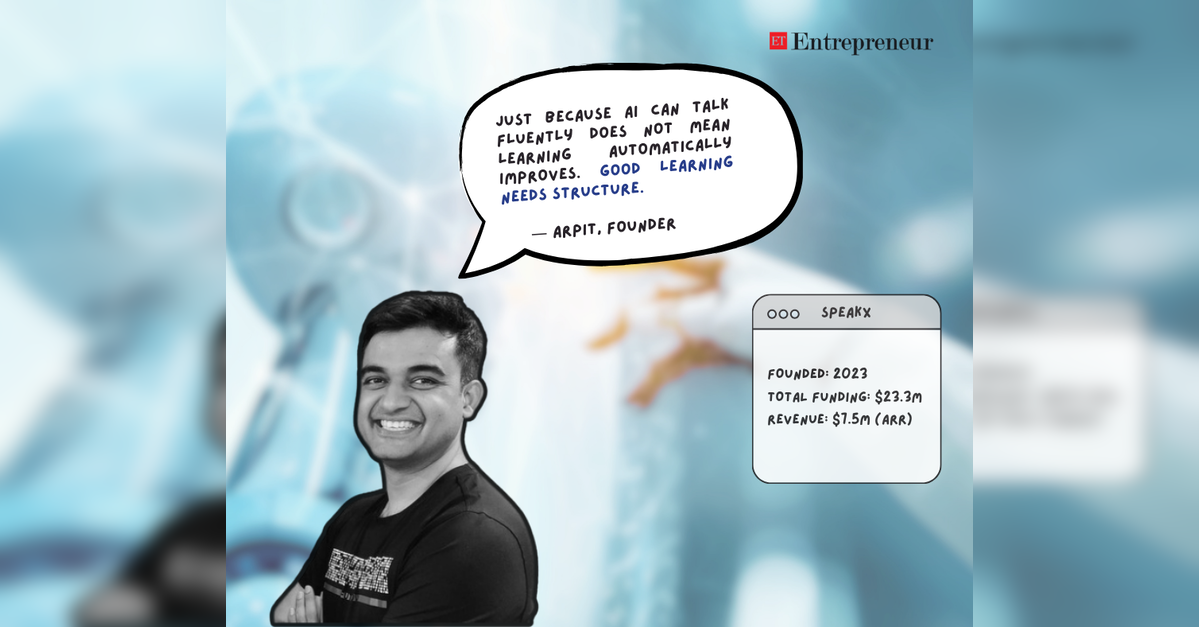
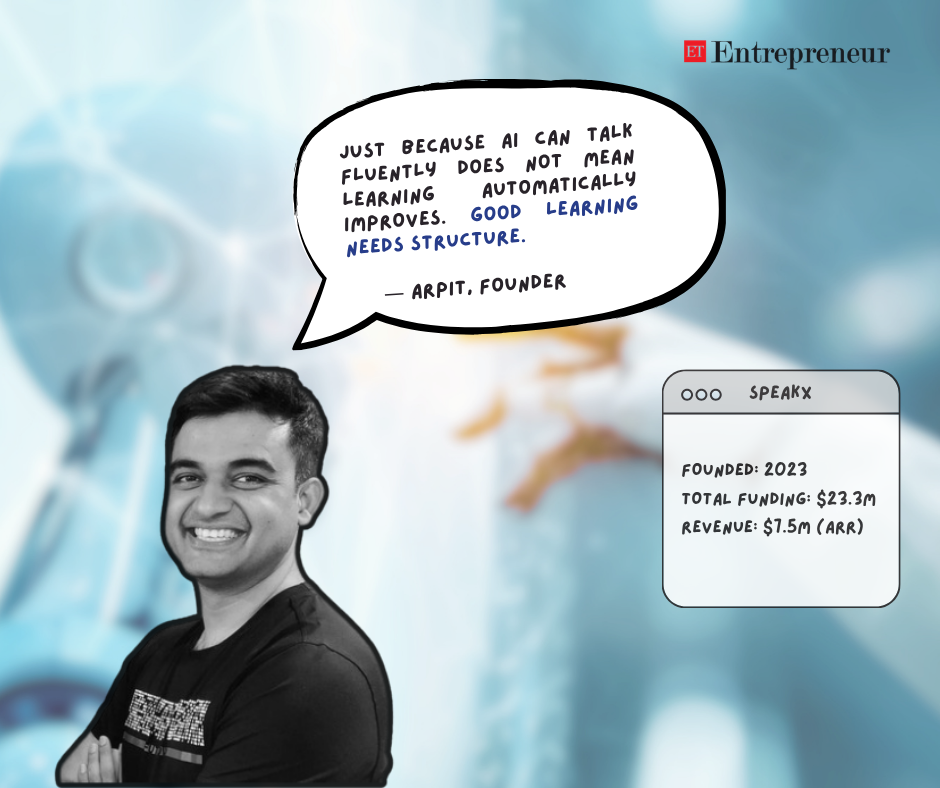
“Just because AI can talk fluently does not mean learning automatically improves. Good learning needs structure,” Mittal noted.
Instead of overwhelming learners with constant corrections, the platform limits feedback to the most critical areas.
“At any point, we fix only the top one or two mistakes so users stay motivated and do not feel overloaded,” he explained.
The company’s pedagogical priorities also differ from traditional language-learning approaches.
“Our first priority is whether the learner can be understood and feels confident while speaking. Grammar and accent come later,” Mittal said.
To measure effectiveness, SpeakX tracks behavioural indicators such as speaking frequency, consistency of practice, and reductions in hesitation during conversations.
The platform is also designed around Indian accents and everyday conversational contexts to ensure learners are assessed fairly, as opposed to Western learning platforms.
That realization is also pushing SpeakX beyond consumer learning and into enterprise training.
As businesses move away from conventional classroom-based learning programmes, the company has launched SpeakX for Business, an AI-powered communication training platform designed to improve workplace communication skills.
The platform offers personalised communication coaching for employees, allowing enterprises to train large workforces while reducing the costs and logistical challenges associated with traditional learning programmes.
Building an AI-led edtech startup
Unlike traditional edtech businesses that scale by hiring more instructors, SpeakX has intentionally maintained a lean operating model, reserving human intervention for areas where people continue to create disproportionate value.
“We keep our team deliberately small and use human effort only where it makes the biggest difference,” Mittal said.
While AI handles everyday speaking practice, pronunciation assessment and instant feedback, human teams focus on curriculum design, quality assurance and improving the underlying learning systems.
“Our experts review learner data to continuously improve the system and keep the content relevant. Humans step in only for important tasks like updating the curriculum, reviewing quality, and handling rare cases where the AI needs support,” he added.
The approach is informed by Mittal’s broader entrepreneurial journey. Before founding SpeakX, he launched Edcited in 2011, which was later acquired by Cocubes, followed by real-estate platform Roofpik, which was subsequently acquired by Fastfox.com.
Supported by over $26 million in funding from investors including Elevation Capital, IQ and Goodwater Capital, SpeakX is now looking beyond India.
The company plans to expand into markets including Latin America, Indonesia, the UAE and Europe, while also exploring immersive technologies such as virtual reality to enhance language learning experiences.
The startup today caters to over 10 million users globally, including over 200,000 paying subscribers, and has scaled to an annual recurring revenue (ARR) of $7.5 million.
The broader significance of companies like SpeakX may lie beyond language learning itself.
In the aftermath of the BYJU’S era, as India’s edtech sector grapples with questions of sustainability, profitability and learning outcomes, GenAI is offering an opportunity to revisit the old ambition of delivering high-quality, personalised education for the mass-market.
And that could perhaps define what’s next for India’s edtech sector.
If you like ETEntrepreneur stories, add us as a trusted source on Google by clicking here and ticking the checkbox.