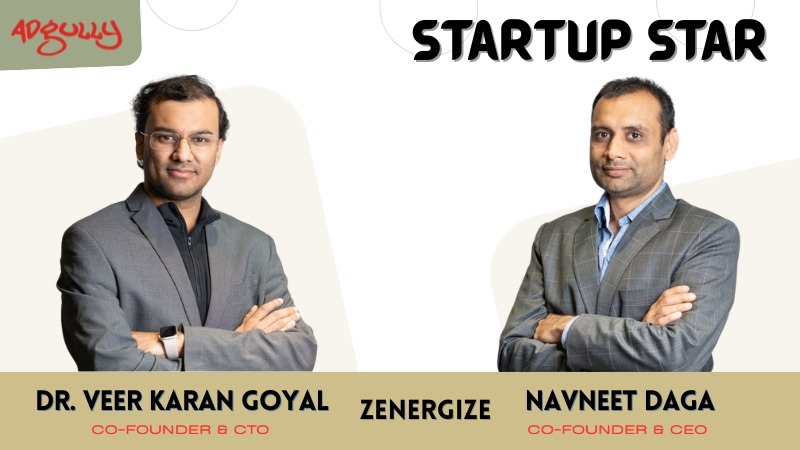
Adgully has been turning the spotlight on visionary entrepreneurs who dared to challenge conventions and build brands that resonate with modern India in our special series – START-UP STARS. Championing the spirit of the ‘Vocal for Local’ movement, Adgully continues to celebrate homegrown businesses that are redefining innovation, quality and consumer trust.
Founded by Navneet Daga and Dr Veer Karan Goyal, Zenergize is building India’s first vertically integrated, Silicon Carbide (SiC)-based power electronics for the country’s EV charging and solar infrastructure. Moving away from imported, assembled hardware that struggles with India’s extreme heat and unstable grid conditions, Zenergize designs, engineers and manufactures its chargers and inverters, down to the PCBs, firmware and thermal systems, specifically for Indian operating conditions, backed by its AI-powered remote monitoring platform, ZenSense.ai.
In conversation with Adgully, Navneet Daga, Co-Founder & CEO and Dr. Veer Karan Goyal, Co-Founder & CTO, Zenergize, speak about how their complementary backgrounds in logistics-tech and power electronics research came together, the commercial edge of owning their full technology stack, why Silicon Carbide is a game-changer for Indian conditions and much more.
Navneet, you spent two decades at Delhivery and Accenture; Dr Veer, you brought a gold-medal PhD in power electronics from IIT Bombay. How did your paths cross in 2024 and what convinced you to build Zenergize together?
Our backgrounds were very different, but we were solving the same problem from different directions. I had spent over two decades building and scaling technology-led businesses across logistics, operations and enterprise transformation, while Veer had spent years researching advanced power electronics at IIT Bombay and working on large-scale electrification projects.
When we met in 2024, it became clear that our experiences complemented each other perfectly. While I understood how to build and scale businesses, Veer understood how to build world-class power electronics. We both arrived at the same conclusion: India was investing heavily in EV charging and clean energy, but most of the technology powering that transition wasn’t actually built for India.
Most products in the market were imported or assembled from global kits and struggled with India’s extreme temperatures, grid fluctuations and demanding operating conditions. We believed India had both the engineering talent and the opportunity to build this technology ourselves. That shared conviction became the foundation of Zenergize. From day one, our goal has been to build indigenous power electronics that are designed, engineered and manufactured specifically for Indian conditions.
Most players in India’s EV charging and solar space rely on imported components. How does Zenergize’s vertically integrated model, from PCB assembly to software, set you apart commercially?
The biggest difference is technology ownership. Most companies assemble imported hardware and build software around it. We took a very different approach by developing and owning the core intellectual property ourselves. That includes everything from base architecture, PCB design, firmware and control algorithms to thermal engineering and the manufacturing of critical components like inductors and heat sinks.
Commercially, this gives us much greater flexibility. We can optimise products specifically for Indian operating conditions, respond quickly to customer requirements, roll out firmware updates without depending on overseas suppliers and provide much faster after-sales support.
It also helps reduce the total cost of ownership for customers because they aren’t waiting for imported spare parts or overseas engineering teams whenever an issue arises. As the market matures, we believe customers will increasingly choose reliability, uptime and domestic support over simply the lowest upfront price.
Zenergize is India’s first to use Silicon Carbide (SiC) power devices. What difference does this make for systems built to handle India’s extreme heat and unstable grid conditions?
Silicon Carbide represents one of the biggest advances in power electronics over the past decade and it’s especially relevant for a country like India.
Compared to conventional silicon-based systems, SiC devices operate at efficiencies of around 97 to 98.5 percent, which means far less energy is lost as heat. Lower heat generation directly translates into higher reliability, longer component life and more consistent charging performance.
The second major advantage is thermal resilience. Our chargers are designed to operate at full rated capacity in temperatures of up to 55°C without thermal derating. That’s extremely important in Indian summers, where chargers often run continuously in harsh environments.
SiC also improves switching performance, allowing for more compact designs and better overall system efficiency. Combined with our proprietary firmware and thermal engineering, it enables faster charging, better tolerance to grid fluctuations and significantly higher uptime. For customers, that means dependable infrastructure that performs consistently in real-world Indian conditions.
Tell us about ZenSense.ai. How does it work alongside your hardware to keep chargers and inverters running with minimal downtime?
ZenSense.ai is our intelligent remote monitoring and diagnostics platform that works seamlessly alongside our EV chargers and solar inverters.
It continuously monitors critical operating parameters such as voltage, current, temperature, power output and overall system health. Our firmware also generates detailed fault codes along with real-time operational data, enabling us to identify the exact source of an issue without immediately sending a technician on site.
More importantly, ZenSense.ai doesn’t just react when something goes wrong. It analyses performance trends and identifies early warning signs before they become major failures, enabling predictive maintenance rather than reactive servicing.
Because we own both the hardware and software stack, we can also roll out remote firmware updates, improve system performance over time and resolve many issues without physical intervention. The end result is higher uptime, faster troubleshooting and a much better ownership experience for customers.
Charger downtime and delayed part imports are common pain points in India’s EV ecosystem. How has owning your own supply chain helped you tackle this, especially across your 40-plus city service footprint?
Owning the technology stack fundamentally changes how quickly we can respond when something goes wrong.
With imported systems, even relatively small faults often require support from overseas suppliers for diagnostics, firmware updates or replacement components. That can leave chargers out of service for days or even weeks.
Since we design our hardware, firmware and critical components ourselves, we can identify faults at the component level rather than replacing entire units. Our modular architecture allows technicians to replace only the affected module, making repairs much faster and more cost-effective.
Combined with our service footprint across more than 40 cities and remote diagnostics through ZenSense.ai, we’re able to resolve many issues proactively or significantly reduce service turnaround times. Our objective isn’t just to manufacture chargers—it’s to ensure they continue delivering reliable performance throughout their lifecycle.
You recently closed $2 million in seed funding. How do you plan to split resources between R&D and manufacturing over the next year or so?
Our initial priority after closing the US$2 million seed round was strengthening our engineering capabilities. A significant portion of the funding went into expanding our R&D team, developing indigenous power electronics technology and ensuring our products met the highest standards for performance, efficiency and reliability.
Now that our products are market-ready, the focus is gradually shifting towards manufacturing scale-up and commercial deployment. We’re expanding production capabilities, strengthening our domestic supply chain and increasing market awareness while continuing to invest in next-generation product development.
Currently our R&D and manufacturing operations are based out of our facility in Parwanoo, Himachal Pradesh. As demand continues to grow, we’ll scale both our manufacturing capacity and engineering team in parallel because we believe technology leadership and manufacturing excellence need to go hand in hand.
What policy tailwinds are helping companies like Zenergize scale right now and what still needs to change for hardware startups in India?
The policy environment has become much more supportive over the past few years. Initiatives like PM E-DRIVE, the broader Make in India and Atmanirbhar Bharat programmes, along with state-level EV policies, have created strong momentum for domestic manufacturing and charging infrastructure development.
We’re also seeing states introduce EV-ready building codes and encourage charging infrastructure in residential and commercial developments, which is a very positive step.
Going forward, I believe the conversation needs to move beyond deployment targets alone. We should place greater emphasis on reliability, uptime, thermal performance and infrastructure quality. Installing more chargers is important, but ensuring those chargers consistently perform in Indian conditions is even more critical.
For hardware startups, continued support for deep-tech R&D, semiconductor ecosystems, local component manufacturing and patient long-term capital will be essential. Building world-class hardware takes time and policy has an important role to play in enabling Indian companies to compete globally.
What’s your advice for young engineers and founders trying to build hardware-first, ‘Made-in-India’ technology for global markets?
The biggest piece of advice I’d give is to stay patient and stay passionate. Deep-tech hardware is very different from software. It requires years of engineering, testing, validation and multiple design iterations before you reach commercial scale.
We ourselves spent nearly four years focused on R&D before bringing a commercially viable product to market. That journey taught us that reliability and quality have to come before speed.
I’d also encourage founders to invest in technology ownership rather than simply assembling imported products. Build solutions for the environments in which they’ll actually operate, strengthen India’s supplier ecosystem wherever possible and think about long-term value instead of short-term wins.
India has an incredible engineering talent base. If we combine that talent with indigenous R&D, resilient supply chains and world-class manufacturing, there’s no reason why India can’t become a global hub for advanced power electronics and clean-energy technologies. That’s the opportunity young founders should be building towards.