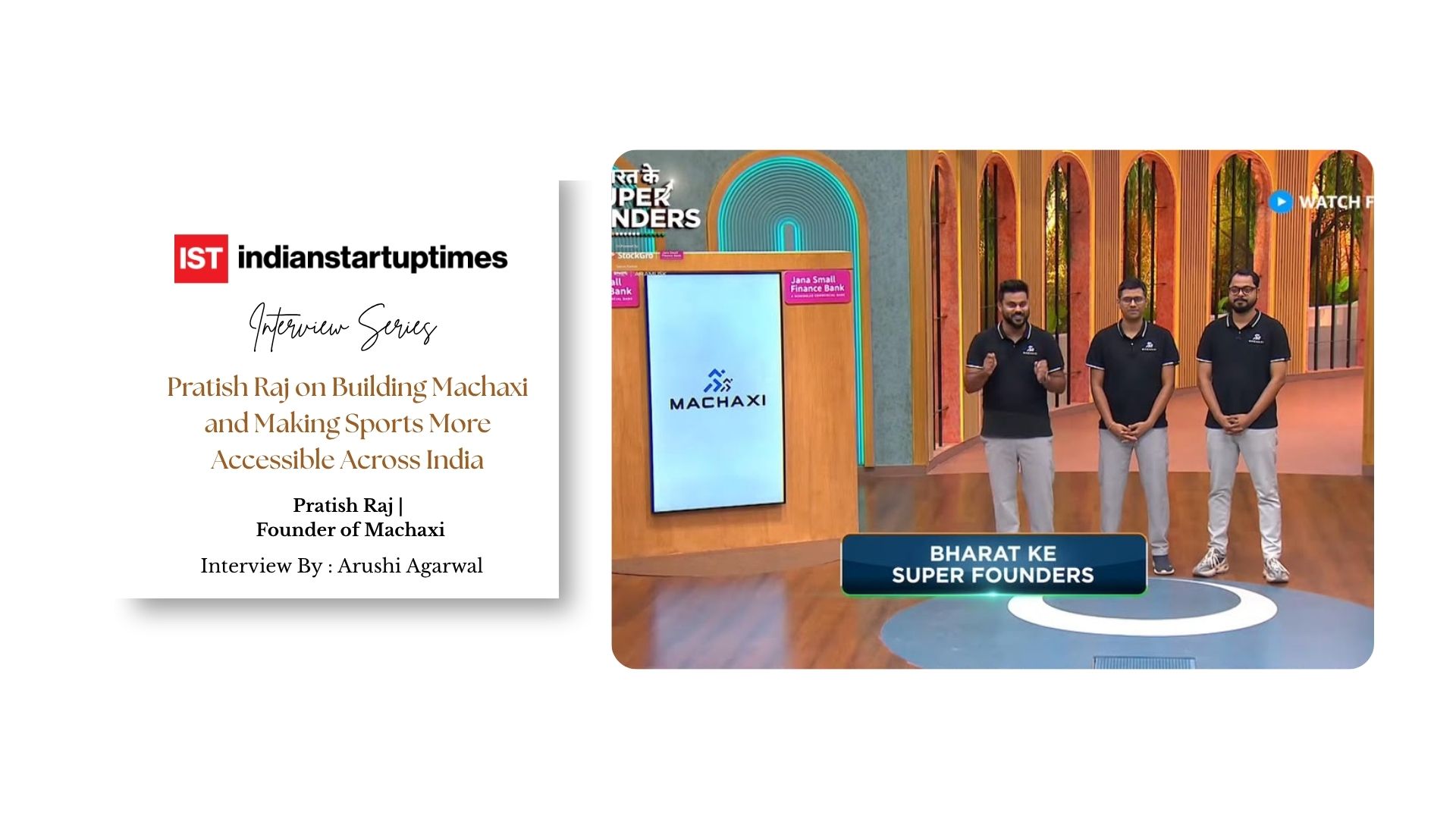
India’s sporting ambitions have traditionally been measured through medals, professional athletes and international performances. But beneath that narrative lies a much broader challenge: getting more Indians to participate in sport regularly.
For Pratish Raj, Founder of Machaxi, that gap represents one of the biggest opportunities in India’s sports ecosystem. The company was built around a simple but ambitious idea—making learning and playing a sport as accessible, structured and dependable as joining a gym.
Raj believes the problem begins with fragmentation. For many families, access to sports depends on where they live, which academy is nearby and, ultimately, which coach they happen to get. The lack of standardisation across coaching quality, infrastructure, customer experience and player development makes sustained participation difficult.
Machaxi is attempting to address this by building a broader ecosystem around both recreational and competitive sport. Rather than operating only as a traditional sports academy, the company aims to support the entire journey—from discovering a sport and learning it systematically to finding a place to play and continuing with it over the long term.
At the centre of this approach is standardisation. Machaxi works on structured curriculums, coach-to-player ratios, assessments, batch structures, customer feedback and technology to create a consistent experience across centres. For coaches, the objective extends beyond simply providing employment. The company wants to offer structured training, technology and a career path while reducing dependence on individual coaching styles.
Turning Sports Coaching Into a Scalable System
Building that consistency, however, has proved to be one of the company’s biggest challenges.
Raj describes sports as an extremely operational business. While founders may initially assume that developing the product or idea will be the hardest part, the more complex challenge lies in delivering the same quality of experience across multiple centres every day.
A coach may be unavailable, a court may suddenly become inaccessible, a parent may raise a concern, or a centre may face a maintenance problem. At scale, these seemingly small variables can create significant operational complexity.
Machaxi’s response has been to convert what Raj describes as “tribal knowledge” into repeatable systems. Curriculums, SOPs, technology, coach training, monitoring and measurable operating metrics are being used to ensure that individual incidents become opportunities to strengthen the organisation rather than remain isolated problems.
This approach also informs Machaxi’s philosophy around scaling. Raj believes that a sports company cannot scale simply by hiring more coaches. Instead, it has to scale the method of coaching.
The company is therefore developing increasingly detailed curriculums that define what should be taught at different levels, how sessions should be structured and how players should progress. Coaching teams undergo training and assessments, while factors such as coach-to-player ratios, batch capacity and player levels are continuously monitored.
The larger ambition is to make the system stronger than its dependence on any single individual.
Bringing Technology Into the Sporting Experience
Technology is another important pillar of Machaxi’s strategy.
At an operational level, technology supports discovery, enrolments, scheduling, memberships, court bookings, attendance, customer communication and centre management.
But Raj sees an even larger opportunity in applying technology directly to the sporting experience.
Machaxi is exploring computer vision and AI capabilities that can analyse movement and technique through video. The long-term possibility is to give players deeper insights into their technique, provide feedback, track improvement and complement what coaches teach during sessions.
Importantly, Raj does not view AI as a replacement for coaches. Instead, he sees technology as a tool that can make a good coach significantly more powerful.
The company’s broader technology philosophy is to use digital tools to enable increasingly personalised coaching while keeping the experience affordable and scalable.
Building Trust One Session at a Time
For a company working with children and families, trust is another critical component of the business.
Raj believes trust cannot simply be generated through marketing. It has to be built through every interaction and, ultimately, every coaching session.
The coach becomes one of the most important representatives of the organisation, particularly when working with young children. As a result, Machaxi places emphasis on coaching quality, coach behaviour, communication, assessments and feedback.
Parents, according to Raj, should be able to understand what their child is learning and why, rather than viewing every session as simply another hour spent on a court or in a swimming pool.
Customer feedback also plays a significant role. Rather than treating negative feedback purely as criticism, Machaxi uses it as an indicator of where the organisation needs to improve.
For Raj, the strongest indication of trust is ultimately simple: a child is learning, enjoying the sport and looking forward to returning for the next session.
From a Single Idea to 40+ Sports Centres
Machaxi has now grown to 40+ sports centres, with Bengaluru serving as its largest market and expansion beginning in cities such as Hyderabad and Pune.
For Raj, however, the most meaningful milestone is not a particular revenue figure or centre count. It is seeing the company evolve from an idea into an organisation that enables thousands of people to participate in sport every day.
The impact is visible at different levels.
Children from the Machaxi ecosystem have gone on to compete at state, national and international levels. At the same time, the company considers it equally meaningful when someone learns to swim for the first time or picks up a badminton racquet after never having played before.
That distinction reflects Raj’s broader philosophy around India’s sporting future. Elite achievement and mass participation, he argues, should not be viewed as competing objectives. A healthy sporting ecosystem requires both.
Building a Culture of Ownership and Speed
As Machaxi expands, Raj sees organisational culture as another important part of its ability to scale.
One of the principles he places the greatest emphasis on is ownership. As organisations become larger, employees can easily become managers of processes rather than owners of outcomes. Machaxi therefore encourages its teams to ask what the problem is and what they can personally do to solve it.
Speed is another important principle.
Rather than spending months attempting to create a perfect plan, Raj prefers an environment where teams can experiment, make mistakes, learn quickly and identify breakthroughs.
Staying close to customers is equally important. For a sports company, that means remaining connected to the court, swimming pool, coaches, children and parents.
Underlying all of this is what Raj describes as hunger—the determination not to become satisfied with past achievements.
Despite the company’s growth, he wants Machaxi to retain the mindset that it is still at the beginning of its journey.
The Next Chapter of India’s Sports Economy
Raj believes India is entering a major transition in how sport is perceived.
Historically, much of the national conversation around sport has focused on professional athletes and medals. Over the next decade, he expects participation to become the much bigger story.
More children could play sport regularly, more adults could turn to sport as a form of fitness, better infrastructure could emerge, and technology could make coaching more measurable and personalised.
Sport, he believes, will increasingly compete with gyms, fitness applications and entertainment for people’s leisure time.
This creates a significant opportunity for companies that can make participation easier and more engaging.
Machaxi wants to build the infrastructure, coaching systems and technology needed to support that transition. Its vision extends beyond operating sports centres to becoming part of the larger sporting journey—helping people Learn, Play and continue in the sport.
Aiming for Tens of Millions of Participants
Machaxi’s long-term ambition is built around a straightforward objective: significantly increasing the number of people who play sport in India.
Raj says the company’s broader mission is to help increase sports participation to more than 10% of India’s population.
Achieving that goal will require Machaxi to become much larger than a chain of physical sports centres. The company’s priorities include expanding quality sports infrastructure, standardising coaching, improving the economics and operational efficiency of centres, investing in technology and developing products capable of reaching users beyond the physical radius of its centres.
For Raj, the opportunity is measured not in hundreds but in tens of millions.
“India doesn’t need hundreds of additional people playing sport. It needs tens of millions,” he says, capturing the scale of the ambition behind Machaxi.
Lessons From the Founder’s Journey
Raj’s entrepreneurial experience has reinforced his belief that execution matters more than ideas.
According to him, almost every business can look simple when presented in a pitch deck. The real complexity begins when customers start using the product.
He also believes founders must be willing to change their minds. A conviction that appears correct today may prove wrong six months later, and becoming emotionally attached to an idea can prevent a company from adapting.
Another important lesson is to focus on solving problems rather than protecting functions. In an early-stage company, Raj believes there is little room for a mindset of “this isn’t my job.”
His approach can ultimately be summarised as being patient with outcomes but impatient with execution. Building something meaningful can take considerably longer than expected, requiring founders to combine ambition with resilience.
Redefining India’s Relationship With Sport
For Raj, Machaxi’s eventual legacy will not necessarily be measured by the number of centres it operates.
Instead, he hopes the company can help change the relationship Indians have with sport—making playing a sport a normal part of growing up and a normal part of adult life.
Some of the most meaningful moments of the journey are therefore not limited to competitive achievements. Watching a child win a major tournament in Machaxi colours is special, but so is seeing a child overcome a fear of water and learn to swim. An adult rediscovering a sport after 15 years can be equally rewarding.
These moments represent the broader purpose behind the company.
Raj’s message to young athletes and entrepreneurs is rooted in continuous improvement: fall in love with getting better.
Rather than becoming consumed by comparisons with others, he believes people should focus on improving consistently over time. Small improvements, sustained for long enough, can lead to extraordinary outcomes.
And for Machaxi, despite its growth to more than 40 centres and its expanding ambitions, the mindset remains unchanged.
Stay hungry.
Interview By: Arushi Agarwal