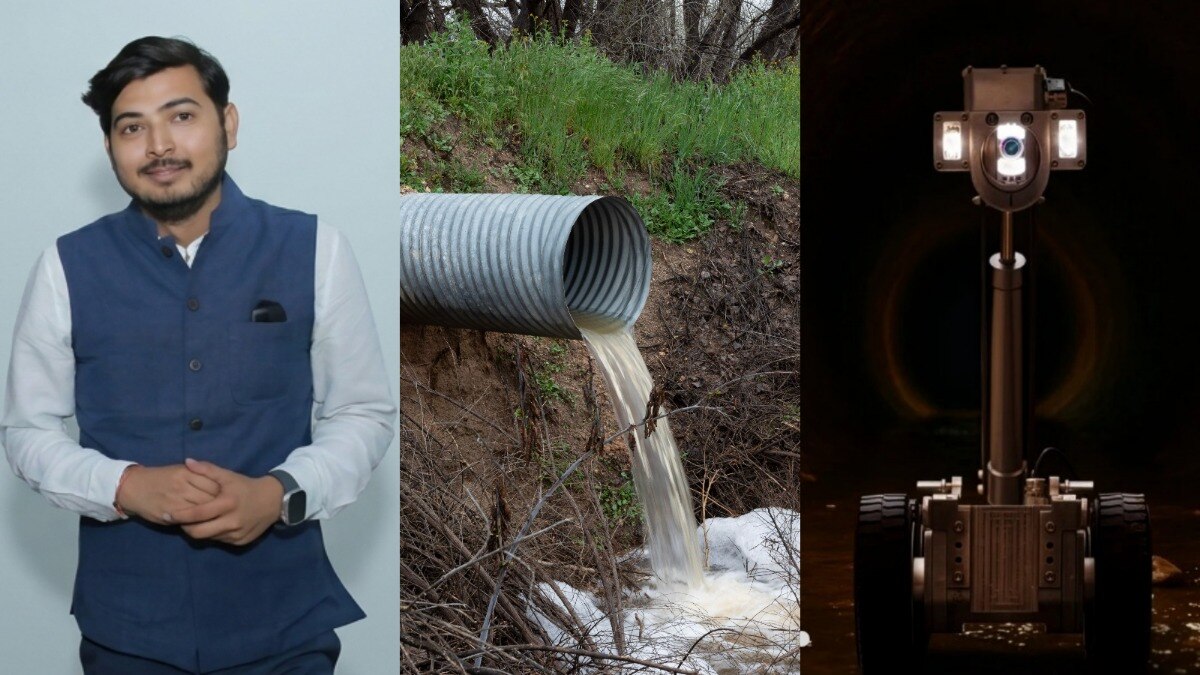
For Divanshu Kumar, engineering was never just about building machines. During his years at IIT Madras, a project on septic-tank cleaning introduced him to a problem that technology could potentially solve: keeping sanitation workers out of dangerous sewage-filled spaces.
Kumar, who grew up in Gaya, Bihar, studied Mechanical Engineering at IIT Madras between 2014 and 2019 and later pursued a master’s in Product Design. His septic-tank cleaning project is amongst his key projects, which marked the beginning of a journey that eventually took him from an IIT laboratory to the startup world. Divnashu was also featured in Forbes India 30 Under 30 list in 2025.
What began as a final-year master’s project under Professor Prabhu Rajagopal eventually became much bigger. The robot, first developed as part of his project, was showcased at the IIT Madras Carbon Zero Challenge in 2019.
WHEN A COLLEGE PROJECT GOT A NATIONAL NOD
The project did not remain confined to the campus.
Kumar’s work on the HomoSEP robot earned the prestigious Bhagyalakshmi and Krishna Ayengar Prize for the best master’s project in the area of sanitation at IIT Madras. The award was conferred by Prime Minister Narendra Modi, making Kumar a Prime Minister awardee.
That recognition came at an important point in his journey. Instead of treating the robot as a successful college experiment, Kumar and his team began looking at whether it could become a practical solution outside the laboratory.
This eventually led to Solinas Integrity, the IIT Madras-incubated startup that Kumar co-founded and now leads as CEO.
THE ROBOT THAT GOES WHERE HUMANS SHOULD NOT
The central idea behind the startup is straightforward: use robotics and artificial intelligence (AI) to deal with hazardous water and sanitation infrastructure.
Its HomoSEP robot is designed to clean septic tanks and manholes. It uses a rotary blade mechanism to break down hard sludge and an integrated suction system to pump out the resulting slurry. The design was developed with safety in mind so that sanitation workers can operate the machine without entering the tank themselves.
The company’s work has also expanded beyond septic tanks. Its Endobot is designed to inspect water and sewer pipelines, including narrow pipelines, while Solinas also offers AI-based data management through Swasth AI.
In other words, Kumar is not simply building a robot to clean sewage. He is building a larger technology system around some of the infrastructure people rarely see but depend on every day.
FROM ONE ROBOT TO A BIGGER MISSION
Solinas has since moved from prototype development to field deployment. IIT Madras mentions that multiple HomoSEP units were planned for deployment, with the project also working with sanitation workers and self-help groups affected by manual scavenging.
The startup has attracted investors and works with government bodies, civic organisations and private companies. Forbes India reported that Solinas had raised $5 million and was targeting Rs 15 crore in revenue for FY25.
Kumar’s work has also brought wider recognition. He was named to the Forbes India 30 Under 30 list in 2025 in the Industry and Manufacturing category. Solinas has also been recognised through awards on innovation and social-impact honours.
HIS FIRST STARTUP WAS NOT ABOUT ROBOTS
Interestingly, Solinas was not Kumar’s first entrepreneurial experiment.
During his sophomore year at IIT Madras, he co-founded Involve, a social enterprise focused on peer-based learning in schools. The venture worked on developing agency among school students through peer teaching and mentoring.
That experience helps explain the common thread in Kumar’s career: using technology, education and entrepreneurship to tackle problems that affect people directly.
For someone who began with a college project, the journey has gone well beyond building a machine. Kumar’s work shows how an engineering idea can move from a campus laboratory into the real world, and, in this case, take on a job that no human should have to do.
– Ends