



This article is part of Fintech Leaders, a channel for builders, entrepreneurs, investors, regulators, and students of financial services. I invite you to share and sign up. If you enjoy this conversation, please consider leaving a review on Apple, Spotify, or Youtube.
I sat down with Harshil Mathur, Co-Founder and CEO of Razorpay, one of India’s most important fintech and tech companies. Razorpay moves hundreds of billions of dollars in annual payment volume and powers about 85% of the country’s largest tech companies. They are also reportedly preparing for a large IPO on the Indian Stock Exchange.
Harshil started coding at age 12 and began building Razorpay in 2014, only a year after graduating college. Their early days were not easy, and Harshil and his co-founder, Shashank Kumar, ran into about a hundred bank rejections before a single bank partner said yes. Fast forward to 2026, and the company today is one of India’s most important payments players.
We discussed the year of rejections that almost ended the company, the defining night Razorpay chose its smallest customers over its biggest ones, why culture values are really long-term financial metrics, why global payment giants keep failing in India, how UPI rewired a billion people’s relationship with money, and the agentic commerce bet that could expand Indian e-commerce ninefold.
Harshil grew up in Jaipur, went to one of India’s prestigious IITs, and took a job at Schlumberger working oil fields in the Middle East. He lasted less than a year. He had been coding since he was twelve and could not enjoy his oil job. All he kept thinking was a side project that would not leave him alone: it was absurdly hard for a small business or a young startup in India to accept a digital payment.
His first instinct was the classic engineer’s instinct. How hard could this be? The more time he spent on it, the more he realized the answer was very hard, but at the same time it bothered him that nobody was solving this problem for the businesses who needed it the most. This was 2014 and India already had over a hundred payment companies. But every one of them sold to large enterprises and left aside the two and three-person startups that were beginning to appear across the country.
Building the actual software and product turned out to be the easy part. Harshil and Shashank both loved coding, so they built what they thought the best payment experience in India should look like. But as most readers will know, payments is not a business you can ship quickly out of a garage. You need banks, certifications, approvals, and antifraud tools.
Throughout the entirety of their first year building Razorpay, the two 23-year-olds with no finance background and no banking pedigree submitted business plans bank after bank and got rejected close to a hundred times. Harshil is actually generous and humble about these days: the bankers were not wrong. He and Shashank understood the technology but did not understand the risk. Every rejection helped them refine their product and this turned out to be a discovery process that led them to a great result.
Then their luck finally turned. After almost a year of knocking on doors, they met a young banker who actually understood what they were building. Startups were barely a known term in India in 2014, and this guy got it. He gave them an in-principle approval to build on top of his bank’s APIs, and Harshil remembers the day very well because he quit Schlumberger the next morning. Raising money was its own fight, with investors calling payments a commoditized space that already had a hundred players in India. But around that same time Razorpay applied to Y Combinator with zero expectations and got in. YC had barely invested in India back then, and suddenly two kids from Jaipur were in rooms with Paul Graham, Paul Buchheit, and Sam Altman (then President of YC).
Razorpay was product-led from day one out of necessity rather than a strategy. You cannot run an enterprise sales motion at companies that are two people in a room, so the best way to reach them is to let them find you.
The math on that decision is brutal in payments. Product-Led-Growth (PLG) works cleanly in high-margin businesses because you recover acquisition costs quickly. But payments margins are thin and a customer cohort can take two or three years to break even. Harshil admits they never did the math at the start. They had not computed CAC or a payback period. He learned those terms later and they just built it, because it was the only path to becoming the default choice for Indian startups.
The part that separates Razorpay from everyone else is what they did with brand. Before Razorpay, no payment gateway in India had a recognizable brand. Measuring via Google Trends, the generic keyword “payment gateway” had more search volume than any payment brand in the Indian category. People searched for a payment gateway, clicked the first or second result, compared, and bought. Nobody cared who made it, the same way nobody cares who makes a plain t-shirt. So Razorpay spent years and resources attacking that and eventually in 2020 they crossed over and Razorpay pulled more search volume than the “payment gateway” category itself. Today, more people search for Razorpay than search for payment gateway, which means they are the category. You can look at it as the Xerox or Kleenex moment for a brand.
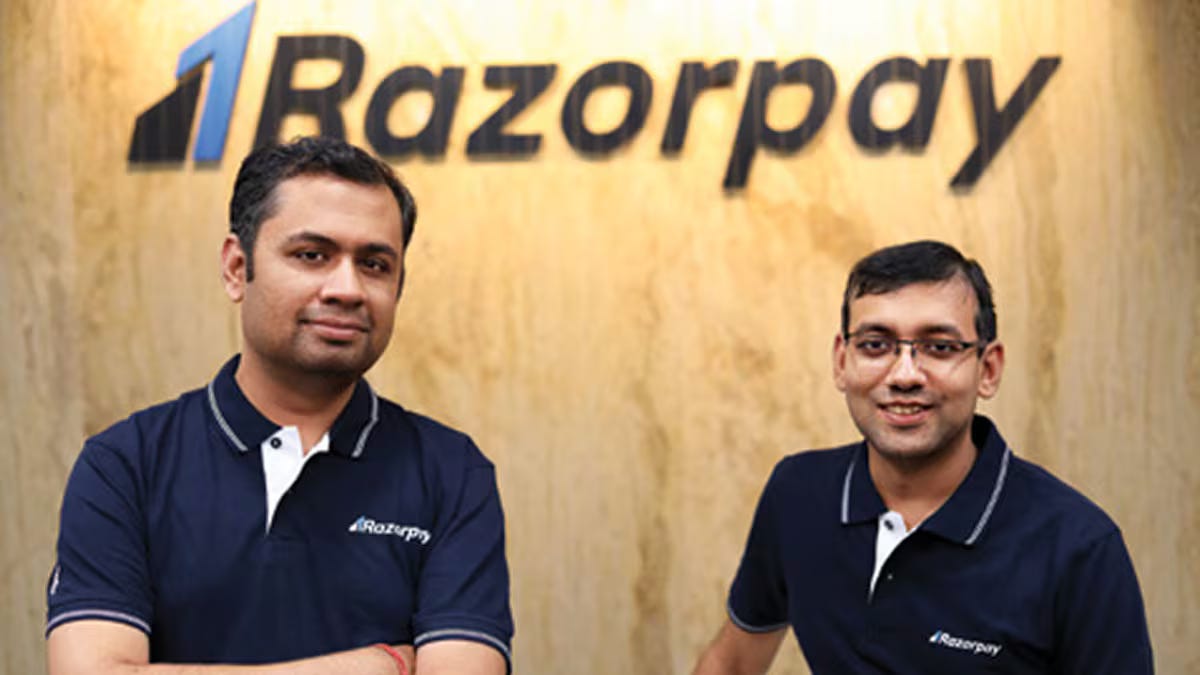
Razorpay has gone from two engineers in a room to thousands of employees worldwide, and Harshil had to learn how to stop being the person who did everything. A few of the rules he built along the way are below.
The 30% rule. Every week or two, Harshil audits where his time goes. Anything over 30% of his bandwidth gets delegated to someone who owns it day to day. A founder cannot be the single point of failure, and it keeps his calendar open for the unpredictable fires.
Culture is set long before you write it down. In the first 50 employees, culture is whatever the founders say and do. Past 100 you have to write it down and rebuild hiring around it. But that only scales what already exists. What you put on paper is what your culture already is.
Culture values are long-term success metrics. Revenue and profit are the short-term success KPIs, but Harshil frames values as the long-term equivalent KPIs: behaviors that compound into real value over five or ten years.
A value only counts when it costs you something. In February 2020, India’s regulator shut down one of Razorpay’s partner banks overnight and froze millions of Razorpay’s settlements. Harshil could cover their ten largest customers or their ten thousand smallest. They decided to pay the small ones, because that money is payroll for them. It cost Razorpay one of their top ten accounts and legal notices from four others, but the whole company and market watched him make the call.
I asked Harshil about Stripe’s failed India entry, and he immediately broadened the question. It is not just Stripe. Nearly every global payment player has tried India, run experiments, invested real sums of money, and exited. The standard explanation from companies exiting the market is that regulation is too hard. Harshil thinks that explanation is lazy.
His view is that India is a fundamentally different market that made fundamentally different choices at the core, and regulation is the output of those choices rather than the cause. The clearest example is the trade between fraud and friction. The US payments system is optimized for success rates -> accepting fraud somewhere around two to three percent in exchange for transactions that clear 95 to 98 percent of the time. You type a card number and you are done. India took the opposite call and mandated two-factor authentication on everything. Once this mandate went live, fraud rates collapsed to under six basis points, but success rates fell to 70 or 80 percent before years of work pulled them back toward 90.
Harshil explained the reasoning behind that trade and it actually makes sense. India’s population came to digital money recently and their relationship with money is different. A thousand rupees (~$20), can be the difference between a family eating or not eating tomorrow, and there is no social safety net for them. In that environment you cannot build a system where fraud is acceptable and disputes get resolved in a couple of months. Most people would lose trust immediately and never come back.
It also extends to recurring payments. India requires that you be notified 24 hours before any recurring charge, with a button giving you the option to easily cancel this recurring payment. You get charged only if you do nothing, but the customer is always in control. You cannot run a subscription in India where someone pays $20 a month forever with no way out. Harshil believes this law should exist everywhere in the world and I agree with him.
The proof is in the outcome. Today 50% of all real-time payments on earth happen in India, and that was only possible because people trusted the system enough to use it. India was overwhelmingly cash-based when Razorpay launched in 2014, and people asked how digital payments could possibly work in a country that ran on cash. Most Indians now carry zero rupees when they leave the house. According to Harshil, using cash in India has become harder than not using it.

Razorpay’s next chapter runs on two strong tailwinds. The first is geographic. The Indian playbook, built on real-time rails rather than cards, is being copied across Southeast Asia, and Razorpay is already in Malaysia and Singapore. The way Harshil puts it, internet companies spread from the US because the internet came from the US. In fintech / payments, he believes the direction reverses, and emerging markets will follow the playbook India wrote.
The second tailwind is AI, and Harshil here has personal conviction. After five or six years away from building, Claude Code and similar tools have pulled Harshil back to the keyboard, because the only way to understand what AI is changing is to build with it yourself.
Razorpay started with two engineers who assumed payments would be easy, then spent a year collecting rejections from bankers who had never heard of a startup. A decade and hundreds of billions in annual payment volume later, the CEO is back at the keyboard, building again to figure out what comes next.
Harshil recommends Founders at Work: Stories of Startups’ Early Days by Jessica Livingston, an off-beat pick he gives to founders because it captures the messy, complicated early journeys of builders like Steve Wozniak before they were famous. He values it for showing the unglamorous early days rather than the polished outcomes.
Harshil Mathur: I grew up in Jaipur, a small town in India, and then went to IIT, one of the most prestigious colleges in India. When I graduated I went to Schlumberger, an oil field company, and worked in the Middle East for about seven to ten months. But I was always a techie, an engineer by background, and I always loved coding, so I never really enjoyed that job and wanted to do something of my own. I ran across this problem of payments while I was in my job, because I was doing a side project, and I saw it was extremely hard to accept digital payments in India. As a techie I thought, how hard could this be? Why is this so complicated? That gave me the motivation to look deeper into it. The more time I spent understanding it, the more I got convinced this was a big problem to be solved. It’s not that there were no payment companies. There are a hundred plus payment companies in India, but nobody was really solving payments for young startups and small teams, two people, three people building something. That was a trend coming up in 2014 and 2015 in India. A lot of startups were coming up, and I thought, if somebody makes it easy for these startups to accept payments on day one, there could be a massive opportunity behind that. That’s what gave birth to the idea of Razorpay.
Harshil Mathur: We power millions of businesses, but the interesting stat I love is that out of 120 unicorns in India today, Razorpay powers close to 85% of them. And it’s not that we power 85% of them after they became unicorns. 90% of those we started powering far before they became unicorns. So we are the de facto payment player for startups in India. As these startups used Razorpay and went on to become unicorns, we power a vast majority of them today. That’s essentially the gist of our journey. We are the de facto choice for startups in India, and as they scale up to become $100 million companies, billion dollar companies, $10 billion companies, publicly listed companies, we continue to power payments in their journey. That’s how we grow. We grow when the digital economy of India grows, and that’s why we are essentially an index of the digital economy of India.
Harshil Mathur: The bank part was honestly the hardest part of the journey. As a techie, building the product was the easy part. Shashank and I both loved coding, so we built the best payment experience we thought India should have. But payments is not something you can build out of your garage and ship out. You need to partner with banks, you need certifications, approvals, and honestly, as a techie, that was the hardest part for me. I remember walking into a bank branch next to my home one day and saying, I want to start a payment gateway. The guy looked at me and said, you want a payment gateway? I said, no, I want to start my own payment gateway. And the guy had no idea, because people don’t typically walk into a bank branch to start a payment gateway in India. Then I went to a different bank, and a different bank, and finally understood that this guy in Delhi or this guy in Mumbai handles it. So we reached out, submitted a business plan, and got rejected because we were two 23-year-olds, almost fresh out of college, with no finance background and no background in banking, who wanted to build a payments company. And they were not wrong. Their view was, you understand the tech part of it, but you don’t understand the finance part, you don’t understand the risk. So they kept rejecting us. In that journey we would have seen almost a hundred rejections by bankers. But every rejection added something, because every time we got rejected we would ask them: what is missing? What should we do? Who should we speak to? And we kept refining our business plan. It took almost a year before we met a relatively younger guy at a bank who understood what we were trying to do, who understood what startups are. Startups was not a very known term in the Indian context in 2014. He gave us an in-principle approval to start building on top of his bank APIs. I remember that day very well, because the next day I left my job at Schlumberger and went full time into Razorpay. That was the only blocker. We didn’t know whether we could actually solve it. Once that was away, we were certain we could build this company. On funding, that was equally hard. We went to a lot of investors and everyone said payments is a commoditized space, there are a hundred plus payment players in India, at least five or six large ones globally, what is the differentiation? We explained that we were building a product-first payment company. There were payment companies in India, but most of them sold to enterprises. They were not built in a product-led growth fashion, and we felt there was an opportunity to build that for startups and SMEs. It was very hard for anyone to see that. PLG motions were not common in B2B in India. Even today, very few companies in India have built a PLG motion in B2B. But fortunately, around that time we applied to Y Combinator with zero expectations, because YC had not invested in Indian companies much before us. We got in, and that was a big turning point.
Harshil Mathur: There were a lot of companies in our batch. There was Readme, there was Deel, multiple strong companies that came out. But the interesting part was that because we got into YC, we got to interact with some of the best mentors in the world. Paul Graham, Paul Buchheit, and Sam Altman was the president of YC during that time. I remember a lot of interactions with him, and a lot of those shaped Razorpay in a very different direction. I can tell you one particular incident with Sam, when we were getting a lot of these bank rejections. We had office hours with Sam and I told him we were getting rejected by banks a lot. He asked why, and I said we’re 23 years old, we look very young, we don’t look like people from finance backgrounds, so it’s been hard. He said, if that’s the problem, why don’t you solve it? I said, what do you mean? He said, if the problem is that you look young, why don’t you dress old? Why don’t you dress the way bankers do? Why don’t you speak the language they speak? And it was logical, right? So after that I bought my first suit. I started keeping a bigger beard so I looked older than I was. It does help, because a lot of people judge the book by its cover. It works in a lot of those circles, that if you look like them, if you look like you belong, it does matter. I don’t know if that led to the final approval, but we did change our approach to banks, at least in the way we looked.
Harshil Mathur: It’s the hardest part of scaling as a founder. If you continue to do everything yourself, you can’t really scale. But at the same time, letting go is not easy, because so many things are so core, and it’s always very hard for a founder to believe that somebody else will do as good of a job as you are doing. As the org started scaling, it became evidently clear to me that the only way the org can continue to scale is that I can’t be the point of failure. So the rule of thumb I had is that if anything takes more than 30% of my time, I need to delegate it. Somebody else needs to own that piece on a day-to-day basis. That’s a rule of thumb I still apply today. Every week, or every couple of weeks, I evaluate where I’m spending most of my bandwidth. Anything that crosses the 30 or 40% threshold, I need to find a way to delegate. It has multiple outcomes. First, it allows scaling. Second, it makes the company a lot more resilient, where founder dependency is lower. Third, it frees me up. The company always has fires, and the founder’s bandwidth always has to go into those fires. If I’m locked into my day-to-day so much, how do I take time out for fires? You can’t predict fires, but they will happen. Every week something or the other will be on fire, and if you’re locked into your day-to-day, you can’t take time out. Or if you do, something in the day-to-day will suffer because of it. So it lets me constantly have enough space on my calendar that whatever the fire is that week, I can spend my time on it.
Harshil Mathur: There are two aspects, hiring and culture, and both go hand in hand. On hiring, at least for the first 200 people, I interviewed almost every single person that got hired at Razorpay, because the early team essentially sets up your culture. In the first 50 employees, the culture is what the founders say and do. People look at you, almost everyone interacts with you, and they see what you do and how you act. You don’t even need to put culture values into a book. We didn’t even have that, and it doesn’t really matter, because what founders say and do becomes your culture. When it crosses 50 to 100 people, that’s when we realized not everyone will interact with me anymore. It’s impossible for a hundred people to work with the founders every day. So you need to start defining your culture values, and you need to set up your hiring process to hire people who match those values very tightly. Once we crossed 200 people, we had set up our hiring funnel very tightly to hire the kind of people Razorpay needs, with culture as a very strong quotient of hiring. A lot of founders come to me and say, our culture is bad, how should we change our culture values? But the culture values you put on paper don’t matter if those are not the ones already being followed. What you put on paper is essentially what is already your culture, because the culture is already decided. What you put on paper is just to scale it from 200 people to 400, to 600. When people think of culture values they think of words on the wall, honesty and integrity and some cool-sounding words you put up because other organizations put them. Honestly, that is a disservice. It doesn’t create any value. The real value of culture is when there is a conflict between short-term outcomes and the culture values. What do you choose? If the answer is that you’re not going to choose the culture value, then it’s not really a culture value. So the way I define it, culture values are essentially long-term success metrics for the company. The short-term success metrics are very clear: revenue, profits, all of those things. The long-term success metrics are your culture values, because you believe that if you do these things repeatedly, they will compound and create long-term value. For example, one of our culture values is customer first. A lot of companies put customer first, but the real reason you do it as a B2B company is that if you do well by your customers, it compounds over four, five, seven, ten years, and those customers tell other customers to use Razorpay. That creates more value than earning more profit from that customer in the short term. That doesn’t mean you don’t make money from your customers. The worst thing you can do for a customer is bankrupt yourself. But it does mean that when there is a short-term conflict, say a customer is overcharged and you have made revenue on it, should you return that money or say I can’t refund it because it’s short-term revenue? You refund it, because you believe acting in the right way for customers will compound. If you do it a thousand times, maybe a hundred of those times the customer tells other people, use Razorpay, because these guys did right by me. As the company scales from 200 to 1,000 people, a lot of those decisions will not come to me. They’ll be taken by leaders and teams on the ground. If they don’t understand what framework to use, they will fall back to short-term goals. Revenue is my goal, this KPI you set is my goal. Unless it’s explicitly clear that you have to optimize for the culture value and not the KPI, the culture is not really set. Words on the wall mean nothing if you don’t set that expectation.
Harshil Mathur: Multiple ones. Generally the best test of culture values is when things are really bad, so let me talk about one of those situations. As I said, we have to work on top of banks. One of the banks that was our primary partner for one of our core businesses, settlements, was shut down by the Indian regulator one night in February 2020, because the bank went through a liquidity crisis, the way SVB did, or the way some banks have globally. The regulator paused all withdrawals from the bank and nobody knew when it was going to come back. It took a couple of months. So a lot of our merchant settlements were stuck, and this is the money of other merchants. The notification came at 6pm. Everyone rolled into the office at 8 or 9pm, because we knew it was going to be a long night and we had to work through solving that crisis. One of the key decision-making points was that we had a choice to either settle the funds to our top 10 largest customers, or settle the funds for the rest of our 10,000 plus smaller customers, because it’s always a Pareto in most payment businesses. The top 10 customers have the majority of the volume, so you can either settle all their money or you can settle the long tail. That’s the amount of funds we had in other banks. Generally the push from sales and business teams is to settle the largest customers, because those are the ones who make the most profit and the most revenue. The top 10 are the ones that really matter, and you can lose a lot of small guys and it doesn’t impact the company that significantly. I took the call, and I remember it, because it was a hard call to convince our executives on. I took the call that we’re going to pay all our smallest customers first, and whatever is left, then we’ll pay our largest customers. The reason was fairly simple. The smallest customers, even though their settlements were $1,000 or $5,000, they would die without that settlement, because a lot of them rely on day-to-day cash flows. The money comes in, they pay their salaries. The money comes in, they pay their vendors and suppliers. If this pause went on for a couple of months and we didn’t pay them, they could be out of business. The large guys, some of their settlements were a million, a million and a half dollars, but even then they had enough liquidity to keep themselves afloat. They had access to credit, access to other channels. So even though it made more business sense to settle the large guys, we paid the small ones. We got legal notices from some of these customers who said, you paid out all your small guys and you didn’t pay me. They threatened to take us to court. We lost one of the top 10, and we got legal notices from at least four. But the reason this is important is that every single person in the org saw when we took that decision, and it made them understand how much these culture values are important to us over short-term KPIs. These are the points where your culture values are really tested. If at that point I had said, yes, we have the culture value of customer first, but let’s keep that aside because this is a crunch moment and let’s pay these top 10 because that’s the business impact, then from the next day that’s your culture value. Your culture value is not customer first anymore. It’s business first. And no matter what you put on the wall, nothing is going to change that from that point onwards.
Harshil Mathur: The hard part of a PLG motion in B2B is that the payback period is very long, especially in payments, because margins are thin. The way PLG works is you spend a certain amount of money to acquire customers and then make that money back over six months, twelve months, fourteen months. In a high margin business those payback periods are small, so PLG motions make sense. In a low-margin business like payments, the payback period is fairly long. It can take two or three years for a customer to break even at a cohort level. But we decided very early that we were building this company to enable small startups and SMEs to accept payments online, and there is no way to do sales to small startups except PLG. You can’t go and sell to them, because they are very small when they start up. The only way is that they discover this is the best way to accept payments. Honestly, we didn’t spend a lot of time doing the math when we started. We didn’t really compute the CAC. We hadn’t computed the payback period. I learned those terms over time as we built this motion and people smarter than me on the marketing side joined. But we just built it, because that was the only way to achieve the objective of becoming the de facto choice for startups in India. So we took a lot of calls to build a brand and build our presence. Most payment gateways before that didn’t really try to build a brand, because it’s very hard to build a brand in this space. One of the interesting flips I remember, and the way I measure it today, is a Google Trends report which shows you keyword search. The payment gateway category had no brand, which means the category keyword had more search volume than any brand in the payment gateway space. People didn’t really care about the brand. When they wanted a payment gateway, they would search for payment gateway in India, click the first or second or third result, compare and buy. Nobody really cared. It’s like saying, I want a t-shirt, I don’t really care which brand it comes from. We spent a lot of time and effort building a brand in that space, and in 2020 we crossed that keyword. Razorpay had more search volume than the payment gateway category. Every other brand in the space is far below the category search. More people search for Razorpay than for payment gateway. In fact, we are the category. We call it the Xerox moment for a brand, when the brand name becomes synonymous with the industry, to the point where people say, just use Razorpay. That’s one core metric we’ve tracked over the years, and we still put effort into it. When people think of a payment gateway, Razorpay should be the name they think of even before they think of the word payment gateway, even before they know the word. That’s the best test of having a strong PLG motion, that you drive on top of the category versus under the category.
Harshil Mathur: Not just Stripe. I’ll broaden it to most global payment players, who have largely been unsuccessful in India. There’s a story of almost every global player who tried entering, did some experiments, made a lot of investment, and then exited. Regulation is a very simple way to paint the picture, but it’s not really the right way to paint it. India is a very different market and it has made very different choices for that market, and regulation is an outcome of that. Comparing the US market to India, one of the most fundamental things about the US payment market is that the success rate of payments is extremely high, but the fraud rate is also extremely high. Fraud and chargebacks are part and parcel of the payment industry there. You don’t have any OTPs, you don’t have complicated signing procedures. You enter a card number and you can close the transaction. If you get somebody’s card number, you can do a transaction on their behalf, and then they can raise a chargeback or dispute to get their money back. So fraud rates in the US hover around two to three percent, but success rates hold around 95 to 98%. India took the reverse call, because India has a largely, I’ll say, digitally young or digitally new population. We are not as digitally native as the Western market. A lot of people are getting into technology, but most of them have come into it in the last five to ten years. What that means is that if you build a system where fraud is acceptable, people will lose trust very quickly. The relationship with money that people have in India is very different from the West. A thousand rupee fraud can impact somebody’s life to the point that they can’t buy the next day’s food. And you don’t have enough social security, enough of a social net, that if you lose that money, that thousand rupees, which is $20 in US terms, it might be so much for you that you can’t put food on your table the next day. In that kind of ecosystem, you can’t take the approach the US did, that some fraud can happen and people can dispute and get their money back after a couple of months. So we took the reverse approach. We said you have to mandatorily have two-factor authentication, which means fraud rates in India came down to less than six basis points, from the two to three percent in the US. But the success rate of transactions also came down. It used to be about 70 to 80%. We worked on a lot of things to take it up to 90%, but still 90% versus 95 to 98%. Those are the choices we took as a market. I’m giving OTP as one example, but there are so many different choices India took. Another is recurring payments. In the US you can subscribe to a gym membership and keep getting charged, and a lot of people complain there’s no way to cancel it. India didn’t allow recurring payments for a long time, because they were worried that a largely tech illiterate population, if they set up a mandate, could keep losing all of their daily savings and again not put food on their table. When they allowed recurring payments, India made a law that 24 hours before you are charged, you have to be sent a notification saying you’re going to be charged in the next 24 hours, and if you want, you can press this button and cancel it. If you don’t do anything, you get charged. But if you press the button, you can cancel. So the customer is always in control. You can’t have a Comcast type membership in India where you’re being charged $5 a month and you have no way to cancel it, where you’re on calls and you can’t. Every time, the customer has control. Looking from the West, a Western company might say India has such tough regulations. But if you look from the Indian context, it makes so much sense. In fact, I believe this law should exist everywhere in the world, because it’s such a strong customer protection law. Those are the things a lot of global companies have a hard time complying with, because it requires them to restructure the way they do payments in the West to comply with the guidelines in India. That’s why you hear this terminology, that India has hard regulations. But I believe a lot of those regulations are built because India is a very different market, and if you’re a company going to operate in this market, you need to work within the framework of this market. India has these realities where people can essentially not be able to put food on the table if they lose $20, and you can’t compare it to the West. In fact, that’s the reason digital payments grew in India the way they did in the last 10 years. It couldn’t have happened if customers couldn’t trust digital payments, and they couldn’t have trusted them if India hadn’t made these hard calls. There was enough pressure not to make these hard calls. India took them, and today 50% of all real-time payments in the world happen in India. It’s because of the trust that people have built. India was extremely cash-heavy when we launched Razorpay in 2014. People used to say, how would digital payments make sense in a country where everything is cash? Today, I carry zero rupees cash in my wallet when I go out. In fact, it’s harder to use cash than to use digital payments in India now.
Harshil Mathur: UPI has been the biggest tailwind India’s digital payments market has seen in the last 10 years, and a lot of growth for companies like us has come because of that infrastructure being available. One of the amazing aspects of UPI is that it’s a public-private partnership infrastructure, built as a public rail where private players like us can build on top of it to deliver the last mile. The ecosystem is open, in the sense that some other consumer company can solve the consumer problem of getting UPI customers, I go and solve the merchant side, and both sides are interoperable. So nobody can build a walled garden like, let’s say in the US, where you have Venmo, and only if your customer and merchant are both on Venmo can you pay. In India, Google Pay onboards customers, I onboard merchants at Razorpay, and a customer who has Google Pay can pay a merchant that uses Razorpay, without us or Google Pay having any interaction with each other. That’s why the ecosystem compounded so rapidly, because every player focused on their strengths and deepened their partnerships. Nobody had to convince another player to open their walled garden. The second thing that changed because of UPI is the way it is built. The reason UPI scaled so much is that India never had deep adoption of credit cards. When UPI came in, mobile was actually very deep. Everyone already had a smartphone, so UPI as a payment instrument was built on day one to be mobile first. What I mean is that cards are not mobile first. If you want to make a payment using a card on your mobile phone, you have to enter your card number, your CVV, your OTP, your expiry date, your name, your address. That’s not how you’d build a mobile payment instrument. And in spite of all of that, it’s still not secure, because if somebody has your card number, they can still do whatever they want. There’s no tightness of security. Now we solve some of this through Apple Pay and so on, but those are layers built on top of the core card layer. It’s not built as a native mobile instrument. Versus if you think of a mobile platform like WhatsApp or Facebook, you can’t expect a mobile app to have a login process where you enter a card number and an expiry date. A mobile login process should never require all of those things. UPI was built on day one to be mobile first. It uses a token to connect the app. The app is deep linked using your SIM, and there’s SIM binding in place from day one. So when a transaction happens on UPI, it is natively secured against the mobile you’re using it on, versus being built in an era which had no mobile. In fact, cards were built in an era where there was not even a telephone line. They were built so that people could Xerox the card number on top and do the transaction. Then we added layers on top to comply with newer guidelines. That’s one of the biggest advantages UPI has. It’s built for today’s era, it’s built on mobile, and that’s why it’s been very extensible. It started as a way to pay from a bank account to a bank account. Today it allows you to pay from a credit card to a bank account, from your UPI or your PPI wallet, from a stored value instrument, and so much more. That’s because it’s built as an authentication system on top of a mobile. For a smartphone generation, it’s the right instrument, built completely without any overhead of complying with an older guideline or an older interface. While cards have over time moved to support things like tokenization, they still have to be backwards compatible, which means I can still take your card number and do a transaction in spite of you having logged into Apple Pay. UPI doesn’t have any of those deficiencies, because it’s built on mobile from day one. There’s no way to steal your UPI credentials, for that matter.
Harshil Mathur: AI is one of the biggest transformational shifts of our generation. It creates a massive set of opportunities, and it also changes or kills a lot of the opportunities that were available in the past. To your earlier question about how I delegated and stepped away from building, once I tasted blood with Claude Code and some of these tools, for the first time after maybe five or six years, I’m back to building again. The only reason is that with AI so much is changing, and the only way to understand what is changing is by building yourself. So I’m spending a lot of time learning how to use these AI tools and building things myself. I have three or four agents that help me do my day-to-day work now, from reviewing all my meetings, reviewing my calendar, reviewing my daily health metrics, to a lot more complex stuff, because that’s the only way to know the power of AI. From a company perspective, there are two parts. One is internal, which is things like coding. Giving everyone Claude Code is one thing, but the more complex piece is how you really change the way products are built, because build time has now shrunk significantly. How do you make the entire product building process more like a factory? That’s a massive change we’ve been undergoing. For example, we built a Claude agent similar to what Anthropic launched a couple of days back. We built our own a couple of months back, where our business team can tag the agent on Slack and say, build this new thing, and it can build it without any engineering involvement. Of course, there are still people who review anything that goes into production. The second part is external: how do we use AI to bring more value to the businesses that we serve? The two big areas we’re focused on are agentic commerce and Agent Studio. Agent Studio is a platform that allows a business to hire an agent on top of Razorpay to do a lot of back-end operations they would typically have to hire a team for. For example, when somebody comes to your checkout, is about to buy something, and decides to drop off, you want to reach back out to that customer, give them a discount, offer something to get them back. We now have an agent that people can spin up on the fly, and there are 100 plus merchants that use it, that will call or message or WhatsApp every customer who drops off, give them an offer or a discount, and try to get them back. The second is agentic commerce, and I’m personally very excited about that, where people can buy things using agents, whether inside apps like ChatGPT, or inside merchant apps by talking to a voice agent, or through their own personal agents. The reason I’m excited is that it’s similar to mobile commerce, and I believe India can leapfrog on this far more rapidly than the West. In the West, e-commerce is already very deeply penetrated. Most people know how to buy stuff online and buy very frequently. In India, e-commerce penetration is still very thin. Less than 50 million Indians actually do regular shopping on e-commerce, although more than 450 million Indians use UPI regularly. That’s because most e-commerce apps are built so you search and browse and find products yourself. That’s not how Indians typically shop. Indians are very conversational, they’re multilingual, and they’re voice first. Most shopping apps are not built that way. AI allows us to build shopping experiences that are agentic first, where people can talk to an agent, decide what they want to buy, ask a couple of questions, talk in their own language, and then buy using their voice. I think that can be an amazing opportunity, and it’s true for India more than anywhere else. More than 50% of all voice notes on WhatsApp are sent in India. That tells you how massive voice is in India. We believe agentic commerce can really shape the way commerce happens in this country and expand the TAM far more massively, versus markets like the West, where it will scale up but it will not be expanding the TAM, because most of the market is already deeply penetrated. In India, because penetration is thin, there is a massive need to penetrate it more by offering multilingual voice and conversational commerce. That makes me very excited.
Harshil Mathur: We are in the early days. We launched agentic commerce on ChatGPT last year. We launched it with Claude early this year, and we launched agentic commerce inside apps like Zomato, Swiggy, and Blinkit, which are the top three quick commerce companies in India. We’ve seen early traction on it. What we need is deeper support from some of the ecosystem players to enable it. But on the brand side and the merchant side, there’s a lot of excitement, and we have onboarded a lot of merchants on these platforms. So I’ll say it’s in the pilot and early PMF stage, but the next couple of years are going to be very exciting.
Harshil Mathur: Definitely. One of the things we see is that because of the way we have scaled in India and grown on top of real-time payments, a lot of countries in Southeast Asia in particular are going through very similar journeys. They’re launching their own versions of real-time payments, because they’ve realized that Western instruments like cards don’t work, for the same reasons they didn’t scale in India. They’re building their own versions of UPI. That’s why we went into Malaysia, we went into Singapore, and we’re looking to launch another market in Asia. A lot of what we’ve built in India makes a lot more sense in those markets. So we believe that over time we can become one of the largest payment providers for emerging markets, all of which have very similar problems and challenges as India. The example I give is that most internet companies come from the West because the internet comes from the West. If you’re successful in the US, you’re successful in other markets outside, because most markets follow the US in building their own internet ecosystems. In fintech in particular, I believe a lot of emerging markets will follow the playbook that India has created. That’s why a company like us, which has scaled on top of that playbook in India, has a right to win in a lot of those markets that are following a very similar playbook to scale their fintech ecosystems. The second big opportunity, of course, is AI. Over the last 10 years we have built a lot of infrastructure on the fintech side, because we believe one of the most important tools that startups and tech companies in the country need is the ability to move money seamlessly, and I think we have solved a lot of that. In the next 10 years, one of the most important things startups will need to scale is going to be AI: the ability to build agents on top of your business problems and on top of your transaction problems. I think Razorpay is in the right position to solve that problem as well. Agent Studio, agentic commerce, and some of the other tools we’re building are a massive domestic opportunity for us, because a lot of the customers we have enabled on making financial operations seamless, we can now make a lot of other parts of their operations seamless using agents. Those are the two big opportunities, and as a combination of those two, I believe Razorpay can be a far more massive player in the global, I don’t know if I want to call it payments anymore, but in the global B2B ecosystem over the next couple of years, because of the opportunity these two tailwinds create for us.
Three things to verify before publishing. The transcript garbles the UPI user number, so I used 450 million, which is what the context supports. Your YC batchmate names come through as “Readme” and “Deel,” worth double-checking. And the transcript never names the bank that was shut down in February 2020, so I left it unnamed.
This interview has been edited and condensed for clarity.
Want more podcast episodes? Join me and follow Fintech Leaders today on Apple, Spotify, Youtube or your favorite podcast app for weekly conversations with today’s global leaders that will dominate the 21st century in fintech, business, and beyond.
Don’t forget to subscribe so you don’t miss big conversations and insights with the giants of Fintech.
I Flew to Kazakhstan to Meet the CEO Silicon Valley Should Study | Kaspi’s Mikhail Lomtadze
Michael Calvey: The Investor Behind Multiple $20+ Billion Companies
Max Levchin – Building Affirm, PayPal, and Why He Only Starts Network Businesses
Pedro Arnt, CEO of dLocal – From MELI CFO to Leading a Multi-Billion Dollar Giant, Lessons from a Serial Builder
Raimundo Morales, CEO of Yape – The SuperApp for 16 Million Peruvians Redefining Financial Inclusion
Jack Zhang, CEO of Airwallex – A $6 Billion Powerhouse Solving Global Payments for Companies
How Deel Built a $17 Billion Company in 7 Years – Dan Westgarth, COO
Source link