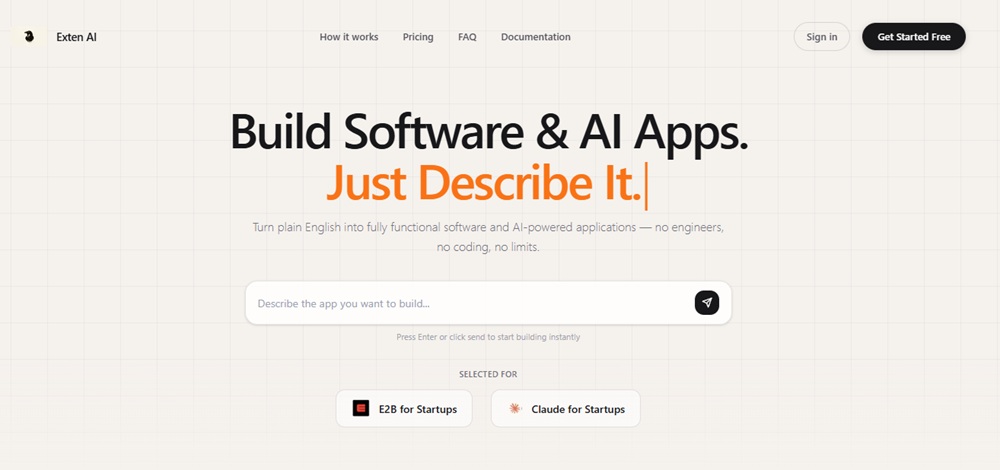
South African startup Exten AI has developed an AI-native platform that lets entrepreneurs with no coding skills build working software applications just by describing them in everyday language.
Launched earlier this year by Luncedo Simelane, Exten AI turns natural-language prompts into production-ready apps. Unlike many “text-to-code” tools, it goes beyond the frontend, providing a robust underlying infrastructure layer for every generated application, and instantly provisioning a full backend that includes an isolated database, file storage, secure user authentication infrastructure, and the runtimes required to host and run autonomous AI agents.
“It is basically a digital tech co-founder to a non-technical entrepreneur with a great software idea, delivering a production-ready stack in under 30 minutes,” Simelane told Disrupt Africa.
Simelane taught himself coding before leaving his LLB studies to focus on software architecture full-time.
“I realised that tech infrastructure gaps were the single biggest bottleneck holding back African innovation,” he said, adding that the key gap in the market is what he calls the “plumbing problem”.
“Global text-to-code platforms primarily serve existing developers to make them code faster, or stop at creating superficial visual frontends,” he said. “Solo builders and small business merchants hit a brick wall because they don’t know how to deploy backend systems, structure relational databases, or handle security authentication. Exten AI solves this exact problem by acting as an automated technical partner.”
On competition, Simelane said: “We sit between global frontend prompt tools, which skip the database entirely, and complex enterprise low-code systems like Microsoft Power Apps, which are far too expensive and rigid for emerging market creators.”
The startup is fully bootstrapped. An early proof of concept was endorsed on Sunday Sessions by Professor Mamokgethi Phakeng, former vice-chancellor of the University of Cape Town, and Exten AI is launching a pilot at the end of September with the University of Fort Hare’s Centre of Entrepreneurship and Rapid Incubator. Student founders there will use the platform to build MVPs for their businesses.
“Demand immediately outpaced our initial server capabilities,” Simelane said. The first public release drew over 100 signups, and Exten AI moved into a closed-cohort testing phase to keep its infrastructure stable. Early users have already launched live apps, including LedgerAI for accounting automation, EduAgent for teachers’ lesson planning, and LuminaAI, a custom communication dashboard.
Exten AI uses a tiered SaaS subscription model.
“While generating and testing apps is frictionless, users pay a predictable monthly subscription once their apps go live to the public,” Simelane said. Pricing scales with server load, database storage, and AI agent usage. “Because we’ve prioritised architecture optimisation during our closed-cohort phase to perfect our user unit economics, early revenues have been minimal.”
Scaling has been the biggest challenge.
“Having dozens of users simultaneously asking an AI engine to map out, provision, and launch complex database schemas live on the cloud caused massive infrastructure queues early on,” Simelane said. “It required weeks of deep-dive architecture rewrites to isolate and stream these automated builds.”
Exten AI is now raising a ZAR1.5 million (US$90,000) investment round to scale its server layers and support thousands of concurrent builds. The startup is currently focused on South African SMEs and solo founders, but plans to expand to tech hubs and university incubators across Sub-Saharan Africa.
“Emerging markets are experiencing a severe software developer shortage alongside an explosion of young entrepreneurs who need localised digital tooling to survive and scale,” Simelane said.