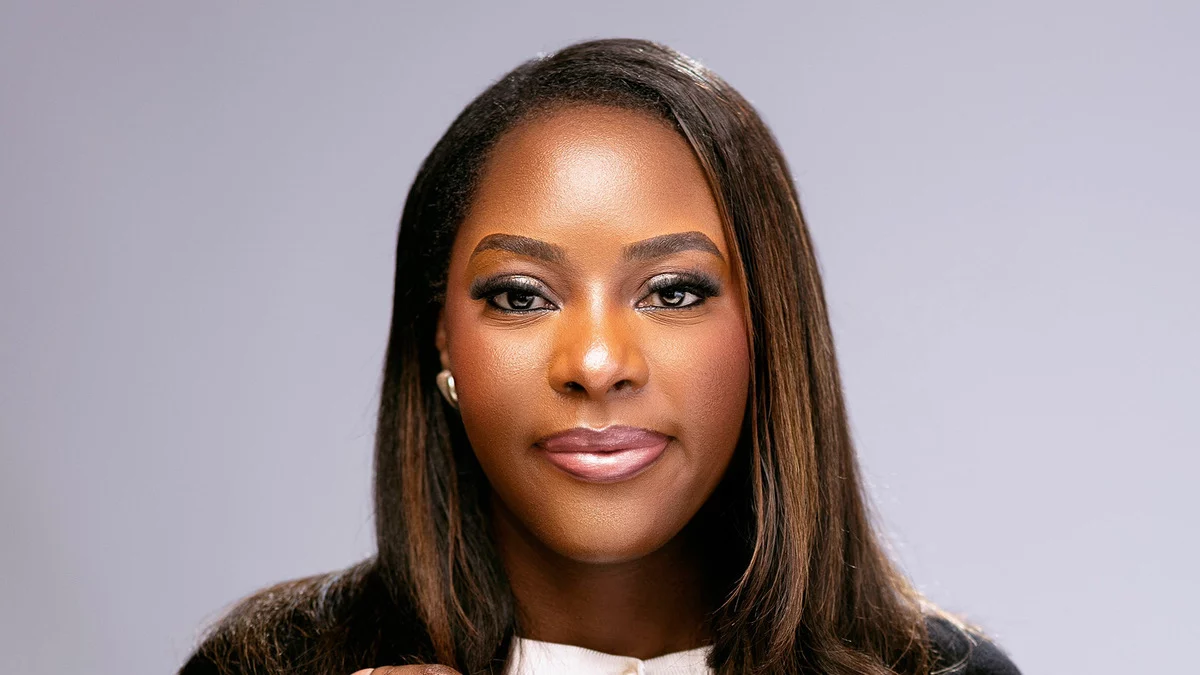
Most investors decide whether to back a startup after a pitch, a handful of meetings and several weeks of due diligence. Victoria Olayide Adesanya, founder of VOA Venture Partners, an Africa-focused venture capital firm, demands something more before writing a cheque: she wants to spend six months working inside the business.
VOA backs startups building the financial infrastructure that moves money into and out of Africa, with a focus on founders from the African diaspora. Adesanya said she bets on the parts of fintech most people never see, pushing back on the idea that African fintech is crowded.
She calls the market young and says financial infrastructure, mostly business-to-business, is full of gaps. Two of VOA’s portfolio companies show what she means. Blockradar lets fintechs offer stablecoin wallets through an API without hiring blockchain engineers. REasy helps small businesses in Francophone Africa pay suppliers in China and Dubai and handle the shipping.
Before starting the firm, Adesanya spent over a decade in finance, including roles at Barclays and Credit Suisse and advisory work for investment banks such as Morgan Stanley. Adesanya spends six months inside a company through VOA Build, a programme the firm has been piloting with a handful of companies this year. VOA works with a startup as an extra go-to-market strategist, with no investment, and the only goal is to grow revenue.
In return, VOA earns a share of the revenue it helps create and a small equity stake that vests over the engagement. Whether VOA’s fund later invests is a separate decision. Adesanya built the programme for a market where early-stage startup funding is hard to find. According to Africa: The Big Deal, the number of African startups raising between $100,000 and $1 million fell 44% in the first half of 2026.
In this conversation, Adesanya explains why she started VOA, how VOA Build works and what founders give up to join it; what six months alongside a team shows that due diligence misses; and why she tells pre-seed founders not to make fundraising their North Star.
This interview has been edited for length and clarity.
You worked at Barclays and Credit Suisse, then ran a startup advisory. Why start VOA, and why this thesis?
When I was at Barclays, I ran an events programme called the Africa Forum. Once a quarter, we brought in about 200 people, some Barclays employees and some clients, to learn about what was happening on the continent. We would pick a topic, such as healthcare or how technology was helping countries leapfrog. This was the early 2010s, when mobile money was just rising, and everyone was saying Africa is the future.
Roughly 15 years later, we are still saying the same things, and it feels like not much has changed.
When we started the fund, we thought about the kinds of startups we wanted to back. But the real question was this: how do we make sure Africa becomes a key player in the global economy? If Africa is where growth will be, how do we speed that up, and how do we keep a piece of that pie?
Most African businesses are small, and most can only sell to customers in their local area. Their counterparts in the West can transact globally. We want to change that, and we want more global businesses to set up on the continent. For both, the most basic thing needed is financial infrastructure.
We looked at the core barriers to capital moving into and out of Africa, and that became our thesis. We use a five-pillar framework: market fragmentation, regulatory and compliance challenges, technology and infrastructure gaps, financial inclusion and the informal economy, and cybersecurity and fraud risk. We invest in financial infrastructure and solutions that make that movement possible.
People on the continent talk a lot about closing the financing gap for small businesses. If we truly want to close it, those businesses need the same opportunities as their global counterparts. Then they can build sustainable companies that stand their ground in the long term, with or without financing.
There is a personal side too. My grandmother was a trader in the 1970s and 1980s. She bought goods in London and Hong Kong and sold them in Nigeria, and the way that kind of business works has not changed much since. We also kept meeting amazing founders who lacked capital. African and African diaspora founders receive less than 2% of global venture funding. It is ridiculous.
Fintech is already the biggest sector in African tech. What do you think about it?
First, a caveat. The African market is young. The biggest companies you can name are 10 to 15 years old, and ventures have been around much longer in the West. Compared with what we see globally, we are scratching the surface.
Second, fintech is a big word. People picture a consumer remittance app and think that is all there is. Financial infrastructure is mostly a B2B play. It covers the things that happen in the background, which many people never think about, and there are many gaps there.
One big example is cybersecurity and fraud risk, one of our pillars. There are not many companies there to begin with, and many of the ones we have seen are consultancies that turned into startups. We are still looking for a big, successful company in that space, and fraud risk keeps increasing.
Everything we look at is a necessity. The internet has made the world global. You can use WhatsApp anywhere, and that should filter into every area of our lives, including how money moves.
Investors also need the best startups to return money to their own backers. How do you plan to stand out to startups?
Capital is scarce for everyone right now, investors and founders alike. Many investors are mostly doing follow-on rounds, and new pre-seed companies are finding it hard to raise. Some people see the continent as risky, and some think fintech is saturated. I do not agree with that, but we wanted a way to get assurance for ourselves and for our investors.
That is why we created a programme called VOA Build. We work hand in hand with a company for about six months. Think of it as having an extra go-to-market strategist on your team. There is no investment during those six months, and the only focus is building sustainable revenue. There are some economics involved, such as revenue partnerships and a small equity stake.
We get to see how the startup really operates, and we help it scale. After six months, if the founders decide they do not need outside funding and want to keep bootstrapping, that is fine with us. We have helped build a sustainable business. If they do want to raise, we can do that too, and now in a de-risked way.
Exits are not really happening, so investors are much more selective about where they put capital. This gives early-stage startups a way to build a relationship with an investor who then backs them for their business. We have piloted it with a few companies, and it has shown us things we would not have seen as a traditional fund basing everything on due diligence.
How many companies have gone through the pilot so far, and how did you choose them?
We have worked with a handful of carefully chosen companies this year. We tend to choose businesses we could see ourselves investing in through the fund.
The company needs to be post-revenue, with real, paying customers, and there needs to be a clear opportunity for our involvement to add value. We also look for founders who are willing to engage openly, share information and put decisions into practice.
How do the economics work for a founder?
The economics reflect the scope of each engagement. Broadly, they combine revenue participation linked to specific commercial opportunities we help create or advance and a small equity stake that vests over the engagement period. Any investment from VOA’s fund is a separate decision.
You said Build showed you things you would have missed in due diligence. What has it taught you?
Three lessons keep coming up.
First, execution matters. A strong product or an attractive market does not mean a team can execute consistently.
Second, behaviour is data, and traditional due diligence gives you little visibility into it. A founding team’s responsiveness, follow-through, priorities and decision-making tell you a great deal about how a business operates. Working alongside founders shows you how they take feedback, make hard choices and turn those choices into action. That gives us a stronger basis for judging whether they can scale.
Third, commercial outcomes matter. A busy pipeline or a list of partnerships can look impressive, but we want to know whether those relationships turn into revenue, usage or other real milestones. Working with founders over a long period gives us a clearer view of that.
Some founders may be wary of giving up equity before any investment comes in. What would you say to them?
That is a fair concern. Founders should think carefully about dilution and should not give up equity without understanding what they get in return.
In our case, the equity vests over the engagement period. We also choose companies carefully, and founders will already have seen how we think through their business and the feedback we give before they decide to work with us.
In the end, founders should weigh that trade-off for themselves.
What happens if another investor wants to back a company while it is still in the programme?
We welcome that. Companies can raise money while they are in VOA Build and keep working with us through the programme. Our purpose is to help founders build sustainable companies, and investment that supports their growth is a good outcome.
That speaks to the wider purpose of VOA Build. Working closely with founders gives us first-hand insight into how they execute, make decisions and respond to problems. By focusing on execution, VOA Build helps a founder’s operating record carry more weight in funding conversations. That can reduce the reliance on trusted networks, which often leave capable founders, particularly African, diaspora and Black founders, outside those conversations.
When there is very little data to go on, which signals matter most to you?
First, I look at the founder’s motivation and the decisions they have made so far. Why this problem? What have they done with the resources available? I am looking for evidence of resilience and sound judgement, especially when things have not gone to plan.
Second, there needs to be real traction. I want evidence that customers value the product. A business whose whole plan for winning customers depends on raising money does not give me that.
Third, I look for depth of understanding: the customer, the market, the product and the alternatives already out there. A founder should be able to explain why customers would choose their product and where competitors are stronger. That tells you a lot about how seriously they have engaged with the problem.
How do Blockradar and REasy, two of your portfolio companies, show what you look for?
They are good examples for the argument that fintech is saturated, because they do such different things.
Blockradar’s angle is that blockchain and stablecoins are becoming necessary to make payments efficient. You can settle in real time with stablecoins, without waiting ages for correspondent banking. But for a fintech or a financial institution to use this technology, it usually has to hire blockchain engineers, and that is expensive. Blockradar removes that complexity. A business can plug into its APIs and get stablecoin wallets and all the features it needs without hiring a blockchain engineer. Everything becomes faster and more affordable.
REasy is very impressive. For now, it focuses mostly on the Francophone African market. It makes payments and logistics simpler for small businesses that trade globally, with China or Dubai, for example. A lot happens behind the scenes in those trades, and if a small business does not get its money on time, the impact is huge. Today’s infrastructure does not really work for very small businesses, so they sort out payments and logistics informally, through a black market that sometimes works and sometimes does not, with delays and inefficiency. REasy brings everything into one digital place, so it is transparent and more affordable. Over time, as more businesses transact on the platform, REasy can use that data to help them get credit or financing.
Both sit in the fintech bucket, and neither solves the problem you would expect a normal fintech to solve. One serves small businesses, starting in Francophone Africa, with plans to cover most of Africa and other emerging markets. The other helps fintechs avoid the complexity of blockchain. They are completely different businesses in the same sector. My point is that there is so much opportunity. I challenge everyone to think more deeply about fintech, and financial infrastructure in particular, because there are so many inefficiencies.
You called cybersecurity and fraud a big white space. What would a company you would back there look like?
We are still looking, but we have a clear sense of what we want to see: deep domain expertise, a strong understanding of fraud risk and cybersecurity across several African markets, and the local knowledge and networks to support that.
The challenge is that the problem is so broad that startups in this space can end up offering many different products and custom services. That can push a business towards a consultancy model and make it harder to scale. Still, we are hopeful that AI can help companies build more focused products that scale.
What data or experience shaped your thesis?
Our thesis is not based on any one book or report. We spent one to two years researching the core barriers to capital moving into and out of Africa. The data is fragmented and spread across many places. We narrowed it down to the five pillars.
Our Bridging Borders with Africa series, on our website, takes each pillar and explains what the problem is and why it matters. Each article draws on 20 to 30 data points. The problem is complex and systemic. When we work on regulatory solutions or cybersecurity, that is not technically a fintech issue. We are looking at the whole system.
What advice would you give a pre-seed fintech founder who is raising right now?
The name of the game is staying in the game. Do not make raising money your north star. Focus on understanding your market and customers deeply, building something they value, and finding creative ways to make progress with the resources you have. That work can strengthen your case for funding even if the money arrives later than expected, and the experience will always be valuable. For fintech in particular, that foundation also means understanding your regulatory requirements, how you manage risk and the economics of serving your customers. You should be able to explain these clearly to investors, alongside your growth.
Also, build genuine relationships with investors instead of only reaching out when you need funding. We can tell. Where an investor offers thoughtful feedback, consider it, act where it makes sense, and keep them posted on your progress and what you have learned. A regular investor update is a simple way to keep that relationship going and help them see how your business is developing.
And remember that venture capital is one path among several, which may sound unusual coming from a VC. Depending on the business, grants or suitable debt may be a better fit. We keep relationships across those sources because our wider goal is to help build sustainable businesses and ecosystems.
True scale demands moving beyond surface-level integrations to robust execution. We’ve filtered the noise out of Moonshot 2026, optimising the conference strictly for high-calibre connections between startup founders, global financial operators, enterprise leaders and individuals rewiring Africa’s technical frameworks. Get 20% off Early Bird tickets for a limited time.