




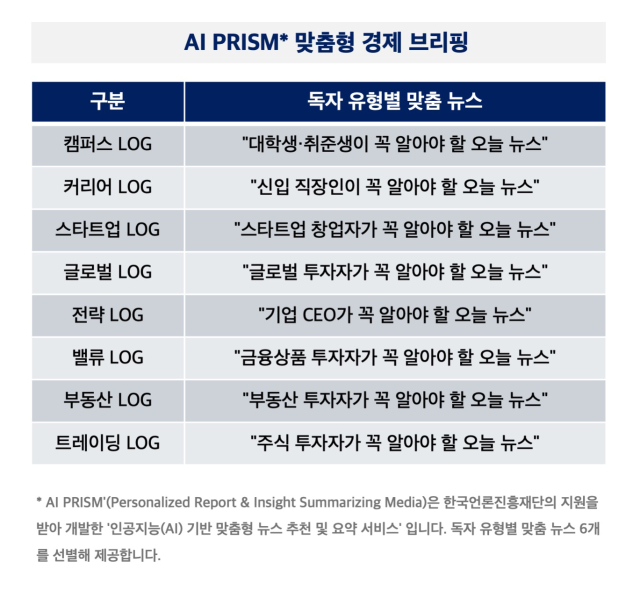
▲ AI PRISM* Personalized Economic Briefing
* Editor’s note: AI PRISM (Personalized Report & Insight Summarizing Media) is an artificial intelligence-based personalized news recommendation and summarization service developed with support from the Korea Press Foundation. It selects and provides six news items tailored to each reader type.
■ K-Medical AI Heads to Mongolia: Korean medical artificial intelligence startups are building proof-of-concept cases in Mongolia, drawn by the country’s weak medical and telecommunications infrastructure and heavy disease burden. With the two governments strengthening cooperation on AI, bio and healthcare this year, an institutional foothold has been laid for the local expansion that the private sector had pioneered on its own.
■ AI Wet Labs: AI developers are increasingly setting up their own wet labs equipped with chemical experiment facilities, both in Korea and abroad. The trend reflects efforts to prove in real-world settings the hypotheses that AI has identified in theory, and is also intended to secure academic intellectual property rights ahead of rivals.
■ Overseas VCs Visit Korea: U.S.-based venture capital firms are coming to Korea’s largest robotics exhibition to sit down with physical AI companies. The move reflects the overlapping interests of foreign capital searching for investment targets in manufacturing-based Korea and domestic companies seeking to go global.
[News of Interest to Startup Founders]
1. Tested in Extreme Conditions on Grasslands and Deserts: Korean Medical AI Bets on Mongolia
– Key summary: Korean medical AI startups are accelerating their push into the Mongolian market. Talos, a company specializing in AI-based prediction of cerebrovascular disease, is in talks with Mongolia’s Third State Central Hospital over adopting its AnRisk solution, and is expanding its local customer base after signing an exclusive supply contract with MG Hospital in May last year. Aidot is also running proof-of-concept tests of an on-device version of its cervical cancer screening AI, Cervirai AI, with more than five public and private hospitals in Mongolia, while MediIntech is securing local use cases for its motorized endoscope, Intion S. As of 2024, Mongolia’s mortality rates per 100,000 people were 312 for cardiovascular disease and 171 for cancer, roughly 1.5 to 2 times the global average. Expectations are also rising that the barrier to entering the public healthcare market will be lowered after the Ministry of Health and Welfare revised a memorandum of understanding on healthcare cooperation in July, the first revision in 15 years.
2. Proving Hypotheses Found by AI: Startups Build ‘Wet Labs’
– Key summary: Asteromorph, a superintelligence development startup, has opened its own wet lab inside a biotech research complex in Hwaseong, Gyeonggi Province. It is the first startup founded as an AI developer in Korea to set up a wet lab, with about 10 researchers currently assigned and plans to recruit additional staff with master’s and doctoral degrees. Overseas, Anthropic established a life sciences research organization in the first half of this year and set up a wet lab in the San Francisco Bay Area, where it discovered a new enzyme system, while Google DeepMind announced plans in December last year to build a laboratory in the U.K. for analyzing and synthesizing new materials. “In experimental science, the value of AI is only proven when a hypothesis is demonstrated in a real-world environment,” said Lee Min-hyung, CEO of Asteromorph.
3. Silicon Valley Heavyweights Visit Korea to Meet Physical AI Firms
– Key summary: Officials from U.S.-based venture capital firms including Mitsui Global Investment, E12 Ventures, Good Growth Capital, Slater Technology Fund and Silicon Foundry will attend Robot World 2026, held in Ilsan from the 4th to the 6th of next month. It is the first year that overseas VCs are attending the exhibition, hosted by the Korea Association of AI and Robot Industry, and they plan to examine investment potential and business partnerships with domestic companies that hold industrial field data and robot software technology. Also under discussion are the use of global networks through Mitsui & Co. affiliates and the possibility of pursuing proof-of-concept projects with global companies through Silicon Foundry, a venture advisory firm. Holiday Robotics raised 155 billion won in July this year, the largest single investment round for a domestic humanoid specialist. Still, the gap in fundraising scale remains stark compared with U.S.-based Apptronik, which secured $415 million in its Series A last year and $520 million in February this year.
[Reference News for Startup Founders]
4. [Global Hot Stock] AI Agents Spread: Palo Alto Grows Fast on Security Demand
– Key summary: Palo Alto Networks cited the spread of AI agents, more sophisticated vulnerability exploitation and the proliferation of open models as the three major shifts in the cybersecurity market. Results for the fourth quarter of fiscal 2026 (May to July) beat market expectations, while remaining performance obligations, or contract value to be recognized as future revenue, and next-generation security annual recurring revenue hit record highs of $21.2 billion and $9.1 billion, respectively. Its AI-dedicated security product Prisma AIRS surpassed $100 million in ARR just four quarters after launch, with its customer count rising 2.7-fold to 800 from 300 in the previous quarter. ARR at Chronosphere, which Palo Alto acquired, has grown to more than $500 million from $85 million at the time of the acquisition, and the business integration with identity security firm CyberArk is proceeding three to six months ahead of the original plan.
5. Beyond Live Shopping to ‘Creator Commerce’: CJ ONSTYLE Redraws Growth Strategy
– Key summary: CJ ONSTYLE is moving to significantly expand its creator commerce business, which channels creators’ fandoms into purchases. Sung Dong-hoon, head of the platform division at the commerce unit of CJ ENM (035760), said at a media day on the 22nd that the company will raise creator commerce’s share of mobile content commerce transaction volume to 50% by 2030 from 9% last year, and will cultivate 100,000 commerce-focused creators. Last month the company unveiled ONTNER, a business platform that supports everything from product matching to content production, sales, settlement, delivery and customer service, and uses its own AI to analyze creators’ social network service content and follower characteristics to match them with products. The shift targets the move in online shopping from search-driven, purpose-oriented buying toward discovery through content.
6. Goldman Sachs Surveys 225 Global LPs: 84% Say They Will Increase or Maintain Commitments [Signal]
– Key summary: A survey of 225 major limited partners worldwide conducted from June to August by Goldman Sachs’ alternative investment business found that 84% plan to maintain or expand their commitments next year. Of the respondents, 37% said they would increase deployment and 47% said they would keep it at a similar level, while only 11% said they would scale back. LPs pointed to geopolitical tensions as the biggest investment risk for the third consecutive year, and 28% included job displacement from technological advances among their top five risks. LPs cited reduced liquidity from longer exit timelines as the factor constraining larger commitments. By asset class, respondents said investment opportunities had improved from a year earlier in infrastructure (43%) and secondaries (44%), while more than 35% held a negative outlook on private credit.
Source link