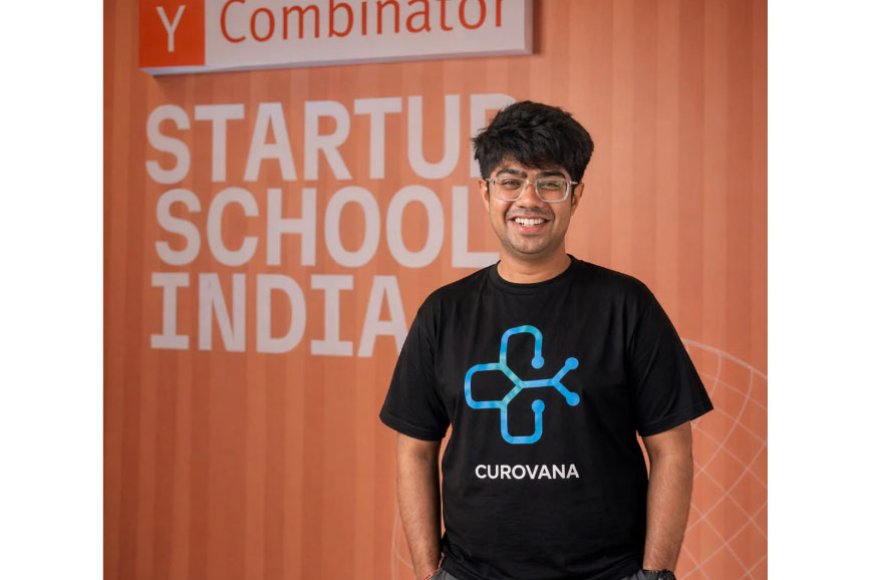
Faridabad (Haryana) [India]: Medical students spend years studying diseases, medicines and clinical procedures, but one part of becoming a doctor is difficult to replicate inside a classroom: making decisions with a real patient in front of you.
That question led Dr. Mihir Sharma, a junior doctor and entrepreneur, to build Curovana, a medical simulation platform that allows students and doctors to practise clinical cases using virtual AI patients before they encounter similar situations in real life.
The idea came from Mihir’s own experience as a medical student. While learning medicine, he felt there was a missing layer between studying a condition in textbooks and actually managing a patient. Doctors are expected to learn by seeing cases, taking histories, ordering investigations and making treatment decisions, but mistakes in real clinical settings can carry consequences.
Mihir began working on a different approach.
Instead of practising only through case discussions or theoretical questions, Curovana lets users interact with virtual patients. They can speak to an AI patient, take a history, order tests, prescribe medicines and observe how the patient responds to their decisions.
The underlying idea is similar to the role flight simulators play in aviation. Pilots can practise handling difficult situations repeatedly in a controlled environment before doing so in an aircraft. Curovana is being developed around a similar concept for clinical training.
The company was established in September 2025, when Mihir was still a medical student. Rather than starting with a large technical team, he coded the application himself and began building the product around problems he had personally experienced during his medical education.
Building a Virtual Patient
What differentiates Curovana from a conventional medical quiz or case-study application is the attempt to make its virtual patients behave more like patients.
The company has modelled aspects of physiology, pharmacodynamics and pharmacokinetics within the simulation. The AI patients can express emotions, cough, respond to different actions and react to the decisions made by the person interacting with them.
That means a learner is not simply being asked to select the right answer from a list. They have to work through a case and decide what they want to do next.
A student may begin by asking questions, move on to ordering investigations and then decide whether medication is appropriate. The consequences of those decisions become part of the learning process.
And importantly, the environment allows mistakes.
For Mihir, that is central to the reason Curovana exists. Medical students and doctors need opportunities to make decisions, understand what went wrong and try again without putting an actual patient at risk.
The platform is currently available as a free application, with Mihir describing the initiative as an effort focused on public good and wider access to clinical learning.
A Startup Built From a Medical Student’s Experience
Curovana is also a reflection of Mihir’s own path. He began developing the application while studying medicine, combining his medical education with an interest in building technology.
This is not his first experience of working on technology for a wider social purpose. He has previously volunteered to build an application for a government initiative, giving him an early opportunity to work on technology outside the conventional classroom setting.
His work on Curovana has since received recognition through Y Combinator’s Startup School India, where he was selected among builders, founders and engineers from across the country. The startup has also received more than US$25,000 worth of credits, which can help early-stage founders access the technology and infrastructure needed to continue building.
For Mihir, however, the larger objective remains connected to the problem that first inspired the product.
Medical education requires both knowledge and judgement. Reading about a disease is different from deciding which questions to ask, which investigation to order or what treatment to consider when information is incomplete. Those are skills that generally become stronger through experience.
Curovana is attempting to create another place where that experience can begin.
The platform is being made available to medical students and doctors, while the broader audience for the initiative includes hospitals, medical colleges and others interested in the future of clinical education.
As AI becomes increasingly capable of simulating conversations and complex scenarios, its use in medical training could extend beyond answering questions. For Curovana, the opportunity lies in using that technology to create a space where healthcare professionals can practise decision-making before those decisions have real-world consequences.
For a junior doctor who started coding his own product as a medical student, that remains the central idea behind Curovana: giving doctors a safe place to learn from their mistakes before a real patient is sitting across from them.


