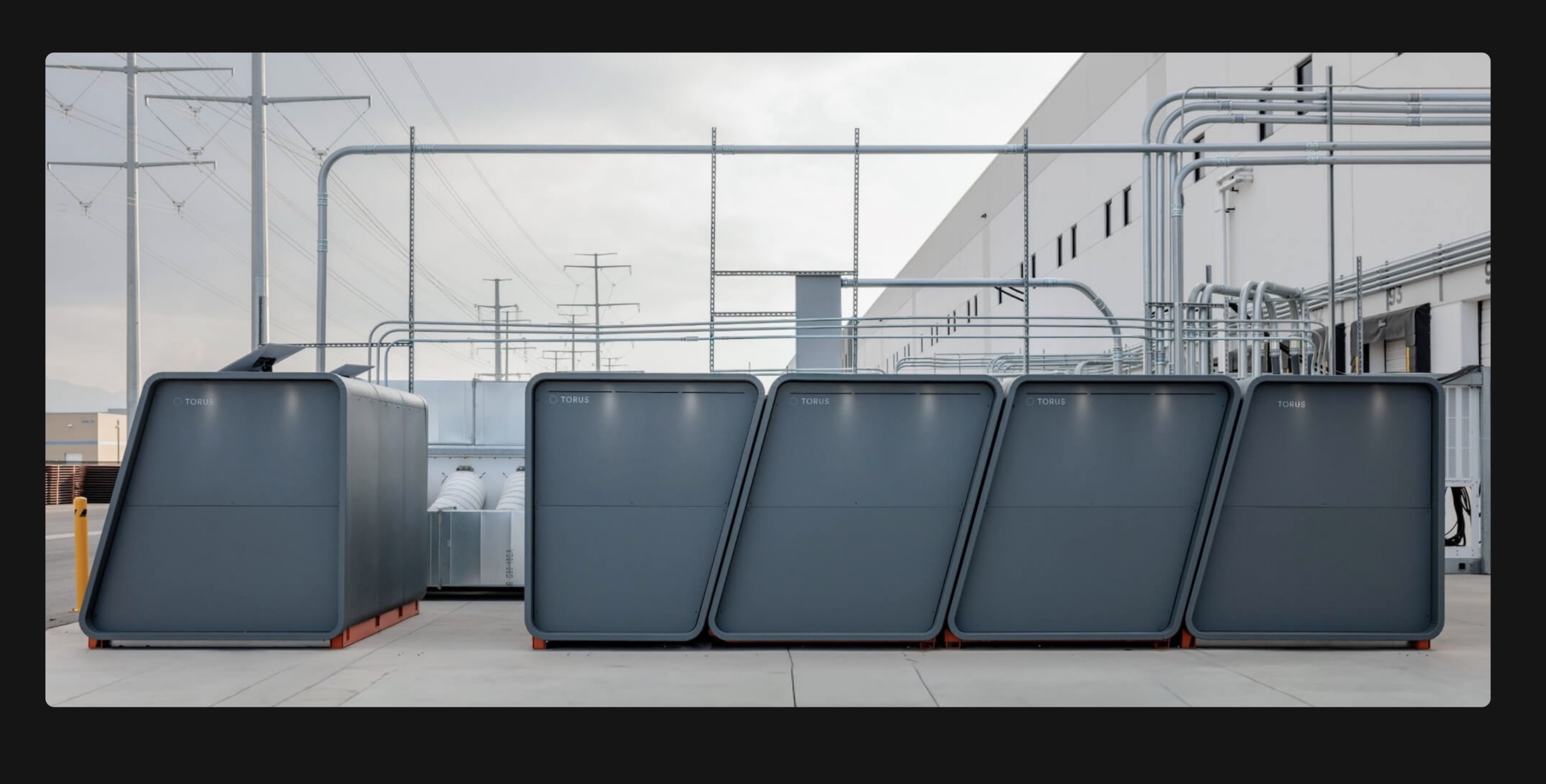
Utah startup Torus on Wednesday raised $500 million in growth capital led by Magnetar and launched Torus Foundry, a line of prefabricated AI inference units that the company says can go from contract to running AI workloads in 12 to 16 weeks. Four other investors joined the round.
Each Foundry site delivers 1 to 20 megawatts of capacity and requires no building construction, according to Torus. The company says the smallest system is roughly the size of a small cargo van, with site preparation taking about a week and installation and commissioning taking one to two days. Torus pairs each unit with its Torus Reserve grid-support system, which it describes as load shaping that ramps in milliseconds.
How Foundry Skips the Grid Queue
Torus CEO Nate Walkingshaw said in the announcement: “Most providers are bringing power to the chips. Foundry brings the chips to power.” In a company blog post, Walkingshaw wrote: “The grid isn’t out of power. It’s congested.” Torus says Foundry runs on power a site already has instead of waiting for new grid infrastructure.
Storage Built Into the Unit
Torus says each Foundry unit integrates an inertial flywheel and battery storage. The company’s separate Spin flywheel product is rated for 25,000 cycles with no capacity degradation, and its specification page lists a six-minute full-discharge design target and response in milliseconds. Torus has not said that Foundry units use that specific product.
Why Power Is the Constraint
Developers are looking for ways around utility waits. A Cleanview tracker counted 46 behind-the-meter data centers planning 56 gigawatts of their own power generation, according to reporting by the American Public Power Association, which put that at roughly 30% of planned U.S. data center capacity.
Regulators are also moving. The Federal Energy Regulatory Commission (FERC) on Dec. 18, 2025, directed PJM to create three new transmission services for co-located loads, according to law firm Mintz. PJM Interconnection is a regional grid operator.
Waits remain long. Marsden Hanna, Google’s global head of sustainability and climate policy, said in January that one utility quoted 12 years to study an interconnection timeline. RMI found the time from application to commercial operation for new generation in PJM exceeded eight years in 2025. That figure covers power plants, not data center loads.
Water, Customers and the Factory
Torus describes Foundry’s closed-loop cooling as waterless, using 95% less water than evaporative coolers. Lawrence Berkeley National Laboratory estimated 17 billion gallons of direct water use by U.S. data centers in 2023, according to Latitude Media.
Hydra Host is a first customer, alongside an unnamed AI cloud provider. Foundry ships in three delivery models: a powered shell without GPUs, a turnkey bare-metal unit with GPUs, and single-tenant inference capacity for enterprises. Torus plans more than 47,000 GPUs in Foundry units by the end of 2027, which is a company target.
Magnetar’s relationship with Torus predates the round. Magnetar invested $200 million in September 2025, when Magnetar’s Neil Tiwari was announced as joining Torus’s board. Magnetar also took part in Hydra Host’s $100 million Series A in June, so the lead investor backs both a Foundry customer and the vendor.
Torus says a dedicated Foundry line at its GigaOne factory in Salt Lake City will produce 500 megawatts of IT load, with plans to expand to 1 gigawatt. The 545,000-square-foot plant came online around January 2026, according to a July report.
Rivals Chase the Same Gap
Torus is not alone in modular AI capacity. Crusoe raised $3.9 billion in a Series F at a $30.9 billion valuation, and TechCrunch reports it builds truck-transportable Spark modular units. Runware’s one-megawatt container pod, the company says, fits in a 20-foot shipping container with closed-loop, water-free cooling.
Most performance figures, including the 12-to-16-week timeline and the water claim, come from Torus rather than independent testing.
Frequently Asked Questions
What is a prefab AI data center?
A prefab AI data center is a factory-built module that packages power equipment, cooling, networking and GPU racks so it can be shipped to a site and switched on without constructing a building. Torus Foundry is one example, with sites of 1 to 20 megawatts.
What is Torus Foundry?
Torus Foundry is a line of prefabricated AI inference units launched by Utah startup Torus. The company says each system runs on power a site already has and goes from contract to running AI workloads in 12 to 16 weeks.
Who led Torus’s $500 million round?
Magnetar led the $500 million growth round. Four other investors also participated, according to Torus.
How fast can Torus Foundry be deployed?
Torus says 12 to 16 weeks from contract to running workloads, with about one week of site preparation and one to two days of installation for its smallest system. Those are company figures.
What does behind-the-meter mean for data centers?
Behind-the-meter means a data center generates or manages power on the customer’s side of the utility meter instead of drawing everything from the grid. Cleanview counted 46 such data centers planning 56 gigawatts of their own generation.
