Taiwan’s strengths in semiconductors, precision manufacturing, and electronics are attracting a growing number of international space technology startups seeking manufacturing partners, research collaborators, and access to Asian markets.
For some of these companies, Taiwan is evolving from a potential sourcing destination into a strategic base for long-term business development.
In 2026, TAcc+ welcomed 13 international space technology startups through its International SpaceTech Startup Supporting Program, now in its fourth year. Organized by the Small and Medium Enterprise and Startup Administration (SMESA) under the Ministry of Economic Affairs (MOEA), and designed and implemented by the Industrial Technology Research Institute (ITRI), the initiative aims to connect international innovators with Taiwan’s industrial capabilities and facilitate cross-border collaboration.
Since its launch in 2023, the program has attracted 42 international space startups to Taiwan and facilitated 37 memoranda of understanding (MOUs) with Taiwanese space industry companies by the end of 2025. Two participating startups had also established local branches to develop business networks and pursue cross-border industrial partnerships.
According to SMESA, Taiwan’s established strengths in semiconductors, information and communications technology (ICT), precision machinery, and metal processing provide the technological and manufacturing foundation needed to expand its role in the global space industry. By bringing international startups with specialized technologies and global market experience to Taiwan, the initiative also seeks to help domestic manufacturers better understand international market requirements, identify opportunities for joint development, and secure overseas orders.
Expanding Taiwan’s international space technology network
This year’s program broadened both its geographic reach and technological scope, attracting 13 startups from countries including the United States, France, Denmark, Singapore, India, Japan, and Australia.
The participating companies represented diverse fields, including satellite manufacturing, remote sensing, satellite communications, edge AI computing, and emerging space applications. For the first time, the program also incorporated unmanned aerial vehicle (UAV) systems and applications, creating additional opportunities for cross-industry collaboration.
From October 13 to November 10, representatives of the 13 startups took part in an intensive program of training sessions, industry visits, business matchmaking, and international exhibitions in Taiwan.
The program introduced participants to Taiwan’s industrial ecosystem, supply chain capabilities, business environment, and resources for establishing local operations. It also facilitated connections with the Taiwan Space Agency (TASA), industry associations, research institutions, established technology companies, and startup communities.
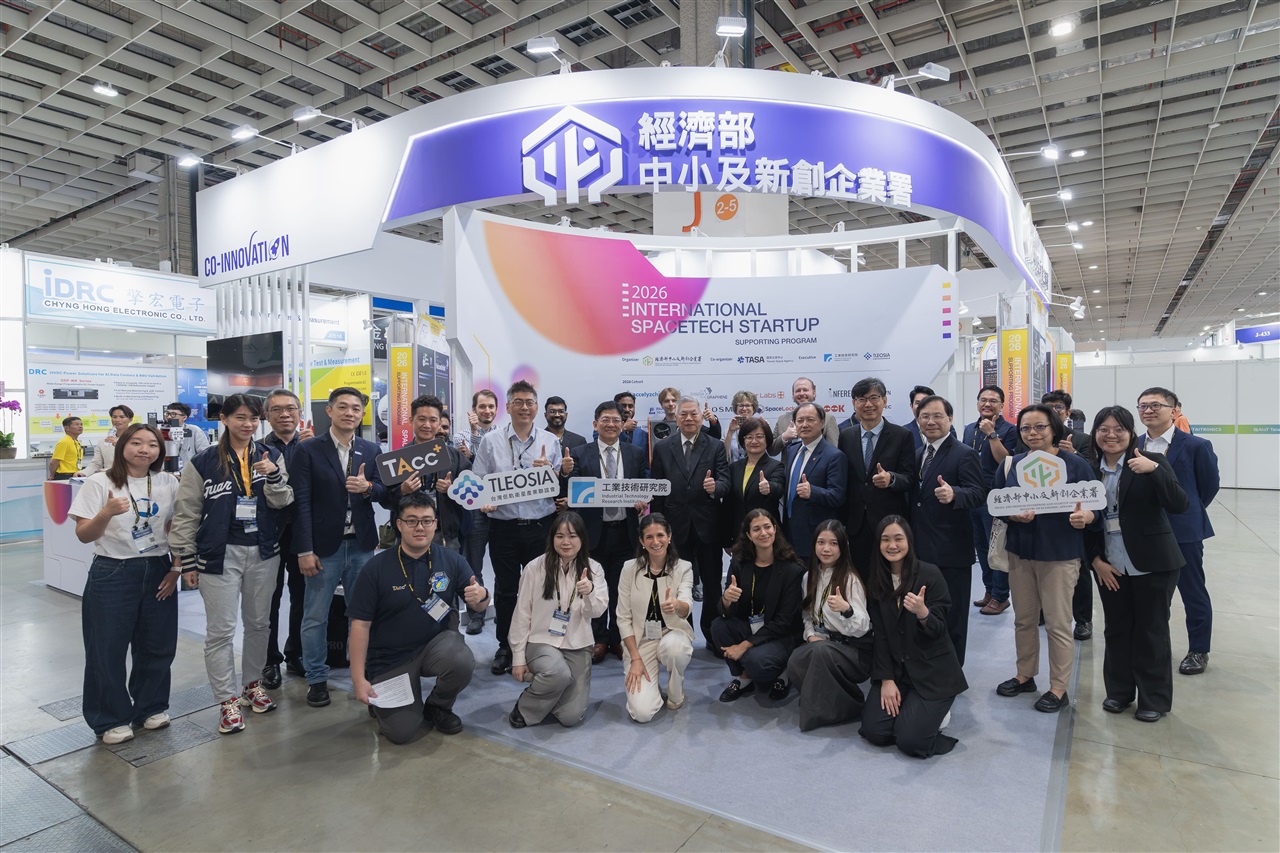
Industry partners included Foxconn, Compal Electronics, and Syscom Group, among others. Participants also had opportunities to attend the Taipei International Electronics Show (TAITRONICS), the Taiwan International AIoT Show, and the Taiwan International Assembly of Space Science, Technology, and Industry (TASTI).
Together, these activities provided platforms for Taiwanese companies and international startups to showcase their technologies, identify complementary capabilities, and explore potential business partnerships.
Beyond these organized activities, interviews with four participating startups revealed how the program helped them uncover opportunities that extended well beyond their original expectations.
ULOOK: Building a Taiwanese satellite supply chain
Founded in Bengaluru, India, in 2024, ULOOK develops radio-frequency (RF) sensing satellites that provide persistent RF intelligence from orbit. Its satellites detect, geolocate and identify emitters such as ships and drones across the air, land, maritime and space domains.
Unlike conventional imaging satellites, ULOOK’s satellites detect and analyze RF signals. This supports both defense and civilian applications, including maritime monitoring.
Co-founder and CEO Siddhesh Naik said the program helped ULOOK identify Taiwanese manufacturers of RF components and satellite subsystems. That opens up opportunities to diversify the supply chain.
The company has already signed two MOUs with Taiwanese companies and is pursuing additional nondisclosure agreements as discussions progress. Naik said Taiwan’s extensive network of small and medium-sized manufacturers was particularly impressive.
Beyond RF components, ULOOK identified potential suppliers for attitude determination and control systems, electrical power systems, and onboard computers for small satellites.
The company also uncovered an unexpected business opportunity: giving Taiwanese component manufacturers access to space.
As ULOOK prepares to launch its satellites next year, it could host Taiwanese components aboard its spacecraft, giving the manufacturers an opportunity to gain flight heritage and demonstrate their technologies in orbit.
ULOOK is also bringing the same RF-sensing technology to airborne platforms. This year the program included UAV systems for the first time, and the company is offering its RF-sensing payloads for integration & testing on aerial platforms.
Danish Graphene: From distribution to potential local manufacturing
Danish Graphene, a spinout from Aarhus University in Denmark, develops graphene materials and thermal management solutions for space hardware and other advanced applications.
Its technology uses graphene’s exceptional thermal conductivity to improve heat dissipation in electronic systems, including chips, optical devices, lasers, and RF components.
Thermal management is particularly challenging in space, where electronic equipment must operate in a vacuum while increasingly powerful computing systems generate additional heat.
Founder and Chief Commercial Officer Andreas Laursen said the company initially joined TAcc+ to identify potential partners and gain access to Taiwan’s electronics and component manufacturing industries. The accelerator proved especially valuable in helping the company overcome the challenges of identifying suitable business contacts from Denmark.
The company also signed an MOU with Yttek Technology Corp to explore integrating its graphene thermal management materials into satellite communication payloads.
During its stay in Taiwan, Danish Graphene entered discussions with two prospective local distributors, with agreements expected to follow. These distribution partnerships could provide the foundation for a broader local presence.
Having recently completed its Series A fundraising, the company is expanding production capacity in Denmark and aims to demonstrate commercial-scale manufacturing before pursuing overseas production. Taiwan has emerged as a priority destination for that expansion.
Laursen said the company hopes to establish a local office and potentially begin production in Taiwan next year. It is also exploring joint ventures with Taiwanese partners that could help finance, operate, and scale local manufacturing facilities.
Because Danish Graphene’s production technology is modular, the company could begin with a relatively small manufacturing system before expanding capacity.
Laursen rated the accelerator eight or nine out of 10, praising its structured approach, targeted introductions, and the openness of Taiwanese companies to discussing potential collaboration. He said the relationships established through TAcc+ would make future expansion considerably easier.
Drover Labs: NASA robotics expertise meets Taiwan’s industrial ecosystem
US startup Drover Labs was founded by former NASA robotics engineers who previously developed robotic systems for lunar exploration and other demanding space applications.
Drawing on that experience, the company is developing hybrid flying and driving robots designed to inspect hazardous or difficult-to-access industrial environments.
Its robotic systems combine advanced sensors, computer vision, and LiDAR technology to capture three-dimensional spatial data and generate digital twins of infrastructure. Drover Labs describes the robot as only half of its product. The other half is spatial intelligence software that turns the captured data into a navigable three-dimensional digital twin, giving engineers a way to examine and measure an asset without physically entering it. Potential applications include pipelines, underground tunnels, underground utility pits in large buildings, bridges, power generation facilities, manufacturing plants, and semiconductor fabs.
Through TAcc+, Drover Labs gained introductions to Taiwanese component suppliers, precision engineering partners, and prospective customers. The company sees Taiwan as a potential long-term manufacturing partner, not simply as a source of components but also as a collaborator in developing customized mechanical and electronic systems.
During the program, Drover Labs signed production cooperation MOUs with two Taiwanese companies, Unidar Technologies, to develop customized optical modules and evaluate production in Taiwan, and Let’s Com, to provide SMT/PCBA assembly in preparation for commercial-scale production.
One particularly promising opportunity emerged through introductions to Taiwan Power Company. Drover Labs is exploring potential applications for its robots in nuclear power facilities, where three-dimensional mapping and radiation data could help engineers assess conditions and reduce the risks associated with human inspections.
The company also sees opportunities in semiconductor manufacturing, where automated monitoring and inspection could help maintain equipment reliability while reducing the need for personnel to enter sensitive production environments.
Drover Labs is developing hybrid flying and driving robots for industrial inspection and working with prospective partners to define initial evaluations. Commercial deployment timing will depend on technical validation and customer requirements. Beyond Taiwan, the company is in early discussions with a major Japanese construction company about inspecting underground utility spaces. Over the longer term, it envisions fleets of autonomous robots continuously monitoring industrial facilities and generating data for predictive maintenance.
For Drover Labs, Taiwan offers both manufacturing expertise and potential customers in industries that could benefit from its inspection technologies.
Emergentia: Discovering investment and R&D opportunities
US-Australian deep-tech startup Emergentia is developing an energy-efficient analog AI processor that embeds neural networks directly into hardware.
Unlike conventional AI processors that execute software-based neural networks, Emergentia’s technology processes signals at the sensor level, potentially reducing energy consumption by orders of magnitude.
The technology targets edge intelligence applications, where devices must process information efficiently without relying heavily on cloud computing. Potential applications include satellite data processing, early wildfire detection, and electric vehicle battery management.
For space applications, the company is working on technology that could process hyperspectral imaging data aboard satellites, reducing the volume of information that must be transmitted to ground stations. This could enable faster identification of thermal anomalies associated with wildfires and other events.
Co-founder and Chief Technology Officer Zdenka Kuncic said Emergentia initially joined TAcc+ primarily to find semiconductor manufacturing partners and suppliers capable of producing chips and demonstration boards. However, the program revealed a much broader range of opportunities.
In addition to identifying manufacturing resources, Emergentia discovered potential research collaboration opportunities with ITRI, possibilities for joint development, and prospective Taiwanese investors.
Founded in 2022, the company remains bootstrapped and is preparing its first seed funding round to expand its engineering team and accelerate product development. Kuncic said discussions with Taiwanese investors raised the possibility of assembling a local investment syndicate to participate in the fundraising round.
The company’s management is also exploring the establishment of a Taiwanese entity to pursue the opportunities identified during the accelerator. Kuncic rated the experience 11 out of 10, saying it had exceeded her already high expectations.
Beyond matchmaking: Taiwan as a long-term business partner
The experiences of the four startups reveal a common pattern. While many initially came to Taiwan seeking suppliers or manufacturing partners, they discovered additional opportunities involving technology co-development, access to customers, research collaboration, investment, and local business establishment.
For Ulook, Taiwan offers opportunities to diversify satellite component sourcing while developing new services for local manufacturers. For Danish Graphene, it could become a future manufacturing base serving the electronics and space industries. For Drover Labs, Taiwan combines precision engineering capabilities with prospective industrial customers. For Emergentia, the accelerator opened doors to research partnerships, potential investment, and the possibility of establishing local operations.
These developments also illustrate how Taiwan’s existing industrial capabilities could support its ambitions in the global space economy.
Rather than building an entirely new industrial ecosystem from scratch, Taiwan can leverage its established strengths in semiconductors, electronics, precision manufacturing, and system integration to support emerging space applications.
SMESA emphasized that bringing international space startups to Taiwan is intended not only to encourage technological exchange but also to help Taiwanese companies expand into international markets.
Going forward, the administration plans to strengthen connections among domestic and international industry, academic, and research institutions, while providing additional support for startup establishment and industrial matchmaking.
By linking international innovation with Taiwan’s manufacturing and engineering capabilities, the initiative aims to create more opportunities for Taiwanese companies in space and UAV applications and gradually strengthen the country’s position in the global space industry supply chain.
For the participating startups, the most significant outcome may be that Taiwan is no longer simply a destination for sourcing components. It is increasingly becoming a place where they can develop technologies, build partnerships, attract investment, and potentially establish a lasting business presence.
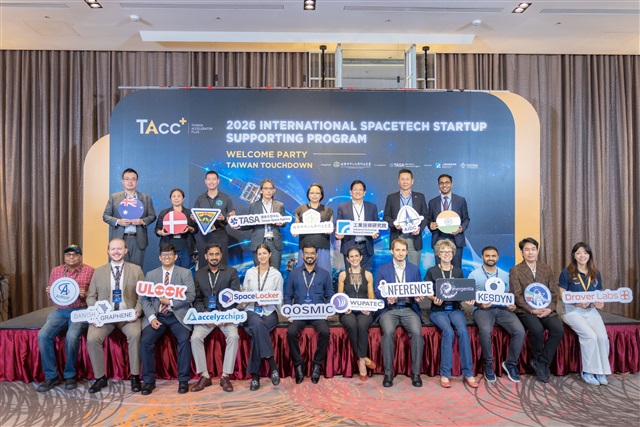
Oct.13 – International SpaceTech Startup Supporting Program Welcome Party. Credit: TAcc+
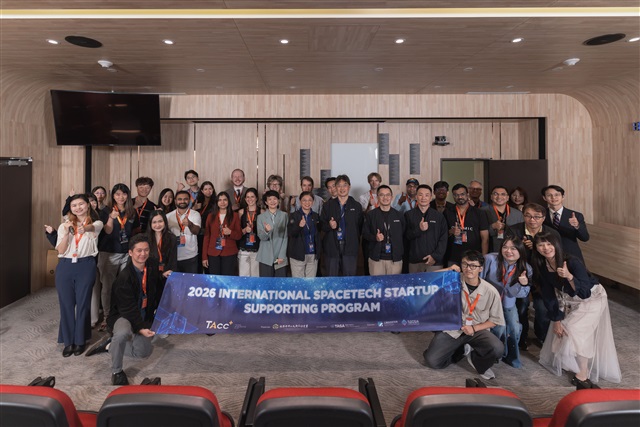
Oct. 30 – Taiwan Space Agency (TASA) visit. Deputy DG Vicky Chu (TASA) is pictured at the center. Credit: TAcc+
Source link