-
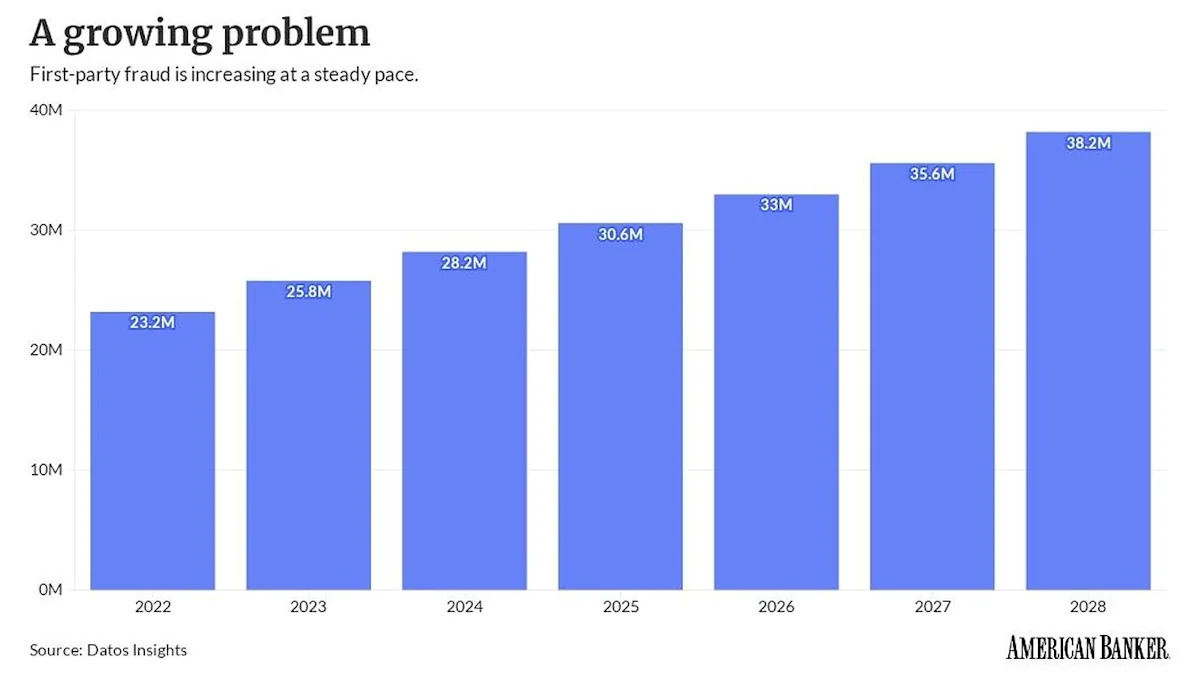
Key insight: It’s extremely difficult to scale fraud controls at the same rate as customer growth. But the fintechs that fail to do it are leaving themselves vulnerable to the kind of attacks that can prove fatal to a young company.
-
Forward look: The future belongs to fintech firms that make sure to develop their fraud controls alongside their growth.
When fintech founders craft their pitch decks, they invariably include charts with lines soaring from the bottom left to the top right. Those charts can be about almost anything — revenue, customers, transactions, volumes.
Yet there’s an item that, despite its potential for explosive growth, rarely makes it in the deck: exposure to fraud.
A startup can go from a hundred customers to tens of thousands at incredible speed. Too fast, sometimes, for its fraud controls to keep up, if there are any at all. That’s dangerous, because new transactions and new payment methods create new potential vulnerabilities — and this has been recently exacerbated with an onslaught of AI capabilities. Put differently, sudden growth makes a startup more fragile, and all it takes is a single, massive attack to kill it for good.
So, while Silicon Valley has taught us to celebrate unbelievable growth and slick interfaces, fintech firms are actually more likely to live or die depending on the fraud they manage to prevent and control. In the age of AI, anti-fraud infrastructure is becoming a proper moat, because new features can be coded relatively easily, but it’s almost impossible to replicate years of fraud data and operational expertise on the topic.
Doubling your customer base doesn’t mean simply doubling your fraud exposure. It’s not quite so linear. New customers come with new accounts, new devices, new counterparties and new behavioral patterns to monitor. Fraudsters only need to pinpoint a single weakness in that sprawling network. Most of the time, they find it because the company is still relying on controls designed when it was a much smaller business.
Product expansion compounds that problem. It’s increasingly common for fintech firms to support a variety of payment methods at once (debit cards, ACH, stablecoins, wire transfers) within their app. Yes, it all looks like a unified system from the outside, but these are actually a half dozen different rails with their own unique vulnerabilities internally, not to mention the additional vulnerabilities introduced with each new vendor integration.
Small businesses can investigate suspicious transactions manually and learn from individual incidents, and improve fraud controls along the way. But as soon as the company scales up, that becomes impossible. A robust system is needed.
If a fintech company is growing faster than its ability to investigate incidents, understand them and categorize them, then its institutional learning process is deficient. Its fraud controls will actually get weaker with time because it’ll lack the discipline to properly analyze what’s going on under the hood.
I already mentioned this, but fraud isn’t linear. In the age of AI, a malicious actor can discover a vulnerability and exploit it with an army of automated bots across thousands of accounts before the company even realizes that something is afoot. Usually, the attack is over in a matter of hours.
Read more:
Nor should fintech firms assume that fraudsters work alone. Cybercriminal enterprises have become remarkably organized. They test vulnerabilities, automate processes and transfer techniques from one platform to another. If a new type of exploit occurs in some part of the industry, we have to expect other platforms to quickly be probed for the same weakness.
In other words, fraudsters share intelligence, which is why fintech firms can’t afford to take the issue lightly. Institutional knowledge about emerging fraud patterns is absolutely invaluable.
Yet when a fintech platform suffers from fraud, the stolen funds aren’t necessarily its biggest concern, because the second-order effects are so significant. The company has to deal with charge-backs, account remediation and a surge in support tickets. But the worst thing is the higher scrutiny from its partners and from regulators and reputational questions about ongoing security. Hacks and frauds can be devastating to a fintech’s overall credibility.
If the firm doesn’t clean up its act, it even risks losing key relationships with sponsor banks and card networks, without which it cannot survive.
The best anti-fraud infrastructure is accumulated experience. An organization should know what normal behavior from customers looks like, which types of devices are suspicious, what mule accounts look like, which merchants generate problems, and which anomalies are actually harmless.
Obviously, that knowledge takes years to build. It’s earned the hard way, one incident at a time. So, a competitor can copy a fintech’s interface in a matter of weeks, but they can’t replicate the lessons they’ve learned.
Part of the challenge, of course, is that from the outside, it’s hard to spot good fraud controls. The focus is always on the visible fraud, the attacks that do occur, instead of the countless attacks prevented. Whereas user growth, faster onboarding procedures, lower fees, new products are all tangible things that investors and customers alike can focus on.
Nevertheless, when a company has strong behavior analysis in place, it allows it to distinguish legit transactions from fraudulent ones much more efficiently. Naturally, the whole operation runs more smoothly. Fewer accounts need to be frozen, and fewer customers have to deal with frustrating processes. Strong fraud controls arguably means less friction.
The future belongs to fintech firms that make sure to develop their fraud controls alongside their growth. They have to treat every attack (prevented or not) as a lesson, and even as an asset. Growth still matters. Founders just need to make sure the line on their chart isn’t climbing faster than their ability to protect it.