It was a diverse week for FinTech deals this week, with 12 different countries home to at least one deal.
There were a total of 15 FinTech deals this week, with a combined capital pool of $614m. This represented a slight downturn on the previous week, which saw $991m raised across 17 deals.
One of the most notable aspects of this week’s deals is the global reach. Typically, the US dominates the space and often accounts for more than half of deals. While the US still took the top spot for deals, there were just three. The only other place to record multiple deals was the UK, with two.
The lion share of funding this week was attributed to just two deals, both of which secured over $200m. US-based Sanctuary Wealth’s $250m growth capital round was the biggest deal of the week. It plans to use the capital to expand its specialist expertise, win new business and complete acquisitions. Germany-based Pliant was a close second, securing €200m ($218.7m).
Sweden-based Trustly, which offers account-to-account payments built on Open Banking infrastructure, was the third biggest deal of the week, closing on $60m. The remaining FinTech deals this week were all $20m and under.
In terms of location, the other two US companies were Supertake and Metano, while the UK-based FinTechs were Acorda and Napo.
Europe had a strong week for deals. In addition to the UK, Germany and Sweden, there were also deals in Norway (Audun) and Spain (Reversa).
There were two deals in the middle east, with the UAE’s Sooner and Jordan’s invoiceQ. South America also had two FinTech deals, with Brazil’s IKKB and Argentina’s Lemon both closing deals. Finishing off the deals of the week were two deals in south Asia with India-based Ionic Wealth and Pakistan-based Neem.
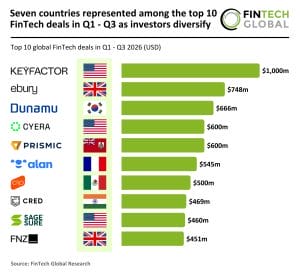
With the US’ weekly dominance in deal activity it is easy to assume it would also dominate in deal size. However, research from FinTech Global this week found that seven different countries were represented among the top 10 FinTech deals in Q1 – Q3 2026.
As for subsectors, WealthTech reigned supreme with four deals in total. The WealthTech companies were Sanctuary Wealth, Supertake, Ionic Wealth and Lemon. It was followed close behind by the infrastructure and enterprise software space, which recorded three deals. These were invoiceQ, IKKBand Neem.
As for the other subsectors, there were two deals apiece in PayTech (Pliant and Trustly), RegTech (Acorda and Reversa) and marketplace lending (Sooner and Audun). Finishing off, there was one deal each in CyberTech (Metano) and InsurTech (Napo).
Here are the 15 FinTech deals covered on FinTech Global this week:
Sanctuary Wealth has received a $250m growth capital commitment from its existing backer Kennedy Lewis Investment Management.
The deal hands Sanctuary a larger pool of money to finance the ambitions, equity sales and succession plans of the firms on its platform.
The fresh funding will be used to widen the specialist expertise available to Sanctuary’s Partner Firms, helping them serve clients across a broader range of needs, win new business and complete acquisitions.
Sanctuary will also gain more room to supply capital directly to Partner Firm owners, whether they want to fund expansion, cash out part of their stake or get ready for a leadership handover.
Kennedy Lewis, a multi-strategy private credit manager overseeing roughly $40bn in assets, has structured its commitment as $50m in mandatory convertible debt alongside a $200m delayed-draw term loan.
In addition, the investor has chosen to turn its current outstanding convertible debt holding in Sanctuary into equity. The relationship between the two firms dates back to 2022, and since that first investment Sanctuary has doubled its count of Partner Firms and nearly tripled the assets on its platform.
Over eight years, Sanctuary has built a platform designed to help advisors leaving wirehouses establish their own independent businesses. Its scale and depth have drawn growing attention from advisors and independent wealth managers, prompting the company to introduce additional affiliation models that give sophisticated advisors greater choice in how they pursue their goals.
Pliant, the Berlin-based B2B payments FinTech, has lined up more than €200m in fresh debt financing capacity across three separate deals with Ascory Bank AG and Viola Credit.
The new capacity is aimed at backing rising credit card transaction volumes and the credit lines Pliant extends to customers throughout Europe.
Commercial card issuing has particular liquidity demands, chiefly the need to fund customer credit balances and to post collateral for card scheme settlement. The new structures provide secured financing against both of these needs, allowing Pliant to handle larger volumes of transactions without compromising the efficiency of its funding model.
Two of the three deals come from Ascory Bank, which has partnered with Pliant for several years. One is a securitisation backed by receivables from Pliant’s European corporate credit card operations. The other covers the collateral needed for Visa’s settlement process, known as the Visa Prefunding Solution, giving Pliant the liquidity to keep pace with growing card activity.
The third deal expands Pliant’s current growth debt facility with Viola Credit and includes an option to raise the amount available. Taken together, the agreements are expected to underpin Pliant’s planned European growth for a minimum of two years.
The debt package comes shortly after Pliant revealed an $80m Series C round, which is earmarked for international expansion and further work on its AI-powered payment infrastructure. The new facilities sit alongside that equity investment, adding capacity specifically for the European commercial card business.
Founded in 2020, Pliant runs a modular B2B payments platform that brings together commercial card issuing, payment accounts, FX and spend management for both businesses and AI agents. Its customers span travel, e-commerce, insurance and AI-native technology, while FinTechs, software platforms and banks build their own commercial payment products on its infrastructure. Through its API-first platform, AI agents and applications can tap into regulated payment rails with permissions, controls and auditability included.
Trustly, the Stockholm-headquartered Pay by Bank specialist, has secured $60m in new capital as it moves to reposition payment data as a source of commercial intelligence for the merchants it serves.
According to FinSMEs, Nordic Capital, Alfvén & Didrikson and BlackRock all participated in the round. The Swedish firm plans to channel the money into building new AI-powered products designed to extract insight from transaction flows.
Its stated aim is to give businesses sharper tools for attracting customers, keeping them engaged over a longer period and anticipating risk before it materialises.
The raise marks a notable strategic direction for the company. Rather than treating a payment as the end point of a transaction, Trustly intends to use the data generated at checkout as a lever for growth and protection, a shift that could change how merchants evaluate their payment providers.
Trustly offers account-to-account payments built on Open Banking infrastructure, allowing consumers to pay directly from their bank accounts with speed and security, in real time. Its network links more than 9,000 merchants with in excess of 650 million consumers, drawing on connections to 12,000 banks across upwards of 30 markets. Well-known names including PayPal, Virgin Media O2 and Booking.com count among its partners.
Supertake, a platform that uses AI agents to convert people’s market beliefs into stock portfolios, has secured $20m in seed funding to scale its business.
Venture firm Adjacent, through Nico Wittenborn, led the investment, with Coinbase Ventures and Union Square Ventures (USV) also taking part, according to a report from TechCrunch.
A number of angel investors joined the round, among them Nat Friedman, currently head of product at Meta Superintelligence Labs, Vercel CEO Guillermo Rauch, product manager Nikita Bier, investor Scott Belsky and Nemil Dalal, a former Coinbase executive now serving as a visiting partner at Y Combinator.
The latest capital comes after a $2m pre-seed round.
Supertake intends to use the money to grow its headcount across functions such as engineering, design and growth marketing.
Supertake’s stated mission is to make investing a meritocracy. Users describe a conviction in everyday language, such as “Everyone will be on peptides”, and the platform builds an investment strategy around it, which is then run by frontier AI agents. Any user anywhere can follow and share these strategies, meaning ideas are judged on their performance rather than on whether their creator has time to monitor markets constantly.
Sooner, a UAE home-buying platform that funds half of a buyer’s down payment, has secured $20m in seed funding as it sets out to change how residents of the country purchase property.
The round drew backing from Nuwa Capital, Amwal Capital Partners, 500 Global, Annex Investments, Alserkal Group, Axeed LLC, Plus VC (+VC), 21 Ventures and Iliad Partners, along with a group of angel investors.
The startup is tackling a long-standing hurdle in the UAE property market, where purchasing a home has traditionally required buyers to find 20% of the price in cash upfront. Under Sooner’s model, buyers contribute 10% at the outset while the company covers the remaining half of the deposit using its own capital. That portion is then paid back in monthly instalments alongside the buyer’s mortgage over a term of between 12 and 60 months.
With the new capital in place, Sooner is aiming to facilitate more than AED 1bn worth of home purchases during 2027. The firm describes this target as an initial step towards helping a generation of tenants move into ownership.
Sooner focuses on salaried buyers living in the UAE who want to purchase a ready-built property in Dubai. The process begins with a roughly two-minute check that shows users which homes fall within their budget, without affecting their credit score. The company then arranges a first-time buyer mortgage pre-approval with a suitable bank, supported by a lowest mortgage rate guarantee, and approves the down payment support. Buyers can then book viewings through the platform and complete the purchase of their chosen property.
Ionic Wealth, a technology-driven wealth management platform owned by Angel One, has secured Rs177 crore ($19m) in a strategic funding round to power its next stage of expansion.
The round was backed by Angel One alongside a group of marquee families, and brings the total amount raised by the company to around Rs466 crore ($50m).
All investors from the earlier round returned for this one. The investor base includes prominent business families, Bollywood personalities, FinTech entrepreneurs, global CXOs, board advisors and media houses.
The investment follows a period of rapid growth. Within two years, Ionic Wealth has pushed its assets under management (AUM) beyond Rs16,000 crore. It now serves more than 2,900 high-net-worth and ultra-high-net-worth clients across over 12 cities, with a team of more than 100 private bankers.
Ionic Wealth plans to use the fresh capital to strengthen its portfolio-led proposition and global capabilities, bring AI into its WealthTech experience, grow its UHNI business and widen its presence both in India and overseas.
The company described the funds as patient capital, which will let it build on its early bets. These include using technology to scale its HNI offering, advancing global investing through GIFT City, opening up fractional access through the Accredited Investor framework and SIFs, and creating a distinct UHNI offering for India’s leading families.
Operating under the Ionic Wealth brand, Angel One Wealth Limited is a wholly owned subsidiary of Angel One Limited, one of India’s major FinTech platforms with a user base of over 40 million. Ionic Wealth is an omnichannel WealthTech platform that aims to rethink wealth management for India’s emerging HNIs and UHNIs.
It gives clients access to exclusive investment opportunities across asset classes, a round-the-clock digital experience through its app, and domain specialists who build strategic plans suited to each client’s wealth journey. The firm uses technology to generate sharper insights, boost team productivity and support scale.
Metano has come out of stealth with $12m in seed capital as enterprises struggle to keep autonomous software under control across their technology estates.
Sierra Ventures headed the round, which also drew backing from Correlation Ventures, High Alpha and 360 ONE.
The business is led by co-founders Neelima Rustagi, who serves as CEO, and Ratnesh Pandey, its CTO, with the leadership team bringing security backgrounds from ServiceNow, Zscaler, Palo Alto Networks, FireEye and Microsoft.
The launch lands at a moment when companies are rolling out AI agents on employee devices, in coding tools, across cloud systems and inside SaaS applications. Each new deployment widens a scattered attack surface.
Current security products tend to guard a single layer of infrastructure, leaving teams without the end-to-end view and behavioural insight required to protect agents that move between those layers on their own.
AI agents also differ from traditional software because they act and decide on the fly, frequently with valid credentials and sanctioned tools. Their conduct can shift depending on the prompts they receive, the outside material they consume and the conditions they run in, so dangers may stay hidden during early testing and only surface later.
Metano tackles this by merging three functions into a single control layer. First, it locates both sanctioned and shadow AI agents, along with MCP servers, skills and software packages, and maps the permissions and exposure attached to each.
Second, it interprets agent conduct through Hive, a live context graph that links tasks, identities, tools, data access and actions over the course of a session, allowing analysts to spot anomalies and judge whether an agent is acting in line with its purpose.
Third, it applies guardrails directly where agents run, including activity that never passes through conventional network gateways, so centrally set policies can halt harmful actions in the moment. The platform is designed to scale alongside a company’s maturity in deploying agents.
invoiceQ has secured $5m in a Series A round that surpassed its original fundraising goal, giving it fresh capital as governments across its markets push businesses towards mandatory digital invoicing.
Manara Ventures and Next Ventures co-led the investment. They were joined by Orange Ventures, the Innovative Startups and SMEs Fund (ISSF) and the Jordan Small and Medium Enterprises Fund (SME Fund Jo), with the latter now backing the company for a second time.
The business already counts over 1,400 corporate customers and has built up a substantial set of regulatory credentials. It holds qualification from Saudi Arabia’s Zakat, Tax and Customs Authority (ZATCA) and meets the requirements of Jordan’s Income and Sales Tax Department (ISTD). The UAE Federal Tax Authority (FTA) and the Oman Tax Authority (OTA) have both recognised it as an Approved Service Provider (ASP), and it also operates as a certified Peppol Access Point (AP) and Service Metadata Publisher (SMP).
Mohannad Tobal, Mohammad Bassit, Fadi Al Jabali and Amer Ayyad established invoiceQ, which offers a cloud-based SaaS platform that allows companies to automatically generate, handle, send and store invoices that satisfy tax rules, all from a single system. Its technology connects with existing ERP, POS, accounting, e-commerce, banking and payment software, meaning clients can meet regulatory obligations without overhauling the tools they already rely on.
Audun, an AI-native debt collection start-up, has secured $3m in pre-seed funding as it sets out to overhaul one of the most manual corners of financial services.
The round drew support from Alliance VC, Y Combinator, Robinhood Ventures, Skyfall Ventures and FirstDegree, along with a group of angel investors.
Audun is taking a different route from most innovators in the space. For years, change in debt collection has largely meant building software and selling it to collection agencies. Rather than offering another product of that kind, Audun has set itself up as a licensed agency in its own right. It is already recovering money for clients using its own platform, which handles every stage of a case, from the opening reminder through to the final payment.
The company argues that technology is moving faster than ever, yet collection practices look much as they did two decades ago. In its view, every debtor is pushed through an identical routine, while case handlers are tied up with repetitive admin. Audun believes the distance between what technology makes possible and what the sector actually provides is now wider than at any point before.
Audun’s platform takes over the routine, administrative side of collection so that its staff can devote their attention to the conversations where human judgement matters most.
IKKB, a financial management platform for companies operating across borders, has closed a $3m seed round to secure regulatory licences and develop new products for its multi-currency business account.
The investment was led by Canary. According to the announcement, the capital will help IKKB obtain the licences it needs to operate as a regulated institution in each of its markets. It will also fund further products built on top of the core account. The firm already has licensing applications under way in Brazil, the US and Canada.
Canary said it first met co-founders Edward Konig and Rafael Katalan in August 2025 and tracked their progress for over a year before investing. The investor said the pair learned quickly, made difficult decisions with long-term goals in mind and achieved a great deal on limited funding. Canary believes a growing number of companies now operate internationally from launch, while the financial infrastructure supporting them remains slow, costly and fragmented.
IKKB’s offering has grown considerably in a short time. Just over a year ago, its product had a single function, converting PIX payments into US dollars. It has since become a multi-currency account for businesses, holding balances in BRL, USD, EUR and MXN. The account connects to local payment rails in Brazil, the US, Europe and Mexico, and offers corporate cards in BRL and USD. The team developed the platform internally on modest capital and prioritised regulatory work from the outset.
The company is focused on giving Latin American businesses a global account. Firms can manage international payments, foreign exchange and treasury from a single platform. The service operates on stablecoin rails and applies AI to provide additional services alongside the account. IKKB offers accounts, cards, currency exchange, payments and treasury management.
Acorda, a London-based anti-fraud startup set up by three former Monzo employees, has secured £1.8m in a pre-seed round as it builds a network that lets banks and payment providers pool scam intelligence.
According to DealRoom, Eileen Burbidge has backed the round. The startup will put the capital towards bringing banks and payment firms onto its data-sharing network.
The platform gives financial institutions a secure way to exchange scam risk indicators linked to the person or business receiving a payment, in the moments before the funds leave the sender’s account.
With this information, the sending bank can judge how risky the recipient is before releasing the transfer. Acorda’s aim is to reduce the number of scams that succeed while also lowering the volume of legitimate payments wrongly flagged as fraudulent.
Acorda operates a fraud data-sharing network designed for banks and payment providers, focused on preventing scams at the point of payment rather than identifying losses once money has already moved.
Reversa, a Madrid-based RegTech firm developing artificial intelligence agents to handle regulatory tasks for businesses and public bodies, has secured €750,000 in fresh capital, which includes a pre-seed round headed by Itnig.
Itnig, the investment vehicle of the founders of Factorial, led the pre-seed portion of the raise. The Jobandtalent co-founders also joined, as did angel investors drawn from the legal and technology industries, among them executives at HappyRobot, Fuse Energy and several multinational banking and energy groups. Reversa also receives backing from Enisa and from the Neotec programme run by CDTI.
The new capital will help Reversa widen the international reach of its regulatory infrastructure and develop sector-focused products on top of it, targeting areas including financial services, energy and real estate. On the urban planning side, the firm is developing agents designed to streamline land-use permits, a recognised obstacle to building new homes. Hiring across engineering, product and sales is also planned.
Reversa’s platform features a regulatory radar, through which agents link directly to official sources, assess how each regulatory change affects a business and support the steps needed to put it into practice. The technology also tackles operational and commercial challenges, such as pinpointing which legal framework applies when a company enters a new market, or automating compliance checks on a new product.
Customers also use it for jurisdiction-specific legal research and for drafting and revising contracts and policies. For public affairs teams, the agents track legislative procedures in real time, helping organisations prepare for upcoming rule changes and engage with the lawmaking process.
Napo, a UK pet insurance managing general agent (MGA) that runs on technology, has named Great Lakes Insurance UK Limited as its lead capacity provider, closed an oversubscribed funding round and appointed industry veteran Tim Smyth as chair.
Great Lakes, which holds an A+ rating from AM Best, will provide the capacity, while ERGO Travel Insurance Services Ltd, part of Munich Re company ERGO Group, will oversee the arrangement as MGA under delegated authority from Great Lakes. All new business from 5 November 2026 falls under the partnership, and renewals will transfer from the same date.
The deal came after Great Lakes reviewed Napo’s underwriting proposition and business plans, and it gives the pet insurer long-term capacity supported by an A+ financial strength rating as it expands.
Alongside the capacity agreement, Napo has added new cover options underwritten by Great Lakes. Its lifetime range now includes 40 options, with yearly vet fee limits between £2,000 and £16,000, plus a choice of excess and co-pay.
Mercia Ventures, an existing backer, led the funding round. IW Capital and Advantage Insurance Company Limited took part as new investors, and DN Capital and Companion Fund, the pet-care venture arm of Mars Petcare, made follow-on investments.
The company did not disclose the size of the round. Napo plans to direct the capital towards further automation in pricing and claims and towards expanding its direct distribution.
Jean-Philippe Doumeng co-founded Napo in 2021 and named the company after his dachshund, Napoleon. He set it up because many pet owners do not realise how fast veterinary costs rise until their animal is sick or hurt, and by then it can be too late to buy a policy.
Napo handles pricing, claims and customer service in-house and applies AI where it makes cover fairer. Its machine-learning pricing models draw on the company’s own policy and claims data, local vet costs and an AI-generated health profile covering more than 500 breeds. This approach lets Napo price rarer breeds on their individual traits instead of automatically classing them as high risk, and it can detect patterns such as how a dachshund’s risk shifts as it ages.
Tether, the largest company in the digital asset sector, has made an investment in Lemon, an Argentine FinTech focused on digital assets, in a bid to widen adoption of USD₮ and XAU₮ throughout Latin America.
The backing is intended to help Lemon create financial products built on digital assets that cost less and are simpler for customers to use.
The size of the investment was not disclosed.
The two firms plan to extend work Lemon has already been doing to make USD₮ and XAU₮ part of everyday financial activity. To keep things straightforward for customers, Lemon provides one Digital Dollar balance underpinned by USD₮.
The platform manages currencies, exchange rates and networks behind the scenes, leaving users free to concentrate on spending, saving or transferring funds. Through XAU₮, customers can also put money into gold without needing a substantial initial sum, as tokenisation allows them to hold fractional amounts of gold that can be tracked and managed within the app.
Lemon operates an app that combines digital assets with day-to-day money management. Customers can save, generate yield, buy stocks, make and receive cross-border payments and, in markets where it is offered, pay using Visa prepaid virtual cards. The firm aims to give people access to their money at any time and in any place by cutting out needless steps between users and their funds.
Read the daily FinTech news
Copyright © 2026 FinTech Global
Source link