

African tech startups raised a record $1.64 billion through debt financing in 2025, a 63 percent increase from $1.01 billion in 2024, marking the highest level of debt funding ever recorded on the continent.
The number of debt transactions also surged to 108, up 40 percent from 77 the year prior, according to data from Partech Africa.
Debt now accounts for 41 percent of all capital deployed in African tech, up sharply from 17 percent in 2019, reflecting a structural transformation in how startups raise capital. Unlike equity financing, which dilutes ownership, debt allows growth-stage companies with predictable revenues to access capital without surrendering control.
Senegal-based fintech Wave exemplified this shift, securing $137 million in debt led by Rand Merchant Bank. The company’s steady mobile money revenues made debt a smarter alternative to equity, underscoring the growing maturity and predictability of African startups.
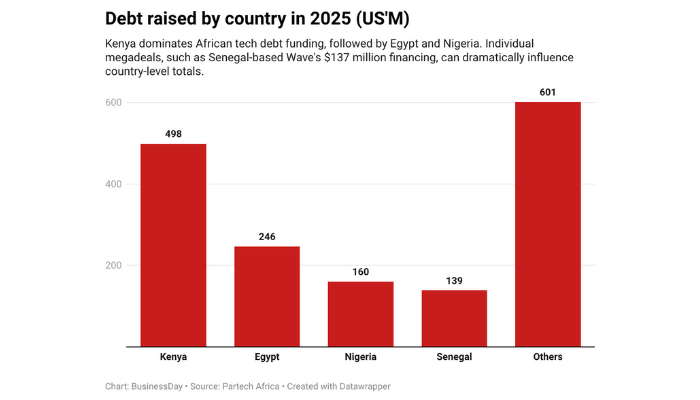
Geographically, Kenya led the market with $498 million raised, followed by Egypt ($246 million) and Nigeria ($160 million). Fintech dominated by sector with $716 million in debt, while cleantech took second place with $627 million, the only sector where debt exceeded equity, driven by solar and clean mobility businesses. Together, these two sectors accounted for 82 percent of all debt deployed.
Read also: Three Nigerian startups receive funding to tackle food crisis
The supply of debt capital is also evolving. In 2025, 77 unique debt investors participated, with 57 percent being debt-only players, up from 48 percent to 49 percent in previous years.
Major active investors included British International Investment, IFC, Lendable, Proparco, and Verdant Capital. Commercial banks are increasingly entering the market, signaling the asset class’s growing credibility.
Experts note that debt is not replacing equity but complementing it, particularly for growth-stage companies with proven cash flows. Seed-stage companies still rely primarily on equity, although the number of active equity investors declined slightly in 2025.
“This is a sign that African startups are getting more mature and predictable,” said Tidjane Dème, general partner at Partech Africa.
The $1.64 billion milestone represents more than a funding record. It signals that a cohort of African startups has reached a level of scale and stability that makes lenders confident in their future cash flows, marking a quieter yet more durable milestone in the continent’s tech ecosystem.
Debt has moved from a curiosity to a cornerstone of African tech finance, and how the ecosystem manages access, sectoral impact, and early-stage equity gaps will shape the next decade of innovation on the continent.
Source link