Startups across Africa and the Middle East raised a combined $111.3 million this week, based on disclosed funding rounds tracked by Techloy, with investor capital flowing primarily into fintech and emerging deep tech. Egypt alone drove the bulk of the week’s volume, accounting for three of the eight deals and the single largest transaction by a wide margin.
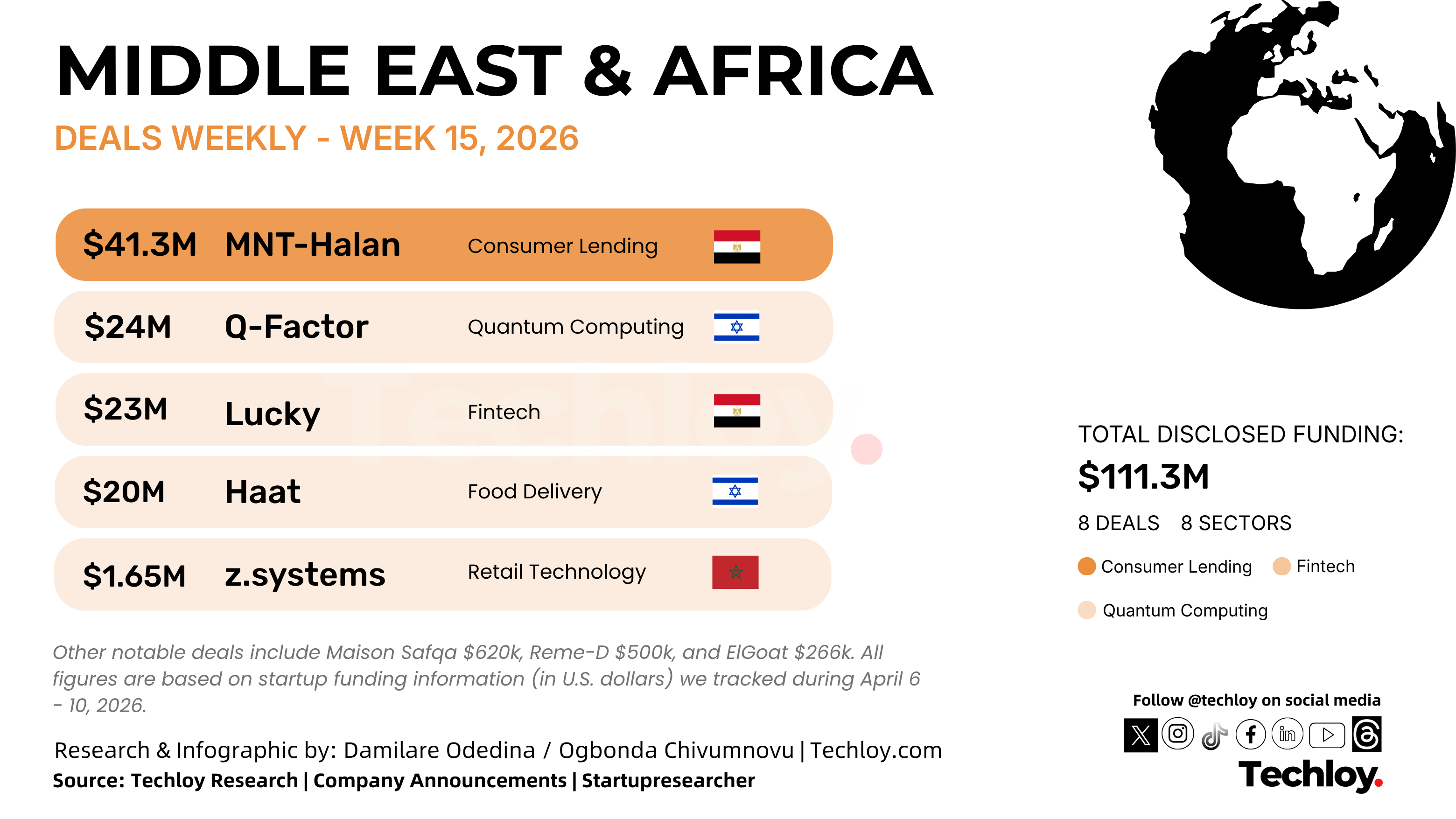
The Week’s Largest Startup Funding Rounds
Here are the biggest disclosed startup funding rounds across Africa and the Middle East this week.
/1. MNT-Halan, $41.3 million, Consumer Lending, Egypt
Hala Consumer Finance, the consumer lending arm of MNT-Halan, raised EGP 2.214 billion, roughly $41.3 million, through a securitisation bond issuance, its fifth tranche under a broader EGP 11.5 billion programme approved by Egypt’s financial regulator. The funds will go toward underwriting new consumer loans, with MNT-Halan packaging its loan receivables into bonds to get fresh capital without giving up equity.
The deal follows a larger issuance in October last year, when the company raised EGP 3.4 billion ($71.4 million) through the same mechanism. Founded in 2018, the Cairo-based non-bank lender hit unicorn status in 2023 and has made this approach its primary funding engine, as part of a bigger push to grow its lending portfolio to between $4.5 and $5 billion by the end of 2026.
/2. Q-Factor, $24 million, Quantum Computing, Israel
Q-Factor, which is developing a full-scale quantum computer based on neutral atom technology, was founded by four leading physicists from the Weizmann Institute of Science and the Technion, and emerged from stealth with a $24 million seed round completed just months after its founding. NFX and TPY Capital led the round, with Intel Capital, Korea Investment Partners, Deep33, and the Matias family also joining, alongside a grant from the Israel Innovation Authority.
The seed capital will go toward expanding the engineering team in Tel Aviv and assembling their first-generation high-qubit testbeds built for continuous scalability. The problem Q-Factor is going after is getting quantum machines to scale well beyond a few thousand qubits, with the founders believing their approach can push neutral atom systems from thousands to potentially millions of qubits, a threshold that could bring quantum computing closer to commercial viability. Both the Technion and Weizmann hold equity in the company.
/3. Lucky, $23 million, Fintech, Egypt
Egypt-based fintech Lucky raised $23 million in a Series B round combining equity and debt, with participation from Disruptech Ventures, DPI via Nclude, Suez Canal Bank, and OneStop. Founded in 2019, the company started in cashback and rewards before shifting its focus to consumer credit, where it now offers instant credit lines and a payment card.
The raise follows a strong run for the Cairo-based company, which reported threefold annual growth in 2025 and reached profitability by year-end. The plan is to use the capital to grow deeper in Egypt, get a PSP license, and start moving into other North African markets.
/4. Haat, $20 million, Food Delivery, Israel
Food delivery startup Haat completed a funding round of approximately NIS 60 million (about $20 million), valuing the company at roughly NIS 310 million (about $100 million) post-money, its fourth round since founding. Israel Post led the round at around $14 million, with food importer Lehman Schlissel putting in about $5 million.
Haat was founded by Hasan Abasi and spent its early years building in Arab communities and cities where delivery apps had not really shown up before, working with over 10,000 restaurant partners. This raise is about taking that momentum into Tel Aviv, where Wolt, its competitor, currently holds a strong grip on the market.
/5. z.systems, $1.65 million, Retail Technology, Morocco
Morocco-based retail technology startup z.systems raised $1.65 million in a seed round led by Azur Innovation Management, bringing the company’s total capital to $2.7 million. The Casablanca startup connects brands, wholesalers, and retailers on one platform, giving smaller players access to virtual storefronts, order tools, and sales data that most of them never had before.
Since launching in April 2025, z.systems reports more than 16,000 active retailers and over 600 brands on its platform, and has been designated as Morocco’s national digital intermediation platform under the Commerce 2030 initiative. The fresh capital goes toward building out the product and pulling more of Morocco’s $40 billion retail sector online.
/6. Maison Safqa, $620,000, Luxury E-commerce, Saudi Arabia
Riyadh-based Maison Safqa raised $620,000 in a pre-seed round backed by 500 Global through the Sanabil MENA 500 Accelerator Fund, alongside Saudi and international angel investors, among them the founder of Ventes Exclusives, one of Europe’s largest flash-sale platforms. The startup, founded in 2024, runs a platform where luxury brands can offload excess inventory through timed sales without publicly slashing prices or damaging how the brand looks.
Since launching in May 2025, Maison Safqa has brought on over 50 fashion and lifestyle brands, including Aigner, Lanvin, and Liu Jo, and has grown gross sales more than 20 times over in under a year. The money will go toward the platform, onboarding more brands, and hosting offline sales events in Riyadh and Jeddah.
/7. Reme-D, $500,000, Biotech, Egypt
Egyptian biotech startup Reme-D secured $500,000 from the Global Innovation Fund to expand production and distribution of its room-temperature stable molecular diagnostic kits across Africa. The Cairo-based company was founded in 2022 by nanotechnology researcher Salma Tammam and makes PCR test kits that do not need refrigeration, which matters enormously in places where electricity is not always reliable.
The funding will go toward commercial expansion into Nigeria and Libya, scaling up production, and pushing further into diagnostics for cancer, genetic conditions, and maternal health. Reme-D currently runs tests for around 50,000 patients a month across 92 hospitals in Egypt, Iraq, Sudan, and Kenya.
/8. ElGoat, $266,000, Sportstech, Saudi Arabia
Saudi Arabia-based sportstech startup ElGoat raised $266,000 in a seed round via Trigon, reaching a valuation of $2.66 million. Founded in early 2026 by Mohammed Almunajem, the app lets football fans predict match results, exact scores, and goalscorers across competitions like the Saudi Pro League and the Premier League, then tracks how everyone ranks against each other.
There is no betting involved, and the app is completely free to use. The funding will be used to build the product further, grow the user base, and expand across MENA.
Conclusion
With $111.3 million in disclosed funding this week, investor attention across Africa and the Middle East stayed heavily concentrated in fintech, with Egypt’s consumer credit sector alone accounting for nearly $64 million. Beyond finance, the deal mix stretched from quantum computing in Israel to refrigeration-free biotech in Cairo and a luxury flash-sale platform in Riyadh. Five of the eight deals fell below the $2 million mark, showing that seed-stage founders across the region are still finding backers alongside the larger checks going to more established players.
Week 14 Biggest Startup Funding Rounds in Africa and the Middle East, Led by ScaleOps, as AI and Cybersecurity Drew the Biggest Checks
Investors sent the biggest checks of the week into AI infrastructure and cybersecurity, while early-stage capital kept moving across fintech, food tech, and mobility from the UAE to East Africa and Angola.