These platforms facilitate easier on-demand court bookings and help players find teams at short notice sports like tennis, pickleball, paddle, among others.
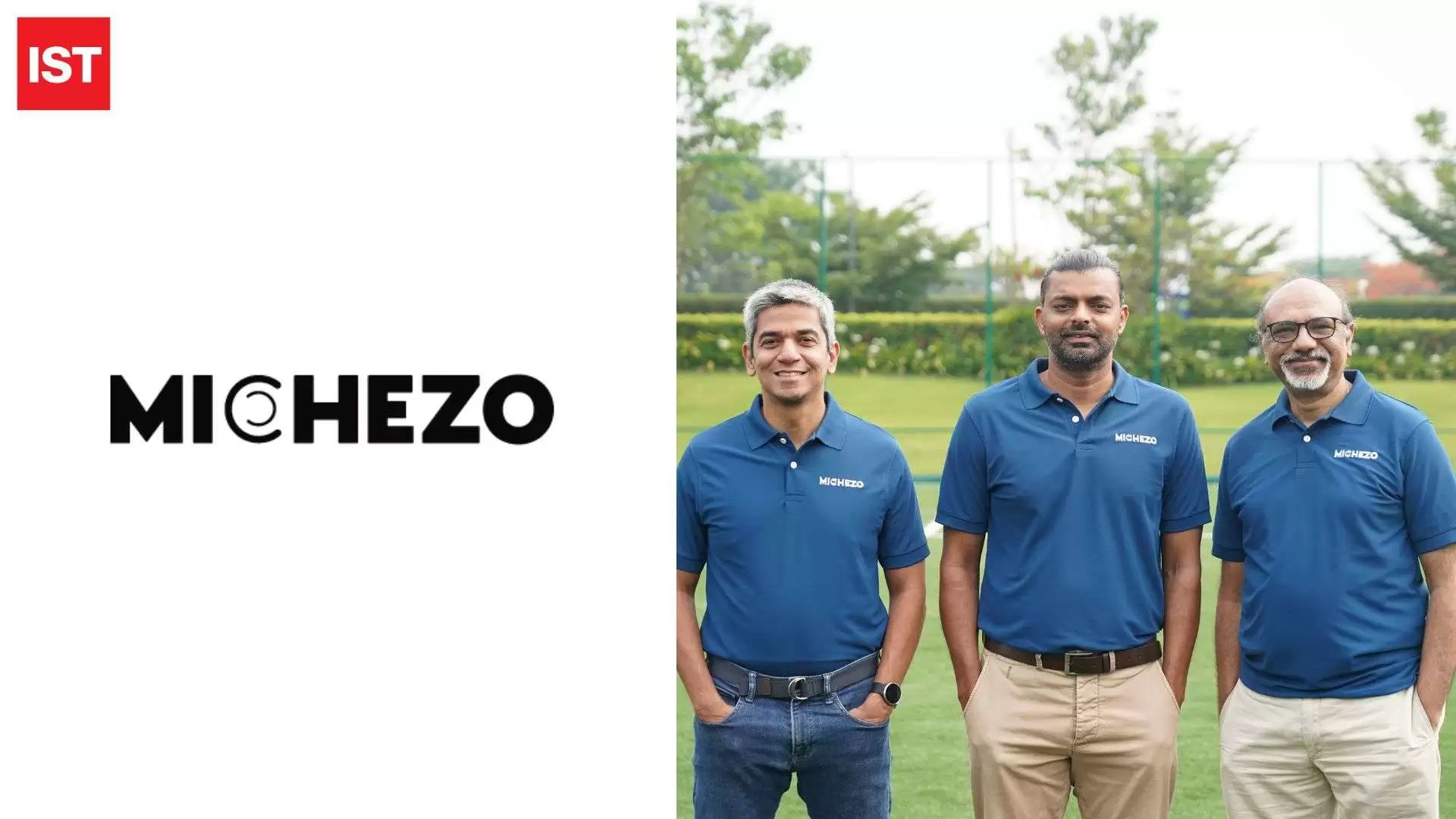
Startups including Hudle, Playo, KheloMore and Machaxi have seen strong traction and attracted risk-capital investors to the segment. Sports tech startup Machaxi, which previously raised capital from Rainmatter and former Indian badminton player Prakash Padukone in June last year, is in discussions to raise a fresh round.
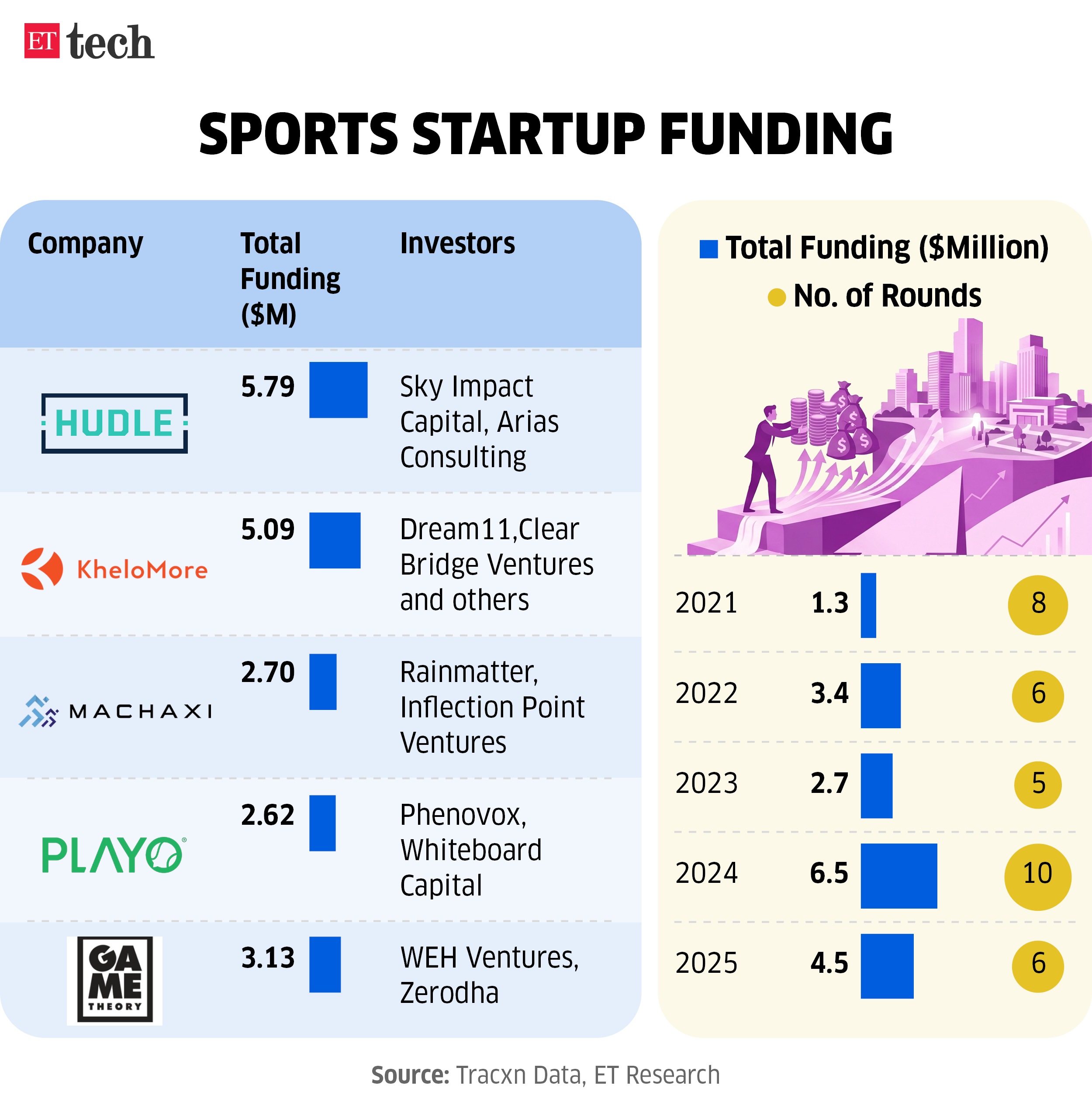
Tracxn data indicates that investor interest in the sports startup segment has shown fluctuating but sustained activity over the past several years. In 2021, the sector saw $1.3 million raised across eight funding rounds, rising significantly to $3.4 million across six rounds in 2022. Funding moderated in 2023 to $2.7 million across five rounds before rebounding sharply in 2024, the strongest year in the period, with $6.5 million raised across 10 rounds.
In 2025, funding stood at $4.5 million across six rounds, while 2026 year-to-date has recorded $774,800 from a single round.
“It’s less about competition and more about identity. This is where India is headed, much like the US did years ago, and that’s why we see a strong future for these experience-led fitness businesses,” said Dilip Kumar, an investor at Rainmatter, the Zerodha-backed venture fund that has deployed around Rs 100 crore in the segment.
The trend extends well beyond racket games with friends after work or weekend court bookings. “Sports like badminton, tennis, or squash have always existed, but what’s emerging now is the rise of experience-led formats, marathons, Hyrox, and similar IPs,” Kumar said.
ETtech
“Content is the easiest and most scalable layer in sports because every game naturally creates moments worth sharing. At the end of every match, people don’t just play they capture it,” said Harsh Shah, founder of HiFy, a startup that installs cameras in courts and grounds so players can capture moments of themselves in action. Those clips go on to serve as social media content, bloopers, motivation, highlights, and more, added Shah, who earlier founded a retail tech startup Fynd (sold to Reliance Industries).
“There has been a clear shift where playing itself has become a social outing, similar to going out to a bar or planning a weekend activity,” said Ujwal Deole, cofounder and COO of KheloMore, who started the company after returning from the US and spotting a gap in the ease of booking courts and sports experiences in Mumbai.
The numbers game
Playo has scaled to five countries, India, UAE, Qatar, Saudi Arabia and Sri Lanka with pilots in Nepal and the UK, and now serves about five million users across 150 cities.
“If sports become part of everyday lifestyle, it evolves for both fitness and community in a far more meaningful way than gyms,” said Gauravjeet Singh, founder of Playo. Founded in 2015, the company turned profitable in November 2022 after recovering from the pandemic and now operates at around 15% Ebdita margins. It clocks about Rs 350 crore in annualised transaction value and roughly Rs 45 crore in annual revenue.
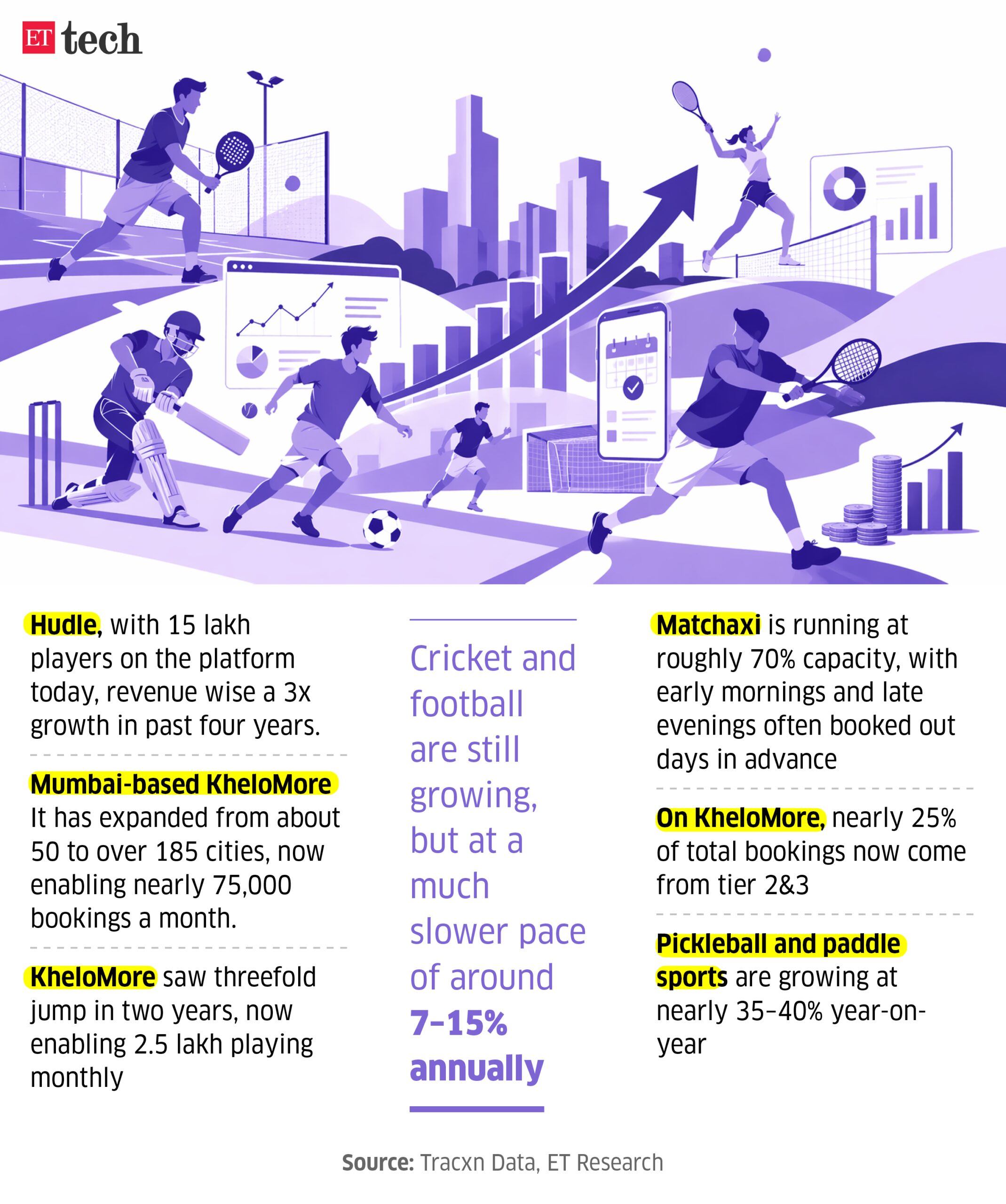
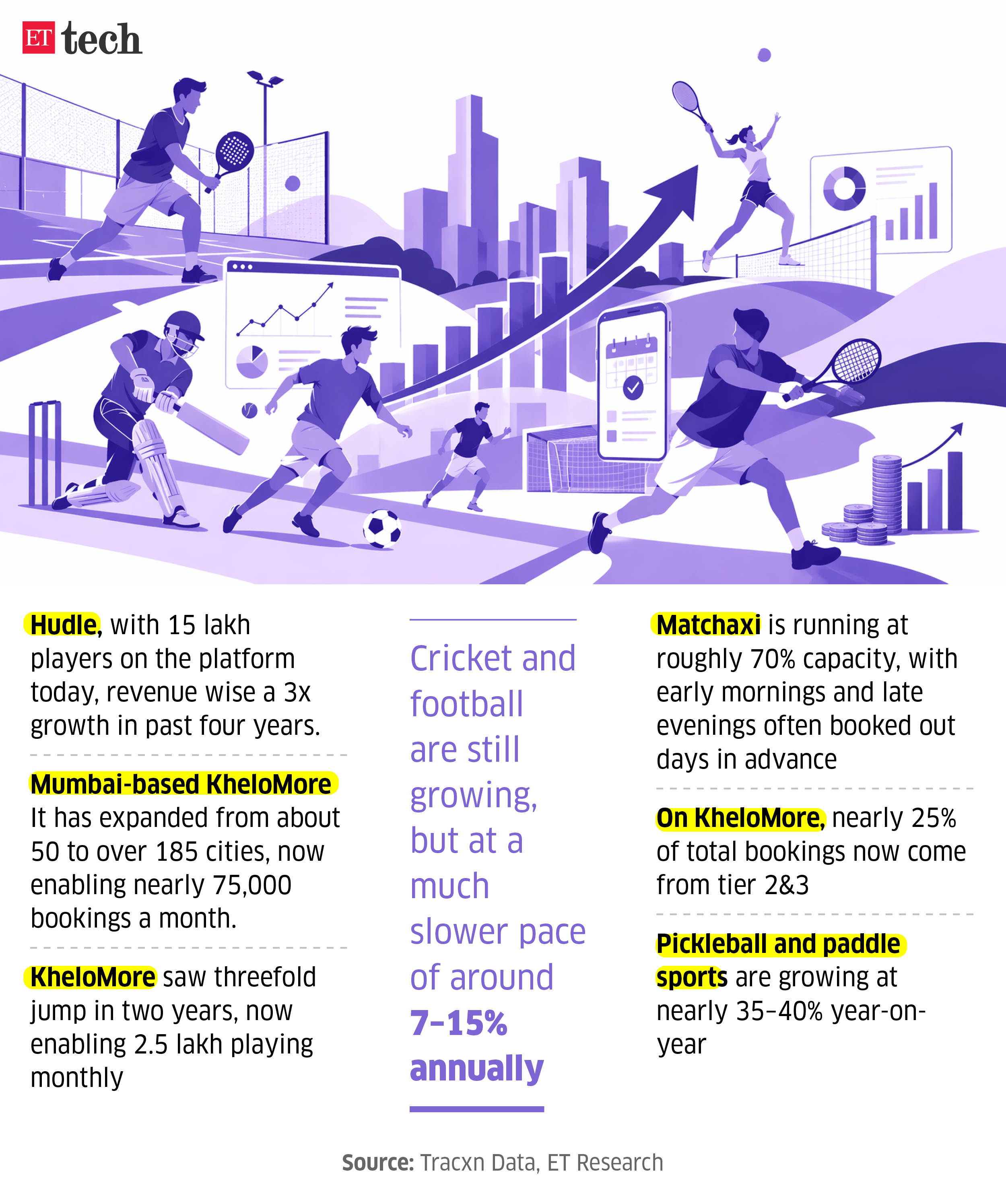
Machaxi is running at roughly 70% capacity, with early mornings and late evenings often booked out days in advance, especially in affluent neighbourhoods. The startup has seen rapid financial growth, with revenue scaling from Rs 5 crore in FY24 to Rs 15 crore in FY25, and an expected Rs 45 crore in FY26, a nearly ninefold jump over two years.
Hudle said it has 1.5 million players on its platform and facilitates about 2.4 million games a year. The startup points to consistent repeat play rather than one-time discovery, with racket sports like padel and badminton emerging as the strongest drivers of retention and habitual weekly play.
Mumbai-based KheloMore has also accelerated over the past two years as recreational sport becomes more organised, expanding from about 50 to over 185 cities and now enabling nearly 75,000 bookings a month, or roughly 250,000 teams playing monthly, a threefold jump in two years.
 ETtech
Growing tier-II and tier-III markets
On KheloMore, nearly 25% of total bookings now come from smaller cities, indicating that the shift toward sports-led fitness and social engagement is no longer a preserve of urban centres. Hudle, which operates across 105 cities, is seeing even faster adoption in places such as Indore, Lucknow and Coimbatore, where limited alternatives like malls or multiplexes make organised sport one of the most attractive weekly activities.
Many of these platforms are unlocking new supply by enabling access to underutilised infrastructure, including school and university grounds, which are increasingly being opened for play after working hours and at weekends. For startups, this opens a broad monetisation opportunity beyond bookings, spanning coaching, events, equipment and community-led experiences. For now, the priority remains building consistent participation and long-term habits.
India’s sports adoption rate is still estimated to be below 1%, significantly behind markets such as the US and Australia. However, as per capita incomes rise and access to infrastructure improves, founders believe the inflection point is only a matter of time.
Source link