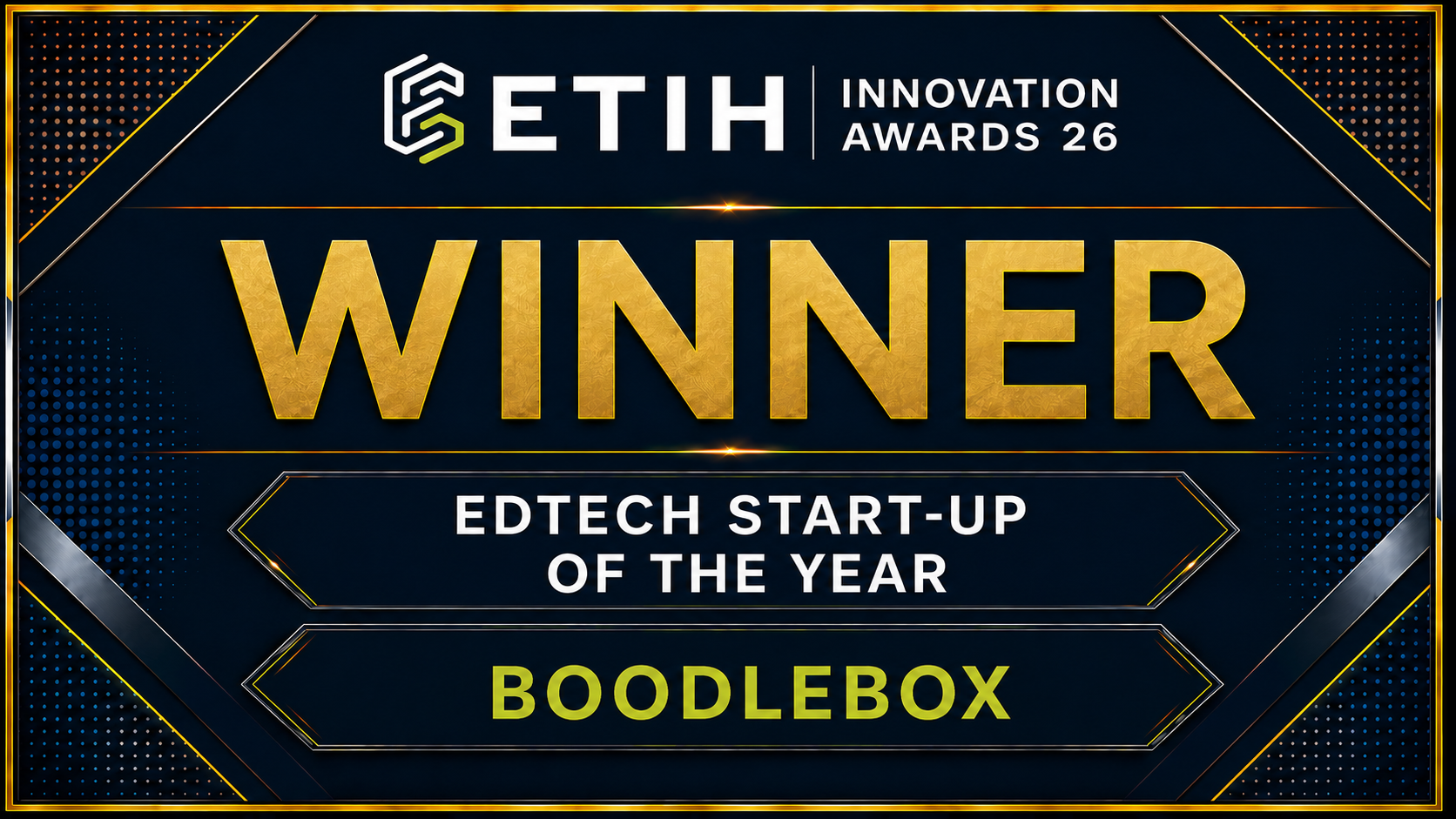
BoodleBox has won EdTech Start-Up of the Year at the inaugural ETIH Innovation Awards 2026, with judges recognizing a higher education AI platform that combines governance, student AI literacy, faculty support, institutional controls, and strong commercial traction.
Founded to address what it describes as higher education’s AI infrastructure gap, BoodleBox launched its platform in August 2024 and has scaled to more than 116 higher education institutions. Its entry highlighted 594 percent year-over-year growth, 175 percent net revenue retention, and partnerships with Microsoft and NVIDIA.
The platform gives institutions a governed environment for multi-model AI access, custom bot building, AI literacy, faculty development, and institutional oversight. Its AI-native classroom model brings together models including GPT, Claude, Gemini, Llama, and NVIDIA Nemotron, while giving higher education institutions controls around compliance, usage, and access.
For France Hoang, Founder and CEO of BoodleBox, the company was built in response to a structural issue in higher education rather than a narrow product opportunity: “When we launched BoodleBox, we saw a Triple Crisis unfolding in real time. Faculty were blindsided by a stealth invasion of consumer AI tools they couldn’t see, guide, or govern. Students were anxious — they knew the workforce was transforming beneath their feet, but they lacked the infrastructure to build durable, portable skills. And CIOs were drowning, managing a dozen disconnected point solutions with zero institutional control and zero coherent strategy.”
That diagnosis shaped the judges’ assessment. ETIH Innovation Awards judge Al Kingsley described BoodleBox as “possibly the cleanest startup story in the field,” pointing to its revenue growth, university adoption, customer expansion, Microsoft and NVIDIA partnerships, and evidence that the product works in real classrooms.
Building an AI operating layer for higher education
BoodleBox’s entry argued that higher education institutions already had core systems for student data and learning management, but lacked a comparable operating layer for AI. The company’s model is built around what Hoang describes as institutional ownership of AI strategy.
The issue, he argues, was not simply that universities were experimenting with AI tools. It was that many of those tools were being adopted without a coherent institutional framework.
“Institutions had an SIS for data and an LMS for courses, but they were missing the third pillar: an AI Operating System they actually owned and controlled,” Hoang says.
BoodleBox positions its platform as that missing layer. It gives institutions access to premium AI models in one governed environment, while allowing faculty and administrators to guide usage, build AI literacy, manage compliance, and support students in developing skills they can carry into the workforce.
ETIH Innovation Awards judge Richard Govada Joshua described BoodleBox as representing higher education innovation because it combines “AI literacy, governance, faculty empowerment, student skill-building, equity, and sustainability into one scalable platform.” He also said it showed evidence of “transforming how institutions teach, learn, and govern AI.”
That breadth was central to the award decision. BoodleBox was not being assessed only as an AI tool, but as a start-up building infrastructure around the institutional realities of AI adoption in higher education.
Hoang frames that mission as a response to AI tools that reached students before institutions had the systems to manage them: “Big AI had bypassed the educator entirely to target the student directly — replacing productive struggle with mere output, and leaving faculty on the outside looking in.”
The company’s response was to build what it calls a faculty-first operating layer. That includes AI Classroom and AI Coach Mode, which are designed to support AI use without removing academic oversight or student thinking from the process.
Emma Thompson, Director of Content and Editor at ETIH, says: “BoodleBox gave the judges a start-up story with both market traction and a clear sector thesis. The entry was not just about fast growth. It addressed how colleges and universities can govern AI, support faculty, and build student fluency in a way that feels tied to higher education’s next phase rather than a bolt-on response to consumer AI.”
Faculty readiness, governance, and equity
A recurring theme in BoodleBox’s entry was that higher education institutions need more than access to AI models. They also need structures that help faculty use AI with confidence and purpose.
Hoang says the company has learned that faculty are not necessarily resistant to AI. They need a different kind of support.
“We’ve learned that faculty don’t want a faster horse, they want a better road,” he says. “They don’t need more hype about what AI can do. They need to move from feeling like AI victims to becoming AI champions.”
That shift appears in the company’s classroom examples. At Dallas College, BoodleBox said 44 faculty members moved from 90 percent uncertainty about AI to 100 percent able to apply AI concepts after a three-hour session. At Pikes Peak State College, the entry referenced zero AI misuse across a full semester, 83 percent of students improving AI prompting skills, and 90 percent rating BoodleBox as a more ethical AI experience.
Kingsley also pointed to those outcomes when judging the entry, describing BoodleBox as the company in its category where “personalisation, automation, decision-making, responsible deployment, and innovation” were “structurally addressed rather than retrofitted.”
Hoang calls this “Institutional Sovereignty,” describing it as the principle that schools should own their AI strategy in the same way they own their student information system and learning management system.
“You balance it by building an ecosystem, not a point solution,” he says. “And you build trust by starting with a principle we call Institutional Sovereignty, the idea that schools need to own their AI strategy the same way they own their SIS and their LMS. Not rent it. Not borrow it. Own it.”
The platform wraps AI access with compliance and institutional controls, including FERPA, SOC 2 Type II, HIPAA, GDPR, HECVAT, VPAT, and TX-RAMP. The company also points to proprietary token-reduction infrastructure, which it says cuts token waste by up to 96 percent.
For Hoang, that is not only an efficiency claim. It is connected to access: “Our 96% reduction in token waste isn’t just a cost story. It’s an environmental sustainability story. It’s a financial accessibility story.” .
BoodleBox deliberately built early traction with independent colleges, community colleges, Historically Black Colleges and Universities, and Hispanic-Serving Institutions. More than 25 percent of partner institutions are in key Hispanic-serving regions, 58 partner schools have graduation rates below 60 percent, and 13 community college cohorts are driving workforce AI readiness programs.
Scott Thompson, Director at Paxton Media, whose brands include ETIH and RTIH, says: “BoodleBox was a strong start-up winner because the commercial story and the education story were pulling in the same direction. The growth figures showed demand, but the more interesting point was where that demand came from: institutions that need AI infrastructure to be affordable and usable by faculty, not just available to students.”
From start-up traction to sector infrastructure
BoodleBox’s growth was a major part of the judges’ decision. In 18 months, the company reported 116-plus contracted higher education institutions, $3.4 million in fully ramped contracted annual recurring revenue, 18,638 paid educational subscriptions, and 10,491 monthly active users. Its entry also cited a 1.18 burn multiple and a 108:1 lifetime value to customer acquisition cost ratio in higher education.
Richard Govada Joshua, ETIH Innovation Awards judge, said BoodleBox showed “the clearest combination of rapid growth, strong unit economics, market timing, institutional adoption, and category-defining innovation.” He also pointed to the company’s position as a potential core infrastructure provider for AI-native higher education.
For Hoang, the award arrives as colleges and universities move from experimentation toward longer-term decisions about AI governance and workforce readiness.
“Institution aren’t experimenting anymore,” Hoang says. “They’re making foundational decisions about governance, workforce readiness, and what education itself needs to become.”
The company’s recent growth has also been supported by external partnerships. BoodleBox has joined Microsoft’s Elevate Program and NVIDIA’s Inception Program, with the latter connected to Nemotron integration. The company’s entry also noted finalist placement at ASU+GSV.
Hoang says the next phase is focused on scale and portability. BoodleBox wants students’ AI toolkits and knowledge banks to move with them beyond graduation, rather than disappearing when they leave an institution.
“We’re doubling down on Portability, ensuring that the AI toolkits and knowledge banks students build inside BoodleBox don’t disappear at graduation, but travel with them into the workforce as a durable, career-ready asset,” he adds.
That approach connects the platform’s institutional infrastructure story to employability and long-term student value. For BoodleBox, the aim is to build not only a governed AI layer for higher education, but a route through which students develop AI fluency that remains useful beyond the course or campus.
The award comes as BoodleBox positions itself for wider expansion across higher education, with the company arguing that institutions now need AI infrastructure rather than another layer of disconnected tools.
Hoang says: “This award validates our core thesis: higher education doesn’t need more disconnected AI tools. It needs a purpose-built operating layer, and the Faculty-First movement is winning.”
He adds that BoodleBox is preparing to expand further across higher education, supported by recent venture-backed funding and its partnerships with Microsoft and NVIDIA: “We aren’t just building better AI. We are building the infrastructure to make the people who use it better. That’s the mission. That’s what’s next.”
To find out more about BoodleBox and its AI platform for higher education, more information is available via the company’s website.