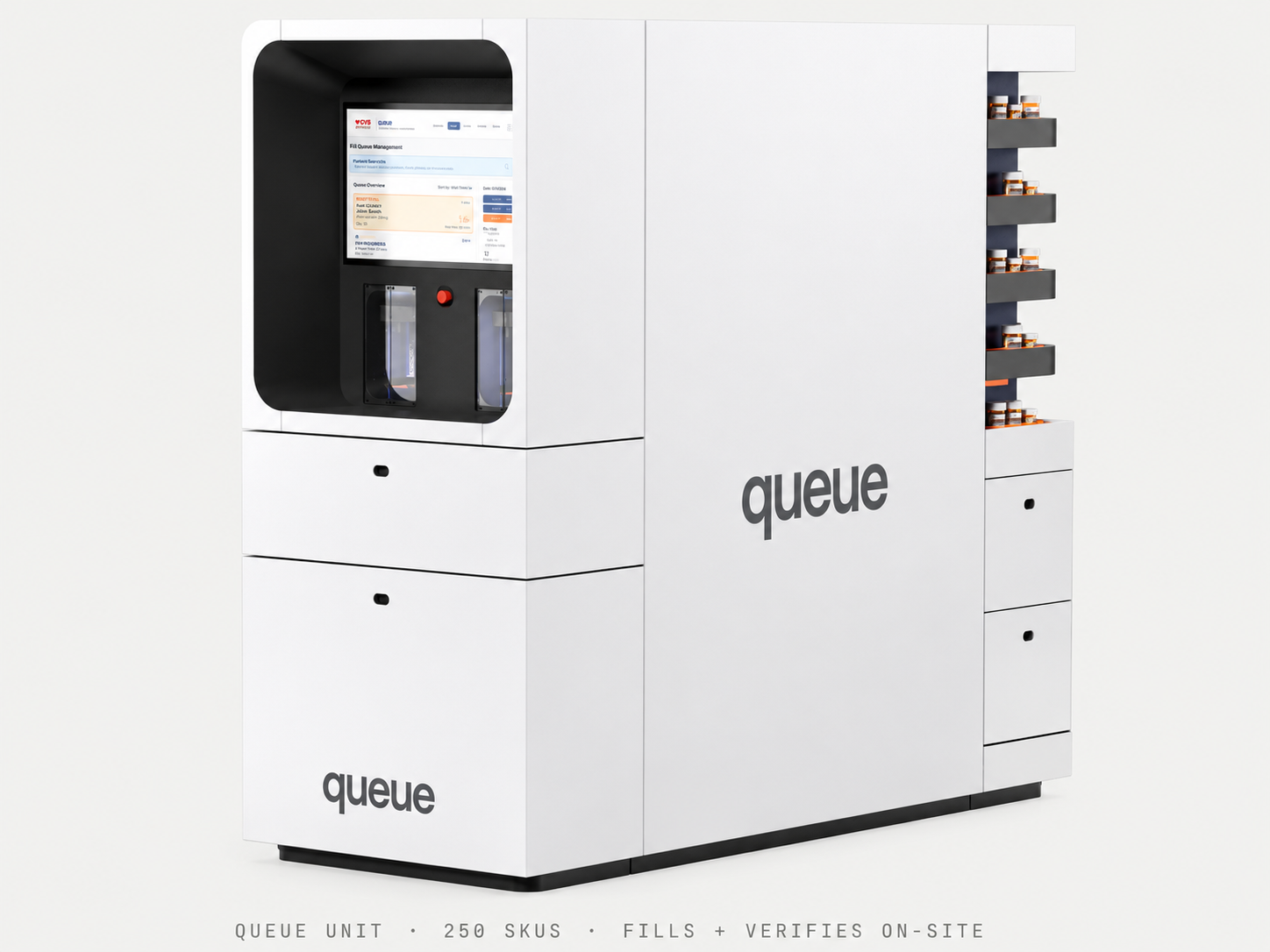
A Palo Alto startup called Queue emerged from stealth on Tuesday with a working robotic pharmacy system, $18.6 million in total venture backing, and a claim that no one in the industry has been able to make before: a sealed wholesale pill bottle goes in one end, a filled and verified prescription vial comes out the other, and no pharmacist needs to be present for any step in between. Business Wire first reported the announcement on June 30, 2026.
Queue’s co-founders — CEO Nick Desai, a six-time venture-backed healthcare entrepreneur who previously led Heal to more than $200 million in funding before it was acquired by Humana, and CTO Josh Liu, whose résumé spans Tesla and Zipline — are entering a U.S. pharmacy market that is, by most measurable indicators, in structural decline. Roughly one in three U.S. retail pharmacies has closed since 2010, according to a study published in Health Affairs by researchers at USC and UC Berkeley. Pharmacy technician vacancies are running at 40% or higher, according to the American Society of Health-System Pharmacists. Pharmacy schools are graduating 3,000 to 4,000 fewer pharmacists each year than the workforce will require over the next five to six years. And pharmacies are increasingly losing money on a growing share of prescriptions because of what the industry calls negative reimbursements — being paid less for a drug than it costs to dispense it.
The company’s seed round of $12.6 million was led by AlleyCorp and followed a $6 million pre-seed led by Riot Ventures less than a year ago, bringing total funding to $18.6 million. Additional investors include House Capital, Ubiquity Ventures, Grep Ventures, and Banter Capital. Queue has already secured an unnamed major national pharmacy chain as its first customer and has deployed a working prototype for early commercial validation.
How Queue’s Robotic Pipeline Actually Works
Queue is not a prescription pickup locker, and it is not a simple pill-counting machine. It is a closed-loop automated dispensing system that handles the entire fulfillment process from bulk inventory to verified patient vial.
Each storage cell in the system holds thousands of pills, loaded from sealed wholesale manufacturer bottles. When a patient walks up to the kiosk and displays a QR code on their phone to verify their prescription, the machine begins the fill sequence. Computer vision identifies every individual pill by matching it to its National Drug Code — the standardized 10-digit identifier that uniquely specifies a drug’s manufacturer, product, and packaging — before it enters the vial, according to Fierce Healthcare. This pill-level optical verification is the system’s primary safety mechanism, intended to catch wrong-drug or wrong-dose errors before a vial is sealed and handed to a patient.
The fill rate is approximately one 60-pill vial every 30 seconds, CTO Josh Liu told The Robot Report. That throughput makes the kiosk economically viable at the retail pharmacy scale — where a traditional counter typically handles around 30 prescriptions per eight-hour shift — and potentially faster for the 250 most commonly prescribed U.S. medications the system currently supports.
A predictive AI layer monitors which medications are running low inside the machine and alerts a pharmacy technician to schedule a refill. This is the one point in Queue’s workflow where a human is required — not to touch the pills or verify the dispensing, but to reload inventory before the machine runs out of a specific medication.
Queue says its system can reduce prescription fulfillment costs by up to 96% compared with traditional pharmacy operations — a figure the company has not supported with a detailed public methodology. The engineering team, which currently numbers 20 engineers in Silicon Valley with backgrounds from Rivian, Waymo, and aerospace programs, is targeting retail pharmacies, hospitals, rural healthcare facilities, and other settings where pharmacy access is limited.
“The accuracy of the drugs we dispense has to be 100% end to end,” The Robot Report quoted Liu as saying. “We think about the problem from the moment the drug is made to when it is imported into the states, put into our machine, and then on the outside coming in with the finished vial filled with your prescription drugs.”
Why Pharmacy is Collapsing and Who Gets Hurt First
The pharmacy crisis creating Queue’s market is not a slow-moving trend — it is an acceleration. The USC and UC Berkeley Health Affairs study found that pharmacy closures more than doubled in the years between 2018 and 2021 compared with the preceding decade. Independent pharmacies are closing at nearly twice the rate of chains. The communities losing coverage fastest are predominantly Black and Latino neighborhoods and rural areas where access to any healthcare provider is already scarce.
The numbers behind that collapse are specific and documented. The Health Affairs study found that approximately 91.6 million people live in counties that saw a net decline in operational pharmacies between 2010 and 2021. An estimated 15.8 million Americans — 4.7% of the population — live in what researchers define as pharmacy deserts, meaning no pharmacy exists within one mile in urban settings or within 10 miles in rural areas. The overall U.S. retail pharmacy market stands at an estimated $670.6 billion, yet the economics for individual pharmacies have become so hostile that closures are now outpacing openings across most states.
For lead investor AlleyCorp, the pitch was less about technology novelty and more about infrastructure necessity. “We believe Queue is building critical infrastructure that can both increase accessibility for patients to get the prescriptions they need, while using robotics and automation to greatly improve labor constraints that exist across pharmacies,” said AlleyCorp general partner Abe Murray in the company’s announcement.
Riot Ventures partner Will Coffield described the approach as addressing the industry’s structural layer rather than its surface symptoms. “Pharmacy has an infrastructure problem. While the industry has been forced to work around labor shortages, store closures and broken unit economics, Nick and Josh have taken a fundamentally different approach: automating the physical fulfillment layer itself.”
What Pharmacists Say Is Still Missing
The case for Queue is most persuasive where pharmacy access has already collapsed. Where it faces the most scrutiny is in the clinical edge cases — the situations where a robotic kiosk cannot do what a pharmacist can.
The concern is not hypothetical. Writing in STAT News in February 2026, University of Utah pharmacy faculty T. Joseph Mattingly II and Mark A. Munger outlined a specific risk: patients whose full medication profiles are dispersed across multiple prescribers, pharmacies, and retail channels have no guaranteed clinical checkpoint at a fully autonomous kiosk. A patient taking five or more medications — a description that fits 20% of U.S. adults, and a far higher proportion of the older adults and people with chronic illnesses who fill the most prescriptions — may not have their full drug profile visible to the system at the point of dispensing.
Adverse drug events are responsible for 1.5 million emergency department visits each year and nearly 500,000 hospitalizations, according to the Centers for Disease Control and Prevention. Even brief exchanges at a pharmacy counter have been shown to identify drug interactions or dosing questions that never surfaced during a clinical visit. That function disappears entirely in a fully autonomous kiosk model — unless the kiosk is built to replicate it, which Queue has not publicly specified.
Mattingly and Munger called for three minimum safeguards for any kiosk dispensing model: mandatory real-time access to a licensed pharmacist on patient request, pharmacist verification of all new prescriptions, and clear automated escalation pathways for high-risk drug combinations. Whether Queue meets any of those three standards is not publicly documented. The company describes its system as supporting “rigorous safety and verification protocols” without specifying what those protocols are, whether they include remote pharmacist access, or how they handle patients picking up a new medication for the first time.
What States Allow Autonomous Pharmacy Dispensing — and What That Means for Queue
Here is the specific obstacle that Queue’s market narrative sidesteps: most U.S. states require a licensed pharmacist to be involved in final dispensing verification — and Queue’s system, as currently described, has no on-site pharmacist.
State pharmacy boards regulate the dispensing of prescription drugs independently in each of the 50 states. A limited number of states have adopted rules allowing pharmacy kiosks or automated dispensing systems to operate under specific conditions, often including remote pharmacist access via real-time video. Among those that had adopted frameworks as of the most recent available regulatory data were Arizona, California, Florida, Idaho, Louisiana, Missouri, and Texas. Most states have not approved fully autonomous dispensing without pharmacist oversight, and none has specifically approved a system where no pharmacist can be reached by the patient at all.
Queue has not disclosed which states it has approval to operate in, what its licensing strategy looks like state by state, or whether its working prototype deployment is operating under a research or pilot exemption rather than full commercial licensure. The company says its early deployment is with a major national pharmacy chain, which typically holds its own pharmacy licenses and could provide a regulatory pathway — but the details of that arrangement have not been specified publicly.
A wide-scale rollout is planned for early 2027, according to SiliconANGLE. Getting there requires not just engineering execution but a regulatory path through state boards that have not yet developed standards specifically for fully autonomous dispensing systems without an on-site pharmacist. Queue is not alone in navigating this landscape — Amazon launched prescription kiosks at One Medical locations in Los Angeles in December 2025 — but the category is moving faster than the regulatory frameworks designed to govern it.
What This Means If You Rely on a Pharmacy
For the roughly 131 million Americans who use pharmacies regularly, the practical near-term answer is: nothing changes yet. Queue’s system is currently a working prototype deployed with one unnamed national partner, supporting the 250 most commonly prescribed medications. A wide-scale public rollout is not planned until early 2027 at the earliest, and only in locations and under regulatory frameworks that have yet to be fully specified.
The longer-term question is more consequential. For patients in pharmacy deserts — the communities where a round trip to fill a blood pressure prescription already means an hour in a car — a verified robotic kiosk in a local grocery store or rural clinic is not a threat to their healthcare. It may be the only realistic option available. For patients on complex medication regimens, the picture is different: the clinical judgment a pharmacist applies at the counter does not currently have a robotic equivalent.
“We think that robotics and AI should be applied in a way that actually enables greater human flourishing,” The Robot Report quoted Liu as saying. “In our particular case, that would mean enabling more connection with people and enabling better service and health outcomes for the general public.”
Queue has built a technically credible machine that addresses a real and worsening problem. The engineering team’s track record — Rivian, Waymo, Tesla, Zipline, aerospace — is serious. The investor backing is institutional. The commercial validation is real. The questions about pharmacist access, drug interaction screening, state licensing, and clinical edge cases are not settled. They are the work of the next two years, and how Queue answers them will determine whether this is a new infrastructure layer for American healthcare or a well-funded pilot that stalled at the state board door.
Frequently Asked Questions
How does Queue’s robotic pharmacy system work?
Queue’s kiosk accepts sealed wholesale pill bottles as input and produces filled, verified prescription vials as output without any on-site pharmacist. When a patient scans a QR code to verify their prescription, the machine uses computer vision to identify each individual pill by its National Drug Code — a standardized 10-digit identifier — before counting and sealing it in a labeled vial. The system fills a 60-pill vial in approximately 30 seconds. A predictive AI layer monitors inventory levels and alerts a human pharmacy technician when a specific medication needs restocking.
What medications does Queue’s robotic pharmacy dispense?
Queue currently supports the 250 most commonly prescribed medications in the United States — a list that covers a large share of the most frequently filled prescriptions but represents a small fraction of the more than 20,000 approved prescription drugs on the U.S. market. Patients on less common medications, specialty drugs, or controlled substances would need to use a traditional pharmacy.
Can a robotic pharmacy replace a pharmacist?
Queue’s system performs the mechanical and optical verification steps of prescription dispensing without a pharmacist on site, but it does not replicate the clinical judgment a pharmacist provides. University of Utah pharmacy researchers T. Joseph Mattingly II and Mark A. Munger published a 2026 opinion piece in STAT News calling for mandatory real-time pharmacist access, verification of new prescriptions, and escalation pathways for high-risk drug combinations in any kiosk dispensing model — standards that Queue has not publicly confirmed it meets.
Is Queue’s robotic pharmacy legal across the United States?
Queue’s fully autonomous model faces a state-by-state regulatory barrier. Most U.S. states require a licensed pharmacist to be involved in final dispensing verification, and the majority have not yet adopted specific rules for fully autonomous kiosk dispensing without pharmacist oversight. A limited number of states — including Arizona, California, Florida, and Texas — have existing frameworks for pharmacy kiosks under specific conditions, typically including remote pharmacist access. Queue has not publicly disclosed its state licensing status or strategy.