India’s healthtech ecosystem numbers more than 4,200 startups founded by over 4,300 founders, spanning digital health, diagnostics, telemedicine, online pharmacies and AI-led care. Per Datalabs, consolidation is well underway, with 108 acquisitions recorded to date. On funding, healthtech has drawn approximately $7.25 Bn between 2014 and 2024, a steady rather than explosive curve, and raised over $700 Mn across 78+ deals in 2024, signaling sustained investor appetite even as the wider market moderated. The sector’s maturity shows in its four unicorns, PharmEasy, Cure.fit, Innovaccer and 1mg, which anchor the top of the capital table.
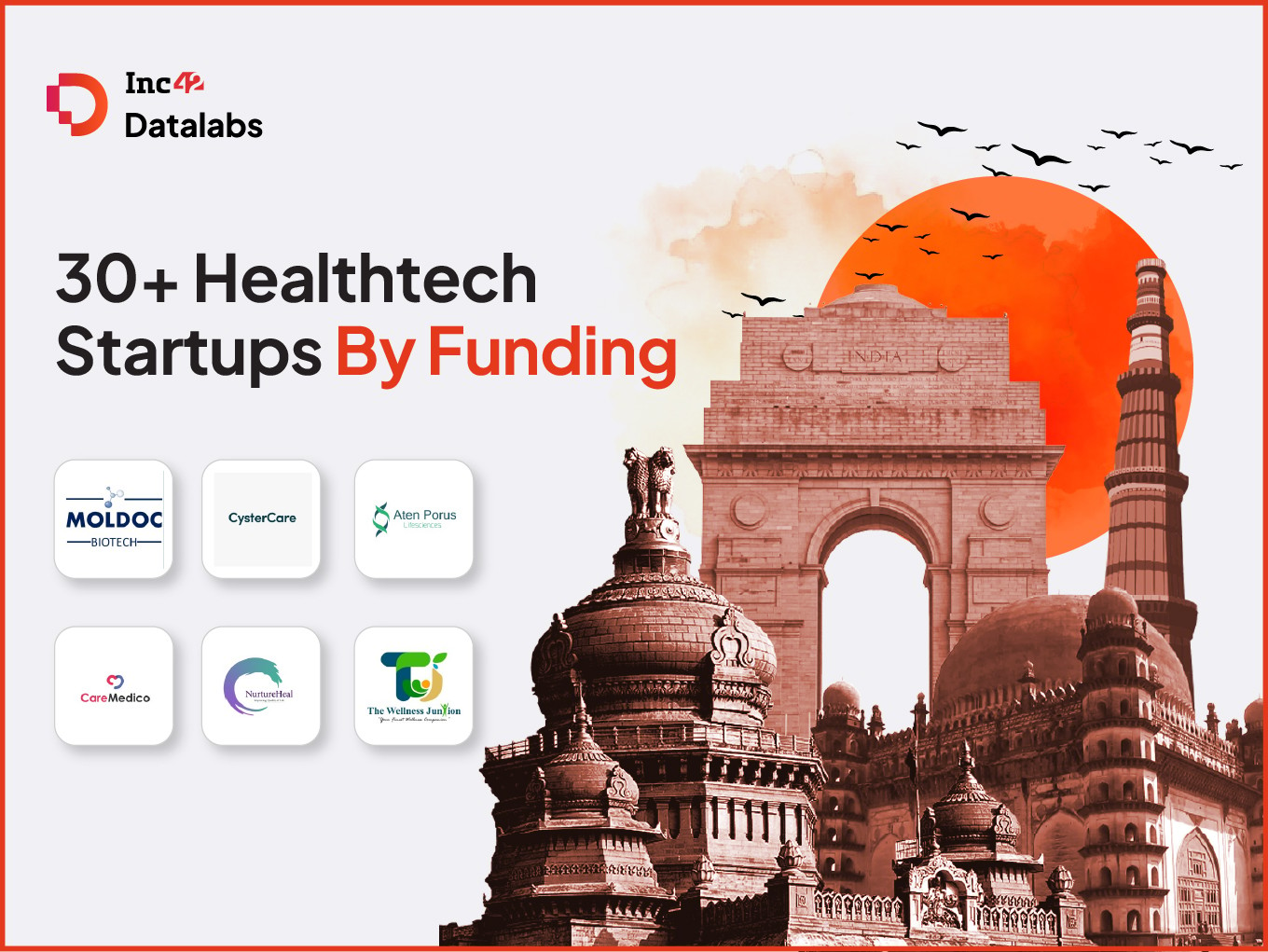
This ranking orders the top 30 companies by total funding raised, per Datalabs, led by PharmEasy ($1.96 Bn), cult.fit ($809.85 Mn), Piramal Group ($771.89 Mn), OneSource ($355 Mn) and MedGenome ($233 Mn). Beneath the leaders sits a deep bench of well-capitalised operators. Innovaccer became India’s first healthtech unicorn on a $105 Mn Series D that valued it at $1.3 Bn, then added a $275 Mn Series F to expand its AI capabilities. Consumer nutrition platform HealthKart pulled in $65.7 Mn from Temasek and A91 Partners, while doctor-discovery and teleconsultation platform Practo has raised close to $228.85 Mn across its rounds. Online pharmacy 1mg, now Tata 1mg after Tata Digital took a majority stake, is the fourth unicorn and remains one of the most valuable e-pharmacy plays in the country.
The capital sits against a large market that healthtech has barely penetrated. India’s healthtech opportunity was projected to reach $21 Bn by 2025, only about 3.3% of a healthcare market pegged near $638 Bn, with healthcare SaaS the fastest-growing slice at roughly 45% CAGR. Even so, no new healthtech unicorn has been minted since 2022, when Tata 1mg last crossed the billion-dollar mark, which is part of why funding is so concentrated at the top of this list. Healthtech’s cumulative $7.25 Bn also stays modest next to ecommerce’s $34 Bn over the same period, a sign that capital in the sector has been selective rather than scarce.