The Tech Buzz may earn a commission when you buy through links on this page. This never affects which products we recommend or what we say about them.
Eric Wu, the founder who took Opendoor public and then walked away in 2022, is back with a new bet: fixing the construction industry’s brutal labor shortage using AI copilots that talk workers through jobs in real time. His new company, NavigateAI, has been quietly building since coming out of stealth in May, and it just locked down $25 million from a roster of investors that includes Elad Gil, Khosla Ventures, and homebuilder Lennar.
Eric Wu built his name turning Opendoor into one of the most closely watched real estate startups of the last decade, taking the iBuying company public before stepping away from the CEO role in 2022. Now he’s chasing a different but related problem: the construction industry can’t find enough workers, and it’s getting worse. His new venture, NavigateAI, has been out of stealth since May, and it just closed a $25 million round backed by Elad Gil, Khosla Ventures, and homebuilder Lennar, according to TechCrunch.
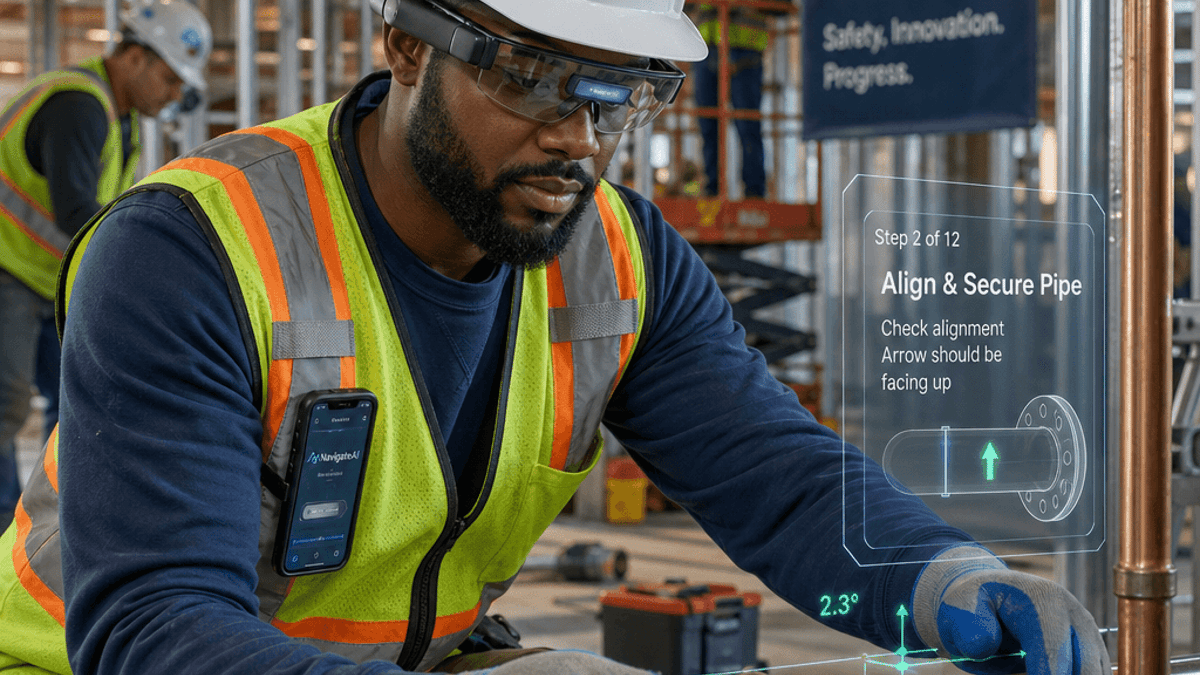
The pitch is simple on its face but ambitious in scope: give construction workers an AI copilot that walks them through tasks step by step, hands-free, using nothing more than a smartphone or Meta’s AI glasses. Instead of flipping through blueprints or waiting on a supervisor to explain a task, a worker gets real-time guidance delivered straight to their field of view or their pocket. It’s the kind of tool that sounds almost obvious once you hear it, which is usually a good sign a startup has found a real gap.
And the gap is real. Data center construction alone now requires somewhere between 4,000 and 5,000 workers per project, a staggering figure that underscores just how strained the labor pipeline has become as AI infrastructure spending explodes across the country. Add in housing, commercial builds, and infrastructure upgrades, and the construction industry is staring down a shortage that isn’t going away anytime soon. Wu’s bet is that AI can’t replace the workers who don’t exist, but it can make the ones who do show up dramatically more productive.
[embedded image: construction worker using AI glasses on job site]
That framing helps explain why Lennar, one of the largest homebuilders in the country, would want a seat at the table as an investor rather than just a customer. Homebuilders have been vocal for years about labor bottlenecks slowing down projects and inflating costs, and a tool that helps less-experienced workers perform like veterans is directly relevant to their bottom line. It’s a similar logic to why Wu found early believers in Elad Gil and Khosla Ventures, both of whom have made a habit of backing founders attacking unglamorous, unsexy industries that happen to be enormous.
Wu’s own history gives the pitch extra weight. Opendoor proved that a founder could take a notoriously offline, fragmented industry like residential real estate and build a tech layer on top of it that actually moved the needle, even if the company’s stock performance since going public has been a rockier story than its early growth suggested. Investors betting on NavigateAI are essentially betting that Wu can pull off a similar trick in construction, an industry that’s arguably even more resistant to software than real estate ever was.
The use of Meta’s AI glasses as a delivery mechanism is also worth watching closely. Smart glasses have struggled for years to find a killer enterprise use case beyond niche warehouse and logistics pilots, and construction could be the environment where hands-free AI guidance finally proves indispensable rather than gimmicky. If NavigateAI can show that its copilot measurably speeds up training and reduces errors on job sites, it could become a template other industrial sectors start borrowing from, much the way warehouse automation reshaped logistics over the last several years.
For now, NavigateAI is still early, five months removed from stealth and just beginning to put its funding to work. But the combination of a repeat founder, a genuinely painful industry problem, and investors willing to write checks before there’s much public proof of traction suggests this is a company worth watching closely as it scales.
NavigateAI’s emergence is less about a flashy new gadget and more about a founder betting his second act on solving a problem hiding in plain sight: America simply doesn’t have enough construction workers, and the ones it does have need better tools to keep up with demand from data centers, housing, and everything in between. Whether Eric Wu can repeat his Opendoor-style disruption in an industry even more resistant to change will depend on how quickly NavigateAI can prove its copilots actually make workers faster and safer, not just on paper but on the job site.