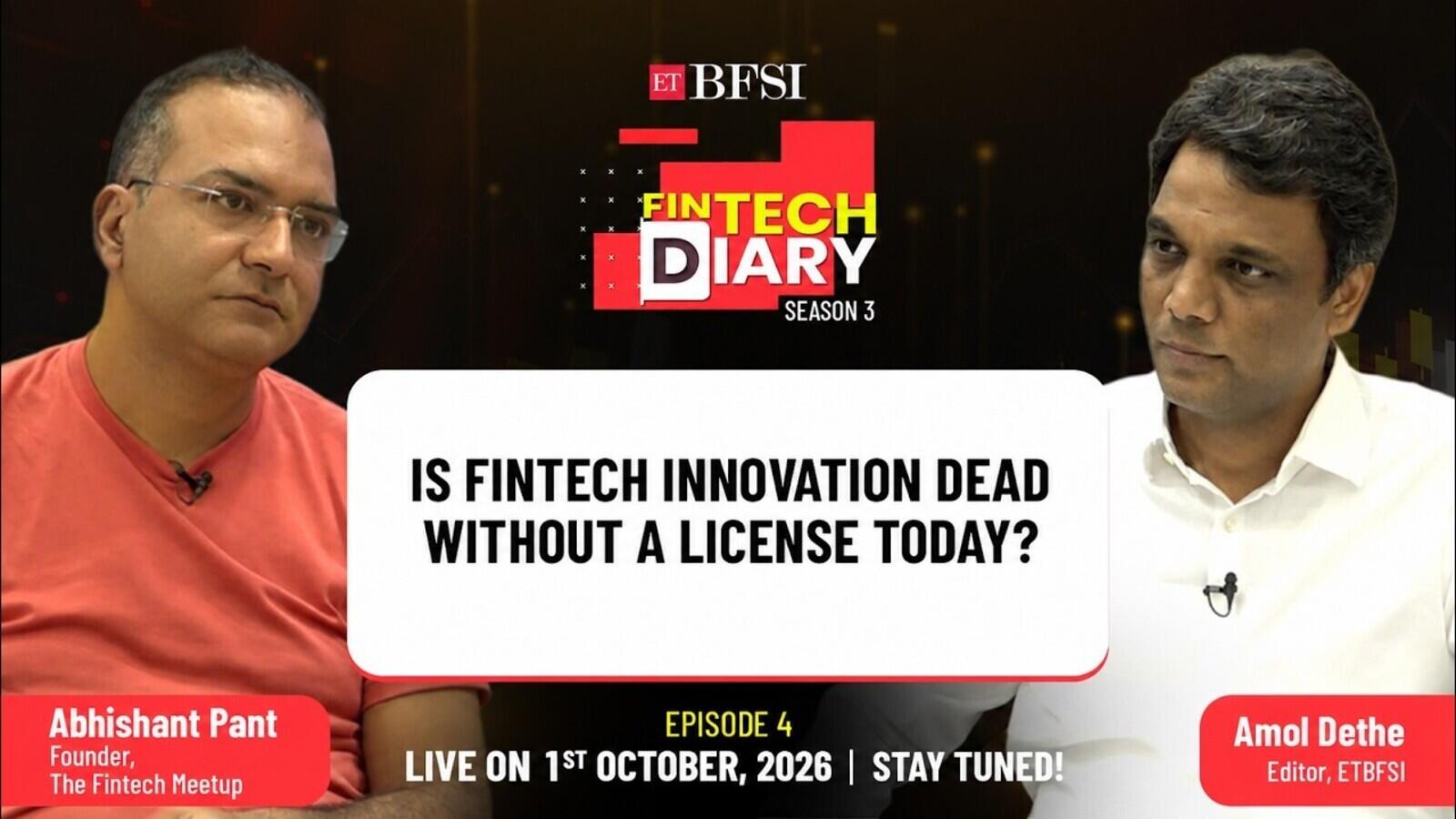



According to Abhishant Pant, Founder, The Fintech Meetup, the ecosystem has moved past the period when startups could simply raise capital on the promise of becoming the “next bank” or disrupting an established financial-services category.
“Whether unicorns will become big or not, cockroaches survive. Cockroaches have survived for long and I hope that Indian fintech finds its cockroaches soon,” Pant said in the latest episode of FinTech Diary Season 3, moderated by Amol Dethe, Editor, ETBFSI.
Pant said the fintech opportunity needs to be assessed across payments, credit, insurance, wealth and data, with each segment now at a different stage of maturity.
Payments loses room for new entrants
Consumer payments, according to Pant, has become largely stagnant in terms of new-player entry, with the market increasingly dominated by large, well-funded institutions.
“There is nothing much which is happening on that side. Anybody who is coming, say super.money, etc., are people who are large institutions, large funded and all of that. So there’s no space for a startup to build anything, and that’s been the case for some time,” he said.
The B2B payments opportunity also faces increasing restrictions, Pant said, despite the underlying opportunity remaining significant.
The result is that several fintech businesses that were able to attract substantial funding four to six years ago are no longer seeing the same level of investor interest.
Consumer credit moves towards maturity
Credit, meanwhile, has developed along two distinct tracks, consumer and business.
Pant said consumer credit has undergone a significant evolution over the past decade, with fintech lenders progressing from startups towards public-market listings.
“The consumer side of the story, practically the journey, its experience, access to credit is something which we have seen and it has played out really well in terms of listings.
According to Pant, this represents a journey that is increasingly approaching maturity, while the SME credit market has struggled to replicate the same digital evolution.
“Because business value chains were not digital in nature, and even today they are not, the journey of evolution of business credit has not happened in the same manner in which consumer credit has happened. As a result of that, what you see today is some form of funding which is happening from an SME side of the story, but the realisation in the venture investor ecosystem is very clear that SME side of the story does not have the same digital and non-linear play which was there in the consumer side of the story,” Pant said.
This has pushed venture investors towards businesses that have a greater physical component, including SME credit, home finance and machinery finance.
Insurance opportunity remains largely in distribution
Insurance presents a different challenge, Pant said.
The sector has broadly offered two fintech opportunities, technology-led businesses and insurance distribution. While the latter has produced large platforms, the technology opportunity has been harder to scale because insurance is a high-value, low-frequency product.
“Insurance is a high value, very low frequency product. As a result of that, if you are building tech for a high value, very low frequency product, your tech will also not create that kind of a value which will get created when you have a tech which is in high frequency,” he said.
According to Pant, this makes it difficult for insurance technology businesses to replicate the economics seen in high-frequency financial infrastructure businesses.
He said the bigger fintech opportunity in insurance therefore continues to be on the distribution side, alongside the emergence of new insurance companies backed by large private-equity investors.
Wealth emerges as a high-value opportunity
Wealth is another segment where Pant sees growing interest, particularly as wealth becomes increasingly concentrated.
“The realisation is that it’s a large play. It’s an identifiable play and it’s a play wherein revenue pools exist. So therefore, fundamentally, you are trying to revisit some of the traditional wealth plays and you are trying to repackage them, build them new and all of that,” Pant said.
He sees a particular opportunity in what he describes as the “neo-wealth” segment, customers who have significant liquid wealth but may not fit neatly into the traditional private-banking or retail-banking segments.
Pant classifies individuals with liquid wealth of more than roughly ₹2-2.5 crore across asset classes as part of this emerging segment.
Five fintech opportunities for the next phase
While several established fintech categories have matured, Pant believes significant opportunities remain in areas that are more difficult to build and scale.
“In my view, the opportunity lies for Indian fintech fundamentally in five spaces. One, building on the SME side of the story at the intersection of digital at the core, human at the core. Second, opportunity lies if you can build at the intersection of agri and finance,” Pant said.
“The third opportunity lies if you can build on fraud as a space. The fourth opportunity lies if you can build on the cybersecurity side of the story. And maybe there are opportunities which can be done from the point of view of what Perfios did in consumer, from the point of view of digital, somebody does the same from an SME point of view,” he added.
Pant, however, cautioned that these opportunities are harder to pursue because the markets are more difficult to define and operate in.
‘Cockroaches’ over unicorns
The changing opportunity landscape is also reshaping what it means to build a successful fintech.
Pant said the industry should move away from the obsession with creating unicorns and focus instead on building businesses that can survive multiple market cycles.
“Whether unicorns will become big or not, cockroaches survive. Cockroaches have survived for long and I hope that Indian fintech finds its cockroaches soon,” he said.
For founders, this means identifying a sustainable business opportunity rather than simply chasing the valuation-led growth model that defined much of the previous fintech cycle.
Pant said the next phase of Indian fintech will therefore be less about the number of startups entering the ecosystem and more about the ability of those businesses to build durable financial-services models.
Source link