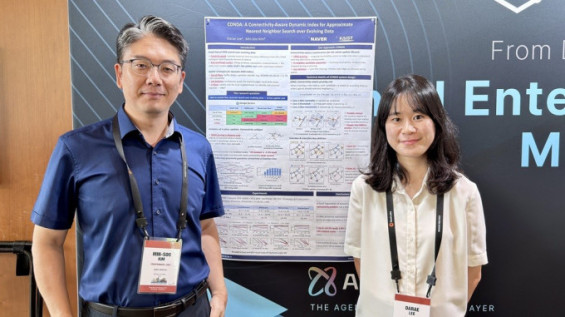
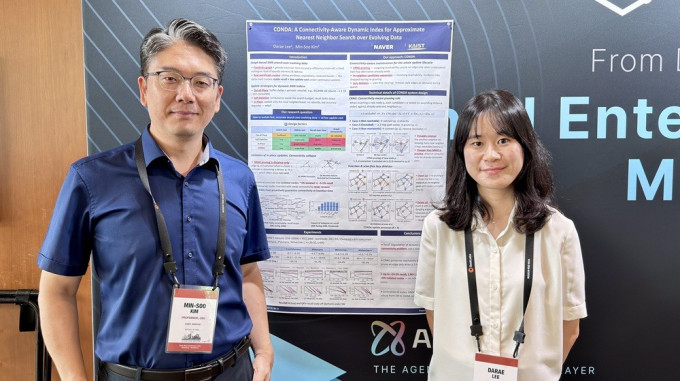
From left: Professor Min-Su Kim of KAIST School of Computing, and master’s student Darae Lee. Courtesy of KAIST
■ On the 5th, KAIST announced that a research team led by Min-Su Kim, professor in the School of Computing, has developed a search technology called “CONDA” that helps artificial intelligence (AI) accurately find required information even as data are continuously added or deleted. The results were presented on September 2 at VLDB 2026, the International Conference on Very Large Databases. Conventional search technologies suffer from broken links between data when new documents are added and old ones are deleted, causing them to miss even information already stored. CONDA maintains these “search paths” and reinforces connections to new data, reducing the chance of missing information. In experiments, it improved search accuracy by up to 24.5% compared with existing techniques, and made processing of data insertions and deletions up to 1.9 times faster. In a six-hour experiment that performed search and updates simultaneously on 100 million data items, it maintained high accuracy and fast response times. The technology can be applied to retrieval-augmented generation (RAG), where AI looks up external resources and uses them in its answers, as well as to corporate document, news, and product search. Graphy, Professor Kim’s startup, plans to release a database product incorporating this technology, “AkasicDB,” in the fourth quarter of this year.
■ Ulsan National Institute of Science and Technology (UNIST) announced on the 5th that a team led by Taesung Kim, professor of mechanical engineering, has developed an “ion switch” that controls ionic flow by forming and dissolving salt crystals. The results were published on September 25 in the international journal Nature Communications. The device uses ions—electrically charged particles—instead of electrons, and consists of a narrow channel about 120 nanometers (nm, 1 nm is one-billionth of a meter) high filled with saline solution. When dry nitrogen is passed through a separate control channel to evaporate water, salt crystals form and block the ion channel; supplying water again dissolves the crystals and allows current to flow. In an experiment that operated the device repeatedly 32 times using a potassium chloride solution, the current in the “on” state was on average 156 times larger than in the “off” state, and it took an average of 8.6 seconds to turn off the current and within 3 seconds to turn it back on. The team also connected two switches to implement a basic logic circuit that processes 0 and 1 depending on input combinations. The researchers expect the device to serve as a fundamental element for computing circuits that mimic the brain’s information processing and for systems that handle bio-signals.
■ UNIST also announced on the 5th that all seven companies recommended this year by UNIST Technology Holdings to the Ministry of SMEs and Startups’ private-investment-led tech startup support program “TIPS” have been selected. In TIPS, a private operator invests in and recommends promising startups, and after government evaluation the selected companies receive support such as R&D funding. General-type TIPS companies can receive up to 800 million won in R&D funding per company over two years, while deep-tech-type companies in advanced technology fields can receive up to 1.5 billion won per company over three years. Five companies—GuardianAI, COPA, NumericTech, Trust Company, and Quantize Labs—were selected for the general type, and two companies—TUNNEL and Cheongmyeong Advanced Materials—were selected for the deep-tech type. TUNNEL is a UNIST faculty startup, Quantize Labs is a student startup, and the remaining five are off-campus companies. UNIST Technology Holdings participated in follow-on investment in TUNNEL and recommended Cheongmyeong Advanced Materials, which had completed the general-type TIPS program, for the deep-tech type so that R&D can continue after the initial technology development stage. Based on an investment platform totaling 38.6 billion won, combining funds currently under management and funds to be formed, it plans to support follow-on funding and overseas expansion for the selected companies.
– doi.org/10.14778/3836663.3836694
– doi.org/10.1038/s41467-026-74735-0
Copyright ⓒ DongA Science. All rights reserved.