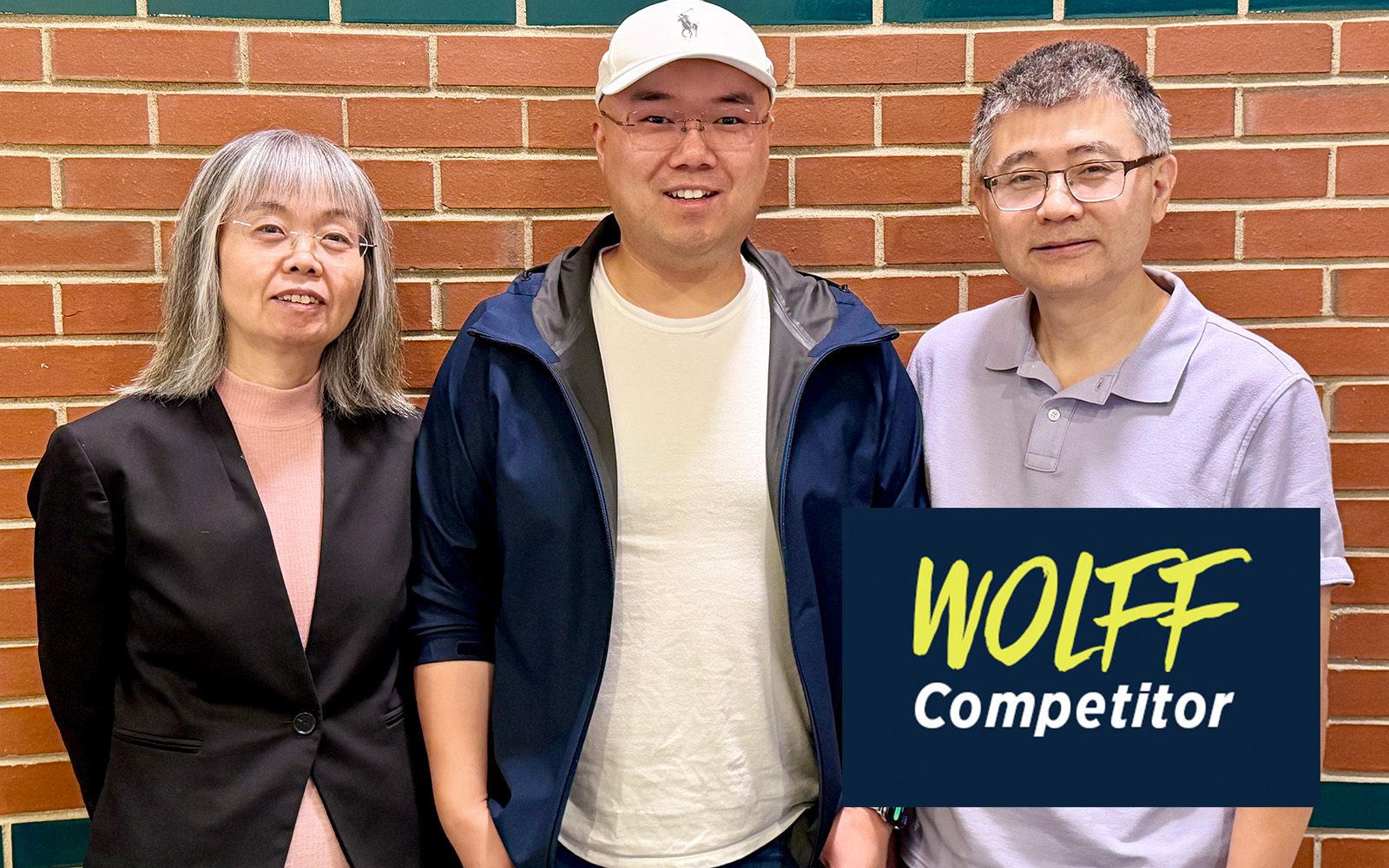
As a scientist, researcher, and now an entrepreneur, Xingyu Wang Ph.D. ‘22 strongly believes that advanced technology should be used primarily to improve the health and happiness of humankind.
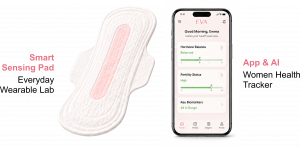
Wang, a post-doctoral researcher, and two of his professors from the College of Engineering, are striving to do that with their newest invention. EVA is a smart-sensing device, embedded in a menstrual pad, that collects data from menstrual blood or vaginal fluid to assess reproductive-health information.
The prototype, which is nearly complete, will be able to identify bacterial and HPV infections. Later phases will recognize signs of hormone changes, including the onset of perimenopause, and even detect chronic illnesses such as endometriosis.
“The doctors I’ve spoken with are all very excited,’’ Wang says. “Historically, women’s health has received insufficient attention in medical research and testing. Although this is improving, more data is needed to better understand and address women’s health needs.’’
“At the same time, finding the time for testing around a family schedule is, at the very least, inconvenient,’’ he says. “We hope women will be able to buy this device at a pharmacy or grocery store, saving them time while providing women and their doctors with more information to support diagnosis.’’
EVA Selected as a Top UConn-Affiliated Startup
EVA is one of five UConn-affiliated startups competing in the Wolff New Venture Competition on Oct. 13 at Pratt & Whitney Stadium at Rentschler Field in East Hartford. Now in its 11th year, the event is hosted by the Connecticut Center for Entrepreneurship and Innovation (CCEI). The competition will award more than $150,000 in prize money, including $40,000 for the first-place finisher.
Wang came to UConn in 2018 to pursue a Ph.D. in environmental engineering and electrochemical sensing technology. He works in professor Baikun Li’s Electrochemical and Biochemical Engineering Lab with Li and professor Yu Lei, also from the College of Engineering. The three business co-founders take great in their company, operating under the name WE-Sensing.
“I finally have the ability to use my knowledge and innovation to help a lot of people,’’ Wang says. “When I’m working on a product problem or barrier, I imagine women buying the product, learning more about their health, and hopefully living a longer and better life. That’s what keeps me moving forward and motivates me to do what I can for them.’’
The entrepreneurs will launch EVA in three phases. The initial prototype, available by the end of the year, will provide information on infections, including bacterial disease and human papillomavirus (HPV). The second phase, hopefully advancing next year, will focus on hormone detection and identifying hormone disorders and changes, including early signs of menopause. Phase three, several years away, would address chronic diseases, such as endometriosis.
The EVA team is confident that their technology design is superior to that of competitors, which typically require at-home blood collection that is then mailed to testing centers. That delays and complicates the process. EVA embeds an ultrathin sensor in a menstrual pad, with a button-sized data logger. Users can receive results immediately via their smartphones. The pad is disposed of, and the tiny data logger can be reused.
CCEI’s Summer Accelerator Helped Wang Develop an Entrepreneurial Mindset
Wang represented the company at CCEI’s highly regarded, eight-week Summer Accelerator program, which assists startup leaders in developing their business plans and offers courses in many aspects of business growth.
“One of the most exciting things to watch this summer was Xingyu’s growth from researcher to entrepreneur,’’ says Alycia Chrosniak, CCEI’s Assistant Director of Brand and Venture Development. “He came into the program with an exciting technology, but over the course of eight weeks, he really pushed himself to think beyond the science and focus on the customer, the market, and what it will take to bring EVA into the hands of the women who could benefit from it.”
Wang is equally enthusiastic about the program and the guidance he received.
“I found that experts from different areas can give you vastly different advice and opinions. I have learned that I have to make the final decisions and to always do it through the lens of the people I care about, the people I’m serving,’’ he says. “Now I have developed an entrepreneurial mindset because I think about how to bring my innovation to real life.’’
If EVA wins the $40,000 Wolff grand prize, Wang says the company will use the money for additional prototypes and to advance customer and market discovery.
“I’m one of the luckiest people in the world,’’ Wang says. “I have a great team, a caring family, and I work with wonderful mentors and colleagues. I’m excited about the work that I’m doing.’’
The Wolff New Venture Competition will be held on Oct. 13 at Pratt and Whitney Stadium at Rentschler Field in East Hartford from 5 to 9 p.m. The event is free to attend and all are welcome. Pre-registration is required at https://luma.com/i2690pqa.
The Wolff New Venture Competition is supported by the generosity of the Wolff Family as well as wiggin(x), Fiondella, Milone & LaSaracina LLP, Sardilli Produce and Dairy Co., Prime Materials Recovery Inc., Big Bang, Baystate Financial, Webster Bank, Mark and Jamie Summers, Putnam Plastics, Eric Marziali, Bob and Linda Delisle, Dick and Carol Stewart and Event Resources.