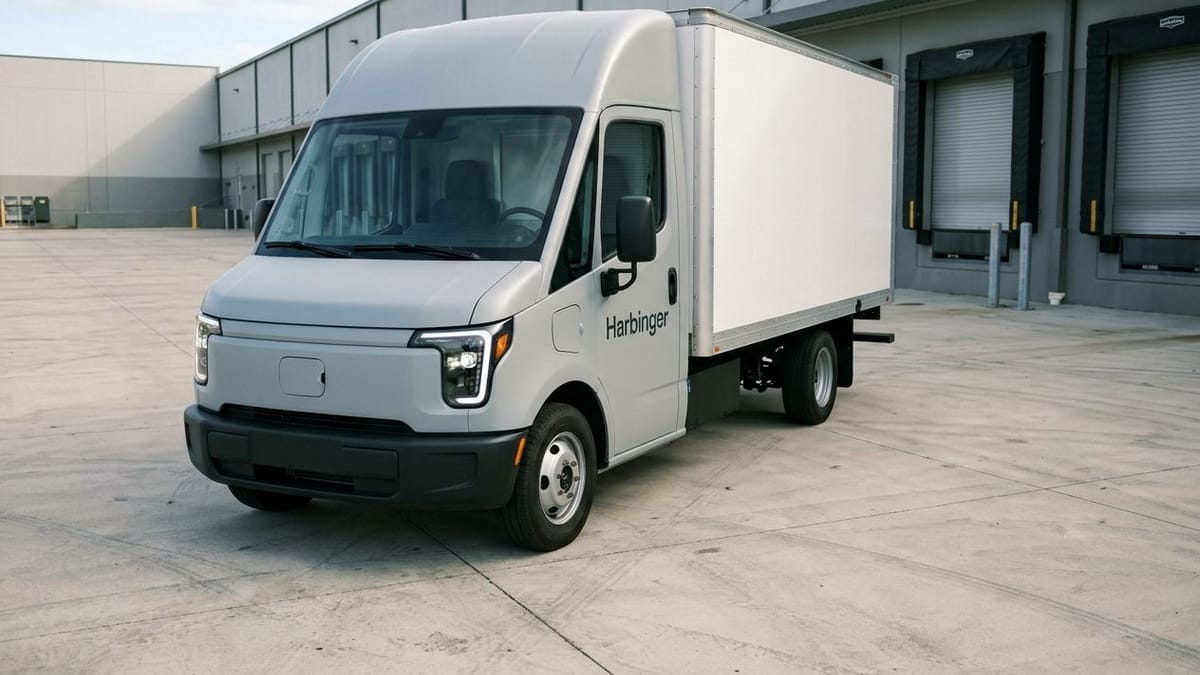
While legacy automakers pump the brakes on electric vehicles, commercial EV startup Harbinger just floored it. The company closed a $240 million Series D funding round this month, riding momentum from a massive $300 million order from FedEx and a fresh defense contract with the US military. Instead of chasing consumer hype, Harbinger’s betting on the unglamorous workhorses nobody talks about: Class 4-6 delivery vans and box trucks that move packages, not headlines.
Harbinger just proved there’s serious money in boring. The electric truck maker announced it closed a $240 million Series D round earlier this month, capping off what might be the most impressive run for any EV startup in 2026. While Tesla and legacy automakers wrestle with softening consumer demand, Harbinger’s racking up contracts by targeting the vehicles most people never notice: the medium-duty delivery trucks and box vans that show up at your door every day.
The timing couldn’t be more striking. As traditional automakers scale back EV investments amid cooling consumer enthusiasm, Harbinger’s commercial-first strategy is attracting exactly the kind of validation that makes investors pay attention. The Series D follows a $300 million order from FedEx and a new defense contract with the US military, signaling that fleet operators see something Wall Street’s been missing.
FedEx isn’t placing bet-the-company orders on unproven technology. The logistics giant’s $300 million commitment represents thousands of Class 4-6 electric trucks, the exact segment where traditional diesel workhorses dominate but electrification makes immediate economic sense. These aren’t flashy vehicles with falcon-wing doors. They’re the trucks that deliver 30 to 60 stops per day on predictable routes, returning to depots for overnight charging. It’s the perfect use case for EVs, and Harbinger built its entire business model around it.
The company’s thesis is deceptively simple: skip the consumer circus entirely and focus on commercial segments where legacy automakers are weakest. Class 4-6 trucks occupy an awkward middle ground. They’re too large for most passenger vehicle platforms but too small to justify the massive R&D investments that Ford and GM pour into heavy-duty pickups. That gap created an opening, and Harbinger drove straight through it.
What makes this approach work isn’t just avoiding competition. Commercial fleet operators make purchasing decisions based on total cost of ownership, not 0-60 times or infotainment screens. They run spreadsheets on fuel savings, maintenance costs, and depreciation curves. When an electric delivery van can save $10,000 to $15,000 annually in operating costs compared to diesel equivalents, the math gets compelling fast. Multiply that across a fleet of 2,000 vehicles, and FedEx’s order starts looking less like a moonshot and more like basic financial planning.
The US military contract adds another dimension to Harbinger’s momentum. Defense applications demand durability, reliability, and domestic manufacturing—exactly the credentials that help a startup mature into a real manufacturer. Military contracts also come with rigorous testing requirements that can validate technology faster than years of consumer market feedback. If Harbinger’s trucks can handle military logistics, civilian delivery routes become a much easier sell.
This Series D round arrives as the broader startup funding environment remains cautious. While AI companies still command eye-watering valuations, hardware startups face intense scrutiny over capital efficiency and paths to profitability. Harbinger’s ability to pull together $240 million suggests investors see a clear route to revenue that doesn’t require convincing millions of consumers to change their buying habits. Fleet sales offer predictability that consumer markets can’t match.
The commercial EV segment is heating up, but it’s not yet crowded. Rivian made waves with its Amazon delivery vans, proving the concept works at scale. Startups like Xos and Lightning eMotors are pursuing similar strategies, but the market’s large enough to support multiple winners. The US alone operates roughly 11 million commercial trucks in the Class 3-7 range, and the vast majority still run on diesel. Even capturing 5% of that market over the next decade represents billions in revenue.
Harbinger’s strategy also sidesteps the charging infrastructure nightmare that plagues consumer EVs. Fleet vehicles return to central depots where companies can install dedicated charging infrastructure. There’s no range anxiety, no hunting for public fast chargers, no wondering if the station will be working. It’s a controlled environment where electrification’s advantages shine and its limitations barely matter.
The company hasn’t disclosed production timelines or manufacturing capacity details, which remain critical questions for any hardware startup. Raising $240 million is impressive, but building trucks at scale requires different capabilities than designing them. The FedEx order provides a clear production target, but delivering thousands of vehicles on schedule will test whether Harbinger can execute on its promise.
What’s clear is that Harbinger found a lane where being boring is actually an advantage. Consumer EVs live and die by hype cycles, design awards, and viral test drives. Commercial trucks succeed by showing up, doing the work, and saving money. It’s not sexy, but it might be the most sustainable path to actually electrifying transportation at scale.
Harbinger’s $240 million raise and FedEx partnership demonstrate that the most important EV revolution might be the one happening in plain sight. While headlines chase consumer vehicle drama, the real transformation is coming for the commercial fleets that move goods every single day. If Harbinger can execute on production and deliver on its promises to FedEx and the military, it might prove that the path to profitable EV manufacturing runs through delivery vans, not sports cars. The next few years will reveal whether boring really does win, or if commercial EVs face the same execution challenges that have tripped up so many ambitious startups before them.