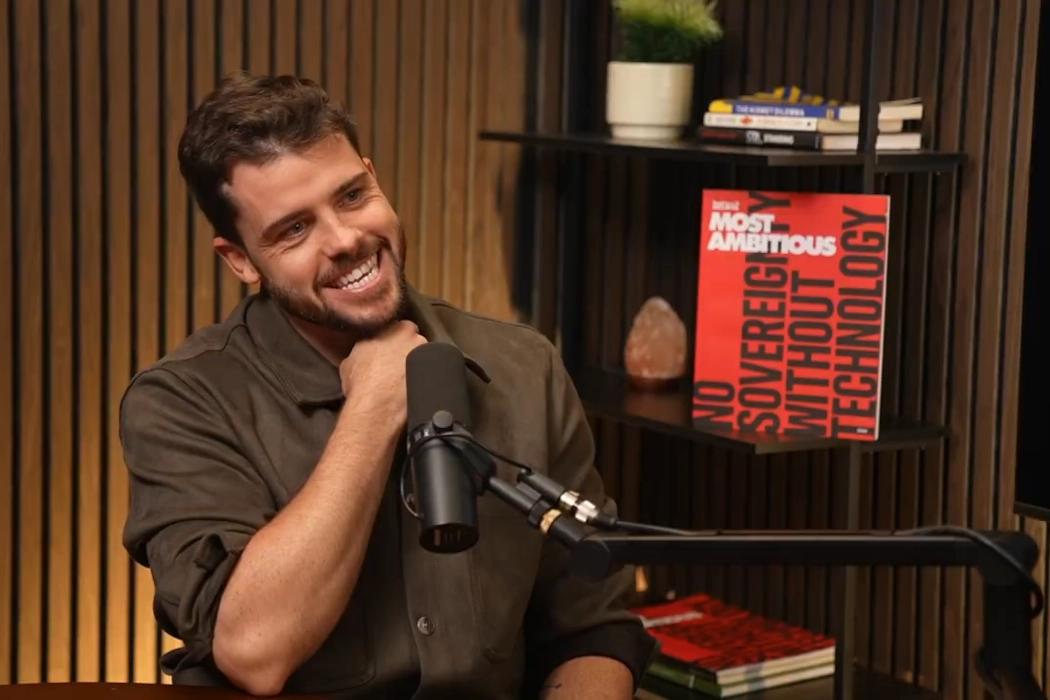
Founder reflects on winning and losing on his own terms as his FinTech startup nears official bank status.
Daniel Eberhard has hit some milestones not many founders have. Last summer, the CEO and founder of Toronto FinTech company Koho saw the company’s valuation reach unicorn status following a $130-million Series E round, joining an increasingly exclusive club of non-AI startups to do so in the post-2023 era.
En route to securing a banking license that, if obtained, will vault Koho into the Canadian challenger bank category, Eberhard sat down with BetaKit Editor-in-Chief Douglas Soltys for a conversation about what he’s learned about leadership on the road from startup to billion-dollar valuation, why he’s not game for prediction markets, and the very peculiar list he keeps in his office. An excerpt from that conversation is below.
The following interview has been edited for clarity and length.
You raised a Series E round earlier this year that got Koho over a $1-billion valuation. What does that mean for the company after a decade?
Internally, I still don’t really think of Koho as a unicorn, even though we are. The cool part is it’s a validation of the team, the work that we’ve done to get here, and the capital in itself is very useful.
There are on the order of 150 unicorns minted each year in the world. Roughly 70 percent of those are AI companies right now. So it’s 40 companies each year that do what we’ve done.
The other part is that only eight percent of companies that make billion-dollar valuations go on to build $10-billion businesses. Fifty percent of them never raise another round, never get acquired. So, 50 percent of them are zombie unicorns. If you just do that math, you’re like: OK, we have a one-in-10 shot.
On the other side, what keeps you humble is that we didn’t do this to be a unicorn. In that respect—who cares? It’s incidental to what we’re trying to do as a business.
Has the perspective around valuation changed in the post-2023 AI era? Do you see Koho and FinTech in a different space relative to what’s going on in AI?
I don’t really care. We are not out to chase valuations; we’re here to build a wonderful business. There’s a nature of cyclicality to what we do, and I don’t spend a lot of time losing sleep over it.
It’s been a 10-year journey for Koho, and you’re coming up to this major milestone of obtaining a banking license. I’m wondering what’s still driving you to get to the end of the beginning?
The team is really good, and I’m having a lot of fun. If the job today was like it was during the first five to eight years, I don’t think I’d have the gas in the tank. I’m at a different phase in life now. I have two young kids, and I’m trying to figure out how I can do this job for the next 25 to 30 years. At the same time, even if I did stop, what would I do? I like this business. I think we’re positioned better than anyone in the country to go solve our version of the problem. We’ve worked our butts off for a decade plus to position ourselves this way, and I do think it takes 25 to 30 years to build a truly generational company.
RELATED: Koho secures $190 million CAD in equity and debt to bolster banking licence efforts
What changed from those first seven or eight years to the point where you’re now having fun?
It’s a confluence of factors. Certainly part of it is existential risk that is not present in Koho the way it used to be. Before, if we ran out of money, we died. We’re in a better position now, and it makes it much easier. The distribution of outcomes is very different.
The other thing is that the team is really good. As you get to this stage, the folks you have around the table are very competent and much better than me in many ways.
There was a Maclean’s interview you did recently; it was revealed that on the wall of your office, you have several motivating, inspirational things. But there’s also a list of names of people that have burned you, or didn’t believe in you. What’s going on there?
I’m happy to talk about it. There are two things on my wall. One of them is a poem called If by Rudyard Kipling and another called Defeat by Kahlil Gibran. But yes, I have a list of people. I used to lean on it a lot more. I kind of consider it dirty fuel and I think there’s a certain utility to that which is like anger or spite. There’s a part of you that’s like “Fuck you, I’m going to prove you wrong.” I think that’s important and useful. There’s obviously much healthier ways to get your energy, though, and building from a place of wholeness and completeness, and that’s what I’m trying to do now.
In the Maclean’s article, there was a reference to what happened in 2021, kind of at the very end of the zero interest rate period (ZIRP) and the end of Tiger Global coming in and throwing checks at a bunch of Canadian companies. What happened at that moment?
In 2021 it was really interesting because it was ZIRP and I was listening to certain members of my board a lot, and I kind of thought of them as the adults in the room; these folks were telling me to grow, grow, grow, double headcount every year, that kind of stuff. Then ZIRP went away, and I was way too deferential to these folks, and they were like, “Why is your burn so high?” It was a total 180-degree flip, and it got really contentious, and I just remember thinking I could follow these people’s advice perfectly, and even then, if it doesn’t work, the bag’s with me. So, I may as well fail or succeed on my terms. That was a really clarifying moment for me as a CEO. It almost killed the company.
So, there is this kind of thing of people that I do want to prove wrong. I don’t look at it that much anymore.
Are you still in contact with those people?
Yeah. We have a great relationship. They’re still on my board. We still have to have productive working relationships. We have a really good board with a lot of healthy conversation and mutual respect.
RELATED: Koho wants to be the new bank on Bay Street
At NACO Summit this year, you talked about the idea of launching a telco. Talk to me about the strategy there.
We don’t have anything to announce right now, but the question we always ask ourselves is: can we give people more agency in their life if we give them better financial tools? If part of that better financial tool is a telco, or access to phone plans at $20 a month, then we’re fairly agnostic about what types of things we’re delivering, assuming it’s useful for the user and we can deliver it in a cohesive way.
There’s been some new competition in Canada, and it mostly seems to be coming from international FinTechs. We’re starting to see some US-Canadian partnerships. Is the real competition going to be international incumbents or disruptors?
I welcome competition, one, for the reason that it makes us better as a company, and two, that it makes the products and services better in Canada. I don’t want Koho to win because we’ve had an insulated market where we didn’t go up against the best companies in the world. That’s not interesting to me. And we like our position because it’s taken us five years to get a banking license, and we may bank some of these entities as they come into Canada. We have a lot of call options in terms of how we think about it.
We’ve seen that the 2015 cohort of young, shiny FinTechs has grown up to capture a meaningful share of the market, yet I haven’t seen too much change from the larger financial institutions. How do you see the market changing?
I think the banks have proven they largely, with few exceptions, have a very, very hard time changing. That said, we are all still incredibly small relative to the banks. So when we talk about this at Koho, with 2.5 million accounts, we think, cool, let’s go directly impact two-and-a-half million people. The way you indirectly impact the entire landscape of the country is when you start showing up on a bank’s earnings reports. That’s how they go: oh yeah, maybe we should stop paying savings rates of 0.01 percent.
Watch and listen to the full conversaion on The BetaKit Podcast:
Feature image courtsy The BetaKit Podcast.