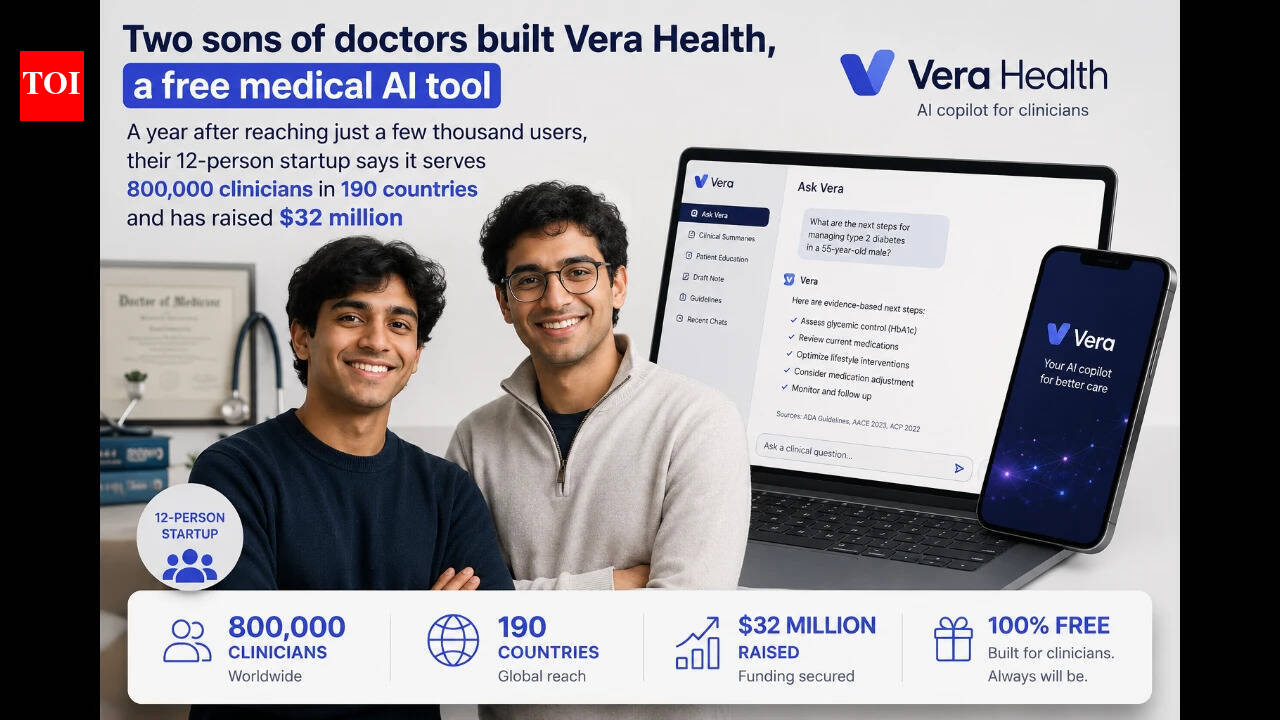

A year ago, Vera Health had a few thousand users. The company says it now serves more than 800,000 clinicians in 190 countries, and it has raised a $28.5 million Series A to keep growing. Threshold Ventures led the round, with participation from Mantis VC and SV Angel. Existing investors Y Combinator and Gradient also put in more money, bringing Vera’s total funding to $32 million. The company says it has done this with only 12 employees and little marketing. Most clinicians found the tool through colleagues, it says. Vera also says it has been the most downloaded clinical app in the world every month since June, and that in September it was downloaded more often than OpenEvidence and Doximity combined. Those figures come from Appark data cited by the company. Monthly downloads have more than tripled since February.Vera is strongest in Europe, according to company data. About one in four physicians in Spain and Italy use it, as do about one in seven in France. The company says daily active users already exceed the monthly active users it had when it raised the round, and that clinicians now ask it hundreds of thousands of questions a day.
How it works
Vera is a clinical search engine. Its pitch is that it finds the evidence first and writes the answer afterward. It searches more than 60 million peer-reviewed papers, guidelines, consensus statements and drug labels. It ranks sources by study design, level of evidence, cohort size, recency, journal quality and citation impact. Each claim links to its source and is color-coded by the strength of the evidence behind it. For a rare condition with only a small case series, the answer shows up red, so doctors can see how little supports it.“Unlike other tools, we believe there’s value in making uncertainty visible,” co-founder Maxime Allouch said.The tool is free for licensed clinicians and trainees. The company says it does not train on their questions and is HIPAA and GDPR compliant and SOC 2 Type II certified. It has a partnership with the American College of Emergency Physicians, which puts the group’s clinical policies into answers with source attribution. Health systems can also load their own protocols through a feature called Vera Spaces.
Built for their fathers
Allouch and Taieb Bennani, both MIT graduates and sons of physicians, founded Vera in 2024 at Y Combinator. They first built it for their own fathers. “Everyone on our team is a clinician, or the child or sibling of one,” Bennani said. He credited that background for the product’s spread among doctors.The company says the new money will go toward its evidence infrastructure, expansion into more markets, and partnerships with medical societies, publishers and health systems. Bennani said the mission is to “close the gap between what medicine knows and what every patient receives,” and that he wants the gap measured in seconds rather than years.
How Vera Health differs from general AI tools
Unlike general-purpose chatbots, Vera Health is built specifically for medical professionals and emphasises evidence-based responses. The platform searches more than 60 million peer-reviewed publications, clinical guidelines, consensus statements and drug labels before generating answers. Each claim is linked to supporting research and includes indications of the strength of the available evidence.“Clinicians are the best data scientists I’ve ever met,” said Taieb Bennani, co-founder of Vera Health. He added that many members of the company are either clinicians themselves or family members of healthcare professionals, helping shape the product around real-world clinical needs.Meanwhile, co-founder Maxime Allouch said the platform is designed to make uncertainty visible rather than presenting every response with equal confidence, a key distinction in medical decision-making.