Health + Science
Founder of HerMD, Dr. Somi Javaid explains how longer appointments, better training, and insurance-based access are giving women the power to lead their care and, in the process, changing outcomes nationwide.
Dr. Somi Javaid didn’t just choose her career—she was called to it. While she was still a pre-med student at Northwestern, she received a life-altering phone call from her father: her mother was fighting for her life. “She had been struggling with left arm pain, shortness of breath and chest pain, and had been begging her doctors to listen to her and because she had lost her mother and sister before her,” Dr. Javaid said.
Her mother’s symptoms were dismissed because, as Javaid puts it, “science and data could not explain why a thin, non-smoking, Middle Eastern woman would ever present with four vessel disease.” Her mother survived emergency quadruple bypass surgery, but the experience left a mark. “In that moment, I realized that women needed an advocate and that I was going to change healthcare as we knew it.”
Years later, after working in a system that gave her just minutes per patient, Dr. Javaid founded HerMD, a national women’s healthcare startup that challenges the status quo of OB/GYN care. The model is built on longer appointments, deep expertise in menopause and sexual health, and a commitment to insurance-based access. “Who could get anything done in a five to seven minute appointment, especially when you have to get naked? Nobody,” she said.
At the core of HerMD’s model is education—not just for patients, but for clinicians. “We have to train existing providers now! Yes, medical school, yes, residency. But what about the doctors we are seeing right now? Those guys aren’t going to be out for 15 to 20 years, which is great for our daughters, but what about us?” That is why they created a HerMD University, to train existing providers in real time, for actionable results. According to Javaid, 93% of OB/GYN residents graduate without training in menopause, a life stage that accounts for nearly 40% of a woman’s life. “I knew how to deliver babies and take care of reproductive years,” she said. “I knew nothing about menopause and perimenopause.”
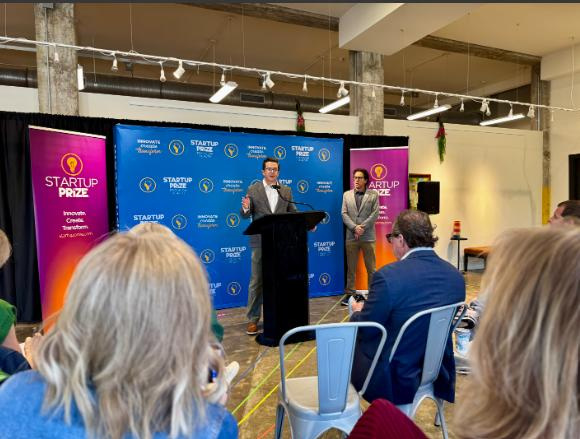
HerMD is also tackling a culture of silence and stigma around female sexual health, an area of medicine long underserved. “We have 29 medications for men. Any idea on how many we have for women?” she asked a room of attendees. “Addyi… First ever female sexual healthcare drug approved 10 years ago. Less than 5% of providers know about it. Less than 1% of the general public knows about it.”
But with information comes responsibility—and sometimes, fear. For HerMD, the future is about empowering women to be the CEOs of their lives and healthcare. Dr. Javaid urges patients not to not give up on gaining the answers they seek. “I tell my patients to get big, take up space,” she said. “Don’t be afraid to ask questions. If your provider is not responding to you, is not an expert in that area, find a provider that is willing to listen to you.”
HerMD’s mission is rapidly scaling. The company has raised nearly $50 million in venture funding, including a $10 million check that came only after a hard “no.” “No is not in my vocabulary,” she said. With demand growing nationwide, Javaid and her team are pivoting away from brick-and-mortar expansion and going all-in on virtual care. “I couldn’t stand that women were traveling from 35 states and three countries to Cincinnati, Ohio,” she said. “So by going virtual only, we’re going to be able to hit all 50 states by next year.” Making this care accessible to all those who need it has always been a top priority.
For other entrepreneurs—especially women—Dr. Javaid shares a hard-won piece of wisdom: “Titles don’t entitle you. So for founders, don’t assume other people know more about your business than you do. Always lead with mission.”
HerMD’s mission is simple but transformative: return control of healthcare to women, with better information, trained providers, and time to be truly heard. “I want an empowered experience where a woman feels complete bodily autonomy, and she makes an educated decision about her health care based on the data of today, not the myth of yesteryear.”
Watch my full interview below.