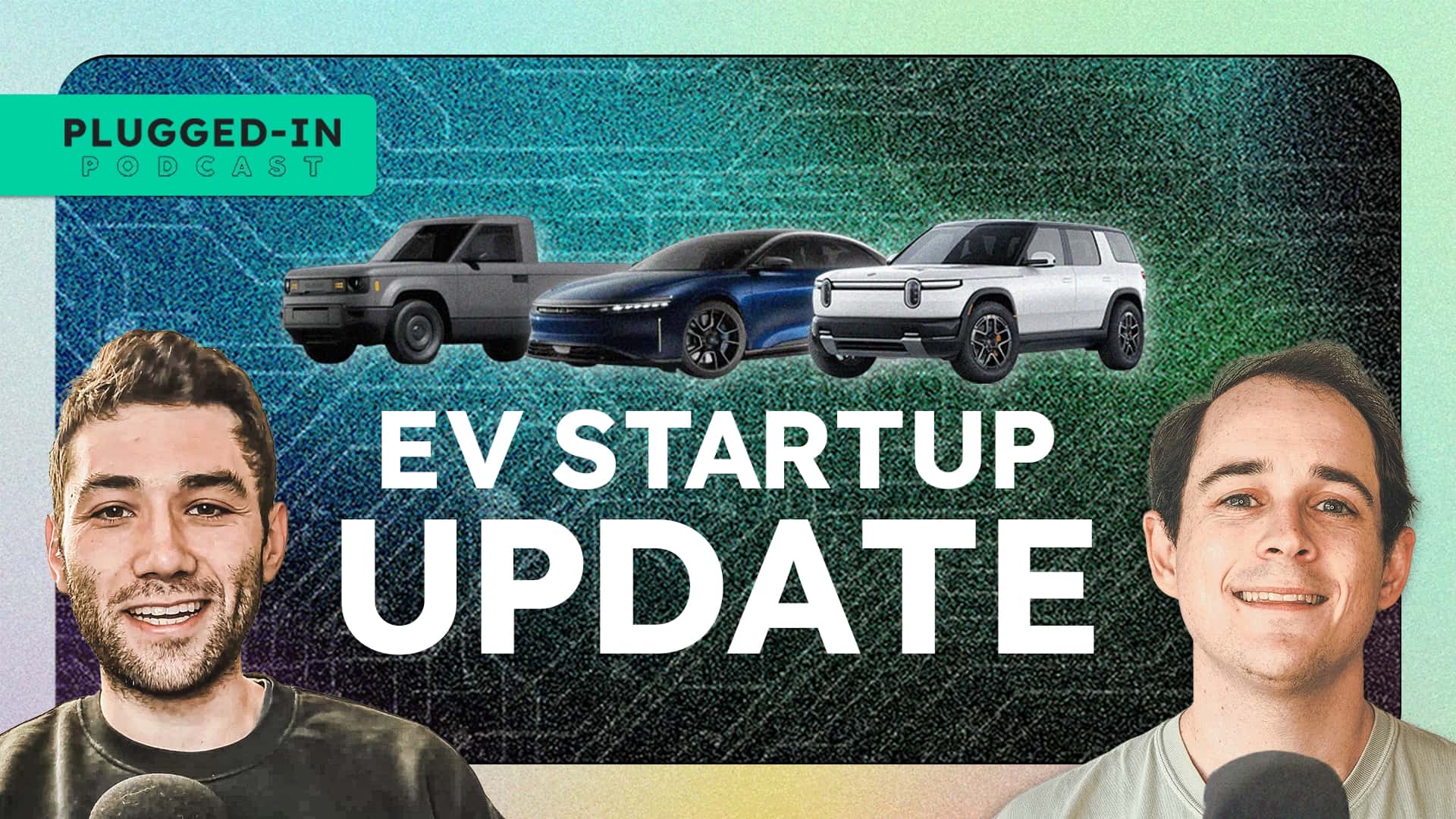
Rivian, Lucid, and Slate need to get this year right. All three are planning to launch crucial products this year, and all three are racing to scale up and start earning money. But in the meantime, they’re trying to stay alive and relevant in an increasingly hostile market.
To do so, Lucid just tapped a new CEO and a $550 million investment from its majority owner, the Saudi Arabian Public Investment Fund. Combined with a new $200 million investment from Uber and an agreement for the ride-sharing company to buy 35,000 Gravity robotaxis, the new injection of cash and sales should help Lucid survive until it can launch and scale its more mainstream products, the Cosmos and Earth.

Lucid will make three vehicles on the mid-size platform, the Cosmos, the Earth, and an unnamed, more adventure-focused third product.
Photo by: Suvrat Kothari
Those are key products for the brand. The company started with a high-dollar luxury sedan, the Air. It’s an excellent EV and a range monster, but modern car buyers have largely shunned big, expensive sedans in favor of SUVs. The Gravity three-row was supposed to address that issue, yet it got off to a rocky start, and competes in a relatively low-volume, high-end part of the market.
The Cosmos, Earth, and one other product will ride on a mid-size platform aimed at the heart of the car market. This is the segment where products like the Tesla Model Y and Hyundai Ioniq 5 compete, with serious volumes and serious competition. Can Lucid’s alternatives match up? Early indications are good, but there’s a long road ahead. Lucky the company just got more money to survive the journey.
Slate’s got some more money coming in, too. The company just announced a $650 million Series C funding round anchored by TWG Global. That should ensure that its roughly $25,000 electric pickup truck can make it to market. The idea is iconoclastic: Rather than bundling in equipment that most consumers want, Slate will offer a truly bare-bones truck and leave accessorization and upgrades to the consumer. That means it’ll launch with crank windows, no infotainment screen, two doors, and an available “SUV kit” that allows buyers to convert it from a truck to an SUV on their own time.
42
Source: Slate
The plan is to start production this year, but we’ll have to see if the truck can still be a hit after the end of the $7,500 federal tax credit. My bet is it’ll be popular with fleets and enthusiasts out of the gates, due to its low starting price, simplicity, and presumably tiny operating costs. The big question is whether this untested kind of vehicle will land with the broader public.
I’m not convinced it’ll win out as a pure value play, as there are sub-$30,000 vehicles that come standard with power windows, four doors, radios, and all of the stuff you want from the factory. But I do think it’ll be a popular lifestyle vehicle for the tech-skeptical, DIY-oriented crowd. The question is how many of those people are in the new car buying population, and how many will truly put their money where their mouth is. I don’t have an answer yet, but we’ll find out when the Slate launches at the end of 2026.
The Slate truck can transform into an SUV with a user-installed kit. But it still gets only two doors and a tiny overall footprint.
Photo by: Tim Levin/InsideEVs
Rivian, too, is in its make-or-break year. Deliveries of the mid-size, more affordable R2 are supposed to kick off this spring. But spring has started, and the clock is ticking. The company is keeping its momentum up with growing sales of the R1 and Electric Delivery Van, as it builds out its service and sales network to support its new, higher-volume product. Can the company stick the landing on quality, service, and consumer interest?
On the consumer interest side, I think the R2 will do fine. Early reviews—including from former InsideEVs editor-in-chief Patrick George—were glowing. The design is a slam dunk. The brand is aspirational. Rivian just needs to avoid the teething issues that have ruined so many EV launches in the past while ensuring its service centers are ready for the extra demand. The company is clearly working on the latter issue. Only time will tell if that work pays off.
98
Source: Patrick George
I’m hopeful. But I don’t know. It’s a bizarre, bizarre year to be launching an EV. To do so as a start-up brand will be a tough challenge for all three of the major players here. I believe there is absolutely room for more direct-to-consumer, EV-only mainstream brands. Will Slate, Lucid, and Rivian claim that space? We’re about to find out.
Contact the author: [email protected].