Welcome back to Asia Tech Review, your curated digest to keep up to date with tech news across Asia.
Today, we are all about exits! Hong Kong has what may be its largest tech acquisition and there’s an impending IPO for a Singaporean startup that rode the VC peak, survived Covid and is now profitable.
Enjoy your Friday and have a great weekend!
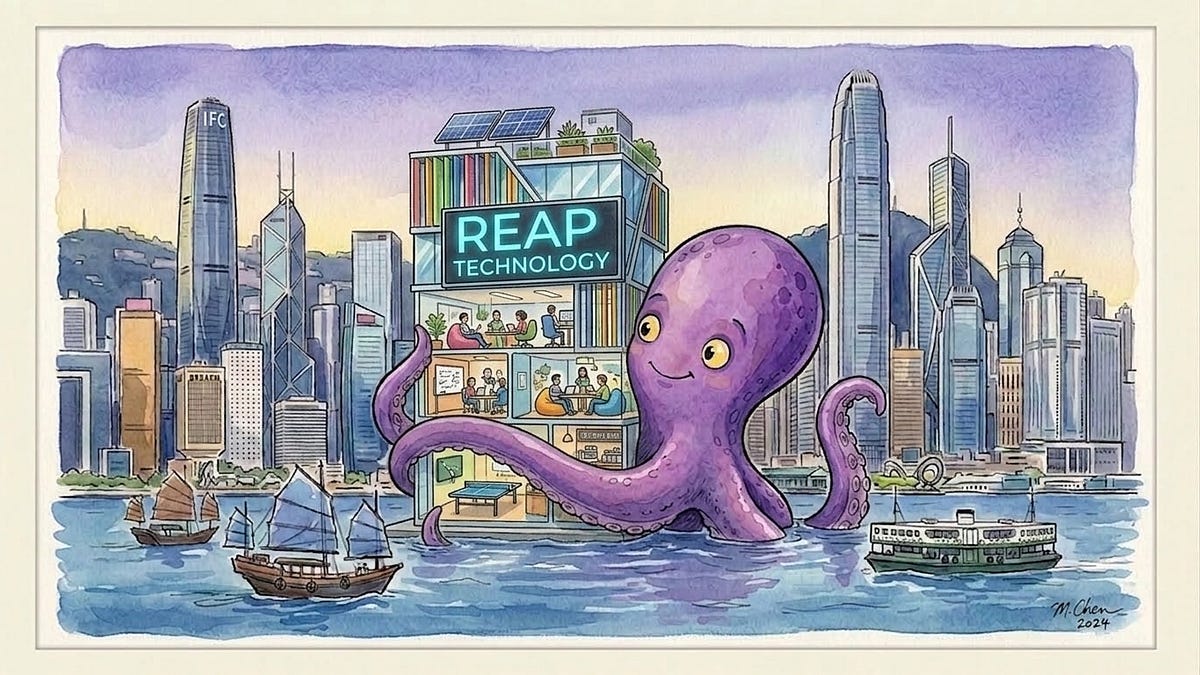
Hong Kong has seen one of the biggest tech M&A exits in its history after stablecoin banking platform Reap was acquired by US crypto exchange Kraken in a deal worth $600 million.
The acquisition is led by Kraken parent company Payward, and it includes a mix of cash and stock that values Payward at around $20 billion. That’s an important number as the company is preparing to (finally) go public, with CEO Arjun Sethi saying it is 80% ready.
The Reap deal is Payward’s second major acquisition in a month, following the capture of derivatives platform Bitnomial. That deal gives Kraken more services in the US, but the Reap acquisition will finally give Kraken a strategy to grow its reach in Asia.
Eight-year-old Reap enables companies to manage their finances using stablecoins instead of traditional banking. Like Aspire, which we wrote about last week, Reap took its early cues from Asia’s diverse financial markets which encouraged support of multiple currencies and markets from day one. But, unlike Aspire, there is no obligation for a bank account. Reap’s features include stablecoin payouts, treasury management, card issuance, global payments, tracking and spending and more.
It will be interesting to see how Kraken/Payward put Reap to work. Certainly it looks like a strong growth play ahead of the IPO, the narrative could move beyond trading into fintech infrastructure, payments and stablecoins.
Already, there are some clues.
Sethi told Bloomberg that Asia is the fastest growing crypto market in the world, and that Reap can not only give Kraken a platform to expand but it can bring its services to the US market, too. That marks another Asia payment platform taking aim at the US, Airwallex, Aspire and now Reap.
Reap’s founding story is also symbolic of its positioning and East-West bridge. Guo was one of the first 100 Stripe employees and he headed up APAC, while his co-founder Kevin Kang has a background in Canadian investment banking and Southeast Asian infrastructure investment.
Some funding databases put the startup’s total funding at around $60 million, but Reap’s own disclosures point to around $46 million. Either way, this looks like a decent exit for its investors, which include Index Ventures, Global Founders Capital, Fresco Capital and Hustle Fund.
I can’t immediately recall a Hong Kong-based startup being acquired for anything like this size, but there have been exits via IPO in the city, many from Chinese companies. Travel platform Klook is probably the one to watch, but Reap has helped put Hong Kong on the map. It’s certainly fitting given Hong Kong just issued its first stablecoin licences and has made strong progress on becoming a global Web3-fintech hub.
I was fortunate enough to speak to co-founder Daren Guo at Money/2020 last month, and hope to have more from that interview soon.
Southeast Asia is notoriously exit starved, especially when it comes to IPOs, so it’s notable that one-time WeWork rival JustCo has filed to go public on the Singapore Exchange (SGX).
The company only lodged its preliminary prospectus yesterday so details of the raise, valuation and more are not yet clear. It is likely to be a huge valuation, initially at least, but it is a positive sign for exits and support in the ecosystem nonetheless.
Founded in 2011, one year after WeWork was born in the US, JustCo operates 54 workspaces across ten countries in Asia Pacific and Australia. It started out modestly before going down the venture capital route with a Series A in 2015 and Series B in 2017.
The business took on a new life in 2018 when it closed a massive $177 million round from Singaporean sovereign fund GIC and real estate giant Frasers Property. That saw a period of rapid growth and ambitious expansion, including an aborted M&A deal in China, which came to an abrupt end when the pandemic hit in 2020.
JustCo has, to its credit, rebuilt its foundations since then. It claims a net profit of $2.7 million last year, a big improvement on a $10.1 million loss in 2024.
The company is pitching investors on new growth, particularly in Japan. Alongside GIC and Frasers Property, which together are joint controlling shareholders, it has picked up IPO commitments from JP Morgan, Maybank, Fullerton and Amova.
That’s a strong lineup. JustCo may be less of a startup these days and its valuation may short of its lofty 2018 peak, but listing will represent a successful exit to its startup journey. Going public will allow it to raise new funds and continue the more measured growth path it is on.
These are the types of listings that need to become standard in Southeast Asia if more founder-led and disruptive companies are to stand a chance at reaching IPO. Listings are a vital signal for investor confidence, and growth in the startup ecosystem.
Singapore is scheduled to begin to allow dual listings with Nasdaq in the second half of this year as it looks to boost the attractiveness and liquidity of SGX.
Singapore got a rare tech listing in January when payroll startup Toku raised $12.8 million. Its shares are down around 8% to date. SGX will believe the fish it catches will continue to get bigger.
Moonshot, the Chinese firm behind popular AI service Kimi, reportedly raised $2 billion at a $20 billion valuation to place itself squarely against DeepSeek. The deal is said to be backed by Meituan, with participation from China Mobile and CPE. [Bloomberg]
Skyroot Aerospace has become India’s first space-tech unicorn after raising $60 million from investors including GIC and Sherpalo Ventures. [Bloomberg]
SoftBank is reportedly planning a push into homegrown AI server development, with the firm exploring plans to design and assemble high-performance systems domestically with support from Nvidia and Foxconn. [Nikkei Asia]
Amazon is laying off 10% of its Singapore office, which is its only outpost in Southeast Asia [Business Times]