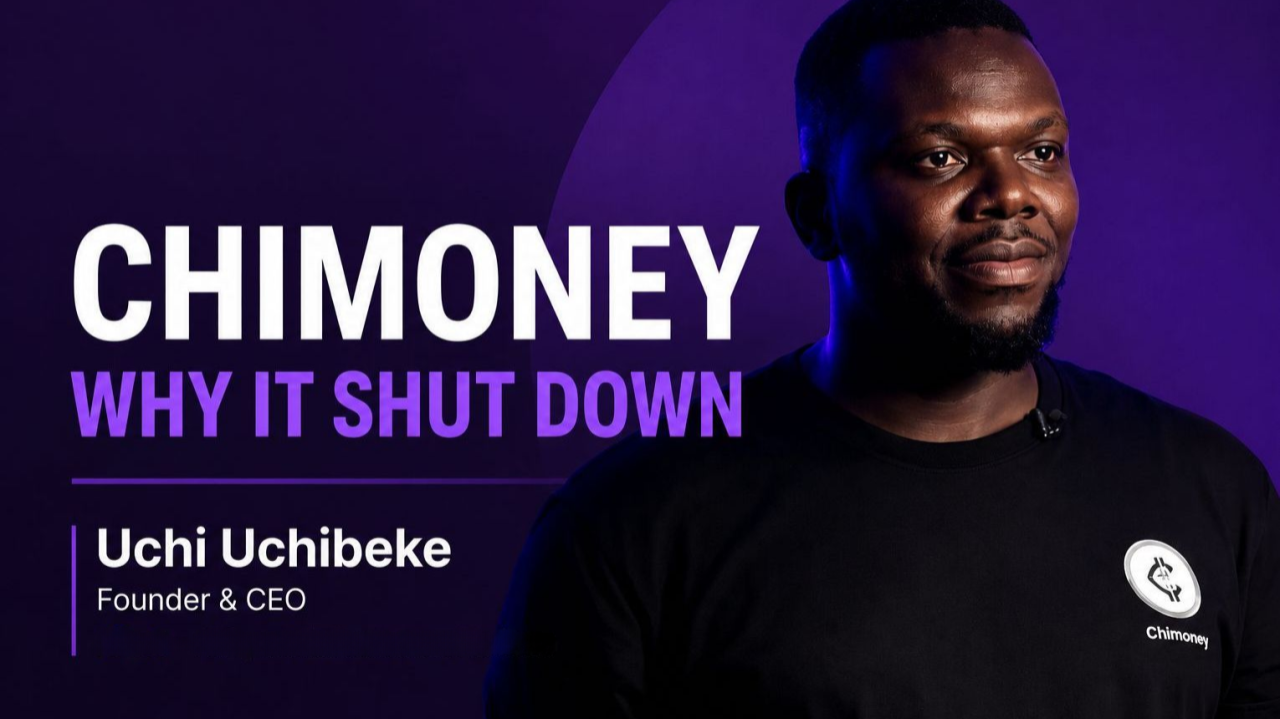
On the morning of 12 May 2026, a Nigerian founder in Toronto sat down and wrote the most honest startup obituary African fintech will read this year. Uchi Uchibeke, founder and CEO of Chimoney, posted to X that his four-year-old cross-border payments company had stopped accepting transactions on 30 April. He had told investors in February. He had told clients in April. Every wallet balance would be refunded by 31 August 2026. The Payment Service Provider licence would be preserved. This is not how African startups usually die. That is why it deserves an autopsy.
The Chimoney shutdown lands in a Nigerian fintech ecosystem that raised $343 million in 2025, a 17% year-on-year decline, according to CBN data cited in InsightPulseHub’s February 2026 analysis of the regulator’s policy report. Africa-wide fintech funding had already fallen 45% to $857 million in 2024, per the Global Finance & Technology Network’s 2024 review. The naira has lost more than 50% of its value against the dollar since June 2023’s float, per Technext reporting on CBN figures, while Nigerian inflation sat at 34.8% in December 2024. Into that environment Chimoney walked in carrying a sub-$1M cap table and a compliance burden built for a $10M company. The arithmetic did the rest. For every Kenyan or Nigerian founder reading this on LinkedIn, the Chimoney case is a clean teaching specimen: no fraud, no governance scandal, no investor war. Just a structural mismatch between ambition and capital, ending with the founder’s hands clean.
Chimoney
was born from a small frustration. Uchibeke, a Port Harcourt-raised engineer who had cycled through IBM,
Shopify
,
SecureKey Technologies Inc
(later acquired by Avast), RBC, and a Director of Developer Relations role at Coil, told Made in CA in early 2023 that the idea grew out of paying hackathon prize money to participants scattered across continents. He had founded NaijaHacks and AfricaHacks. He had moved capital across rails for years. The thesis was simple: a single API connecting bank transfers, mobile money, airtime, gift cards, stablecoins, and Interledger, so that a US company paying a Lagos freelancer would not have to navigate five compliance regimes and three intermediaries. Chimoney joined Techstars Toronto in 2023, secured a FINTRAC Money Services Business licence in Canada, and became one of the first companies in the country to obtain a Payment Service Provider licence under the Bank of Canada’s Retail Payment Activities Act in November 2025. The
Interledger Foundation
backed Chimoney with a $75,000 research grant in September 2023, then expanded the partnership in 2024 to make every Chimoney wallet Interledger-enabled. By 2023 the company posted a 4,500% increase in transaction value and a 600% surge in user accounts in Q1, per The
Condia (formerly, Bendada.com)
‘s reporting on Uchibeke’s post-mortem. Hundreds of businesses across North America, Africa, and Latin America were paying out across 41 currencies. The product, by every account that has emerged since the shutdown, worked.
Then two things broke at once.
The first was the funding math. Chimoney raised roughly $280,000 in disclosed equity, according to
Crunchbase
data cited by BitKE and
TechCabal
, with total capital including grants and accelerator support closer to $1 million across the company’s lifespan. In Uchibeke’s own words on X, that figure was “the worst of both worlds.” Cross-border payments fintechs typically need liquid capital reserves of between $1 million and $10 million in each major jurisdiction simply to satisfy regulators, per The Condia’s analysis citing industry benchmarks; multi-country operations consume 15 to 20 percent of annual gross revenue on compliance alone. Chimoney was operating across Canada, Nigeria, the United States, and a corridor stretching into Latin America. Audit costs, KYC vendors, licensing renewals, and corridor pre-funding ate into a balance sheet that should have been ten times its size. For context,
NALA
— the Tanzania-founded remittance company operating similar corridors — raised $40 million in its Series A. Chimoney was trying to play that game on accelerator pocket change.
The second was distribution. The Q1 2023 growth did not hold. A source close to the company told Tech In Africa that distribution “remained a gap” throughout Chimoney’s life, with engineering and product attention crowding out commercial muscle. Customer acquisition costs across fintech rose roughly 60 percent over the past two years, per The Condia, while well-capitalised competitors —
LemFi
,
Fincra
,
Payaza
Africa,
Raenest App (formerly Geegpay)
, Grey, and NALA Payments Canada among them — were registering under the same RPAA regime in early 2026 with established user bases and revenue already in hand. Chimoney was registering the same licence and trying to acquire customers from zero. The licence cost roughly the same. The distribution cost did not.
A third domino fell quietly in 2025. Uchibeke pivoted the company’s narrative towards AI agent payments, attempting to position Chimoney as infrastructure for autonomous AI systems to hold wallets and move money under controlled authorisation. The pivot did not translate into a fundraise. By February 2026, with revenue flat and no clear path to additional capital, Uchibeke had begun notifying investors. He has said publicly that he explored acquisitions and partnerships. None of them closed on terms that made sense.
The autopsy is unusual because there is almost no carnage to catalogue. There are no laid-off staff filing labour complaints in a Lagos magistrate court, no creditor petitions, no court-appointed administrator, no investor lawsuit. Chimoney’s wind-down has been, by African standards, surgical. The corporate entity, Chi Technologies Inc., remains active. The Bank of Canada PSP licence is preserved in dormant status — Uchibeke described it as hard to get and likely to get harder. Customer wallet balances are being refunded through a self-service portal until 31 August 2026, with unclaimed balances ultimately handed to Canadian provincial unclaimed-property offices, as the law requires. A migration playbook was published for every developer who had built on the Chimoney API. Uchibeke has already begun building a new company, APort, focused on pre-action authorisation for AI agents, with an Open Agent Passport spec already shipped. The team has scattered. By every available indication, nobody got hurt.
The cause of death was not failure. It was a venture-capital arithmetic problem performed in plain sight for four years. Chimoney had a regulator-grade compliance stack costing what a $10 million company would spend, sitting on a cap table that a pre-seed angel deal would have over-funded. It had product-market signal — a 4,500% transaction-value spike rarely lies — but it could not buy the distribution to convert that signal into revenue, because the cash required for distribution was already being consumed by the cash required to stay licensed. The pivot to AI agent payments was an attempt to find a new narrative for the next round. The round did not come. The honest move, from there, was to give the money back. Uchibeke made it.
𝑻𝒉𝒆𝒓𝒆 𝒂𝒓𝒆 𝒕𝒉𝒓𝒆𝒆 𝒕𝒓𝒂𝒏𝒔𝒇𝒆𝒓𝒂𝒃𝒍𝒆 𝒑𝒓𝒊𝒏𝒄𝒊𝒑𝒍𝒆𝒔 𝒊𝒏 𝒕𝒉𝒊𝒔 𝒂𝒖𝒕𝒐𝒑𝒔𝒚, 𝒂𝒏𝒅 𝒆𝒗𝒆𝒓𝒚 𝑨𝒇𝒓𝒊𝒄𝒂𝒏 𝒇𝒊𝒏𝒕𝒆𝒄𝒉 𝒇𝒐𝒖𝒏𝒅𝒆𝒓 𝒓𝒆𝒂𝒅𝒊𝒏𝒈 𝒕𝒉𝒊𝒔 𝒔𝒉𝒐𝒖𝒍𝒅 𝒔𝒕𝒂𝒑𝒍𝒆 𝒕𝒉𝒆𝒎 𝒕𝒐 𝒕𝒉𝒆𝒊𝒓 𝒑𝒊𝒕𝒄𝒉 𝒅𝒆𝒄𝒌.
𝐒𝐮𝐛-$𝟏𝐌 𝐢𝐬 𝐧𝐨𝐭 𝐚 𝐯𝐞𝐧𝐭𝐮𝐫𝐞-𝐬𝐜𝐚𝐥𝐞 𝐛𝐚𝐥𝐚𝐧𝐜𝐞 𝐬𝐡𝐞𝐞𝐭 𝐟𝐨𝐫 𝐚 𝐦𝐮𝐥𝐭𝐢-𝐣𝐮𝐫𝐢𝐬𝐝𝐢𝐜𝐭𝐢𝐨𝐧𝐚𝐥 𝐟𝐢𝐧𝐭𝐞𝐜𝐡. Either raise meaningfully more capital before opening the second corridor, or bootstrap from a single profitable beachhead until the unit economics carry the licence cost. Trying to do both, in Uchibeke’s own framing, did neither.
𝐀 𝐥𝐢𝐜𝐞𝐧𝐜𝐞 𝐢𝐬 𝐚 𝐜𝐨𝐬𝐭 𝐜𝐞𝐧𝐭𝐫𝐞, 𝐧𝐨𝐭 𝐚 𝐦𝐨𝐚𝐭. Regulatory credibility is necessary but never sufficient. The 2026 cohort registering under Canada’s RPAA — Fincra, LemFi, NALA, Payaza, Raenest — are not winning because they hold the licence. They are winning because they brought distribution and revenue into the licence, not the other way around. Compliance buys you the right to compete. It does not buy you customers.
𝐇𝐨𝐰 𝐲𝐨𝐮 𝐜𝐥𝐨𝐬𝐞 𝐦𝐚𝐭𝐭𝐞𝐫𝐬 𝐚𝐬 𝐦𝐮𝐜𝐡 𝐚𝐬 𝐡𝐨𝐰 𝐲𝐨𝐮 𝐛𝐮𝐢𝐥𝐝. Chimoney refunded every wallet, preserved the licence, published a migration guide, gave investors three months’ notice, and gave clients one. In an ecosystem where Dash allegedly diverted $8 million on the way out, where Twiga was accused of orchestrating a covert NewCo restructure to escape creditors, where Sendy went into administration with employees learning by press release, that conduct is rare enough to be a competitive asset for whatever Uchibeke builds next. APort’s first round will close faster because of how Chimoney’s last quarter ended.
Pull the camera back, and Chimoney becomes the cleanest case study yet of the post-ZIRP, post-naira-float African fintech reckoning. The Tiger Global money is gone. The 2021 cheque sizes are not coming back. The diaspora-founder pipeline through
Y Combinator
,
Techstars Toronto Accelerator
, and the global accelerator circuit will continue producing technically excellent African fintechs, but the gap between accelerator cheque size and multi-jurisdictional compliance cost has widened to the point where the middle path — sub-$5M raises chasing global ambitions — is now structurally untenable. Expect more honest shutdowns in the next 18 months from founders who learned from Uchibeke’s example, and more dishonest ones from founders who did not. The CBN’s February 2026 fintech policy report flagged that 62.5% of Nigerian fintechs face regulatory delays of up to a year; in a market where every quarter of delay burns runway that was never raised in the first place, the Chimoney arithmetic will repeat.
The Chimoney shutdown is not a tragedy. The next one might be.
African Startup Autopsies is a recurring series of the Fintech Association of Kenya.