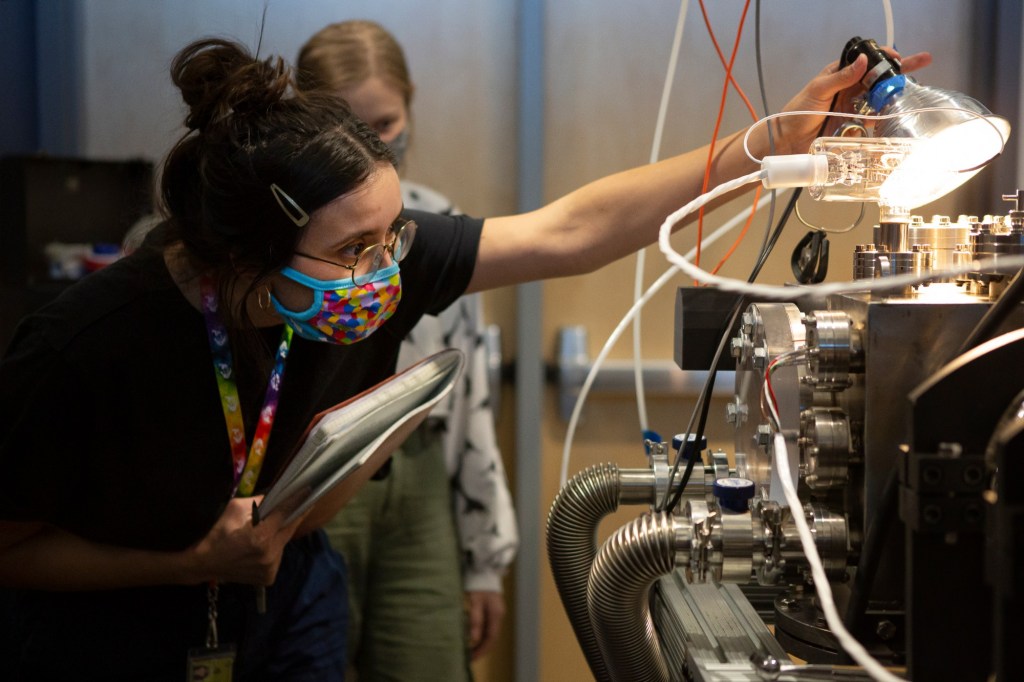
Forge Nano, an advanced materials company and University of Colorado Boulder startup, has reached a $1.6 billion valuation, making it CU Boulder’s 11th “unicorn,” or a privately held company with a valuation of $1 billion or more.
Bryn Rees, CU Boulder’s Senior Associate Vice Chancellor for Innovation and Partnerships, said reaching unicorn status can happen when a company raises a significant round of funding or at a transition point, such as an acquisition or going public.
“(Unicorn companies) create a significant amount of jobs and employment, and they attract capital to the state,” Rees said. ” … They bring this breakthrough innovation from an academic project, more of an intellectual exploration, into real-world impact.”
A unicorn is a privately held, venture-backed startup with a reported valuation of $1 billion or more. Coined in 2013, the term reflects how rare these companies were at the time. Since then, the cohort of unicorns has grown to more than 1,200.
Seven of CU Boulder’s 11 unicorns have reached that status since 2021. This is because by 2021 and 2022, Rees said, the university had established a deeper and stronger pipeline of startups, around 20 to 35 per year, with a variety of partnerships, funding opportunities and programs to support startup founders.
“That puts them in the type of position where they could achieve a very high valuation,” Rees said.
Forge Nano is a semiconductor equipment and advanced materials company that specializes in atomic layer deposition technology. ALD technology enables layers of single atoms to be placed on top of a particle, essentially protecting the particle and functionalizing it. The technology can be applied to improve batteries, semiconductor products, magnets, pharmaceuticals and rocket fuel.
“We’re excited,” Forge Nano co-founder and CU Boulder alumnus Paul Lichty said. “Our view is this is one of the most important manufacturing technologies of the next 100 years. So it’s great to be in a position where we are the leaders in bringing this out to the market.”
The concept originated with CU Boulder professors Al Weimer and Steven George. In 2001, Weimer and George founded a startup company called ALD NanoSolutions that merged with Forge Nano in 2020. Lichty graduated from Weimer’s lab with his chemical engineering doctorate degree in 2011. He also earned his bachelor’s degree in mechanical engineering from CU Boulder. Lichty spent a lot of time at CU, he said, and the education he got was critical, especially his experience with research.
“I think (CU) was extremely important for us to be where we are today,” Lichty said.
Universities have a unique opportunity and role to play when inventing new technologies, Weimer said. Academics can be more exploratory and focused on the long-term, as opposed to companies that may only be thinking two to three years ahead.
“You can come up with things that have really huge opportunities, and I call them platform technologies,” Weimer said. “And then the challenge is, OK, how do you make money with this?”
To have a successful startup, the novel technology has to work, the founders have to convince people it works and is low-cost, and they have to show they can scale it up, Weimer said. The technology used at Forge Nano was “very exploratory,” Weimer said, and they had to work hard to show people that it actually worked.
In his chemical and biological engineering lab, Weimer has 100% job placement for graduating students and lots of interest from new students. Companies contact him regularly, wanting to hire new graduates.
“There’s a huge demand for people who can actually build things,” he said.
As a whole, CU Boulder’s unicorns are largely focused on deep tech, including biosciences, quantum, advanced energy and aerospace. The first CU Boulder startup to reach unicorn status was Amgen in 1990. Co-founded by CU Boulder professor Marvin Caruthers in 1980 and originally named Applied Molecular Genetics, Amgen’s pioneering phosphoramidite chemistry made automated DNA synthesis — and modern biotechnology — possible. Today, the company is worth about $189 billion.
It quickly grew to be one of the largest biotechnology companies in the world, Rees said, and arguably has the largest impact of any CU Boulder unicorn in terms of health outcomes, employment and valuation.
“Folks who have had protein-based therapeutics like human growth hormone, or other treatments for heart disease, these often come from Amgen,” Rees said. “So it’s a hugely impactful company.”
Most of the time, it can be quite a long path for a CU Boulder startup to reach unicorn status, Rees said. Ball Aerospace, now BAE Systems, was founded in 1956 and became a unicorn when BAE Systems acquired it in 2024. Sirna Therapeutics Inc., a biotechnology company founded by CU Boulder biochemistry professor Thomas Cech, was founded in 1992 and reached unicorn status in 2006. The quantum company Infleqtion, co-founded by CU Boulder physics and engineering professor Dana Anderson, was founded in 2007 and reached unicorn status in 2025.
Ayar Labs, founded in 2015, uses silicon photonics to move data with light rather than electrical signals, solving critical bottlenecks in AI and high-performance computing. Built on nearly a decade of research from MIT, UC Berkeley and CU Boulder, the company has raised hundreds of millions to scale its breakthrough technology. The company reached unicorn status in 2024.
Manus, founded by CU Boulder professor Ryan Gill in 2015, works with companies across industries to accelerate the transition to bioalternatives, or better-performing and more sustainable versions of complex molecules traditionally sourced from plants, animals or fossil fuels. It reached unicorn status in 2021.
Solid Power Inc., which develops advanced batteries for electric cars, was co-founded by CU Boulder mechanical engineering professors Conrad Stoldt and Se-Hee Lee in 2011, reaching unicorn status in 2021. The biotechnology company SomaLogic was founded in 2000 when a CU Boulder professor developed a faster, cost-effective process to measure proteins in the human body. It reached unicorn status in 2021.
Leslie Leinwand, a distinguished professor of molecular, cellular and developmental biology, co-founded Myogen in 1996 and MyoKardia in 2012 to advance breakthrough cardiovascular therapeutics. Her lab’s pioneering technology directly enabled the discovery of Camzyos — the first FDA-approved drug to treat obstructive hypertrophic cardiomyopathy. MyoKardia was acquired by the global biopharmaceutical company Bristol Myers Squibb in a $13.1 billion-dollar deal in 2020, and Myogen was acquired by the biopharma company Gilead for $2.6 billion in 2006.
Subscribe to our new newsletter to get CU Boulder’s latest news sent straight to your inbox.