
The OpenAI logo is reflected on the screen of a smartphone with the ChatGPT website displayed. [YONHAP]
The memo arrived about a week before the deadline: Every team had to submit at least one idea to the company’s internal AI transformation competition. For the employees, that meant setting aside actual work to brainstorm on demand.
“They restrict AI use in day-to-day work, citing security concerns, but then ask us to come up with ideas,” a worker at a major domestic retail company said. “It just adds to the performative workload.”
A developer at a Korean tech startup went the other direction — throwing themselves into AI tools with full force. The worker ran five or six Claude Code sessions simultaneously each day, juggling multiple tasks at once, and would set the AI to work overnight so they could review the results the next morning.
Then one day, sitting in front of their monitor, the worker felt their chest tighten. Headaches made it impossible to concentrate. The symptoms persisted, and they eventually quit.
Their experiences reflect a growing phenomenon across Korean workplaces, where the pressure to embrace AI is accumulating into something that looks less like transformation and more like burnout.
In March, Boston Consulting Group put a name to it in a paper published in Harvard Business Review: “AI brain fry” — defined as the mental exhaustion caused by the excessive use or supervision of AI tools that exceed a person’s cognitive capacity. “The mental burden imposed by AI leads to increased employee errors, decision fatigue and turnover costs,” the researchers warned.
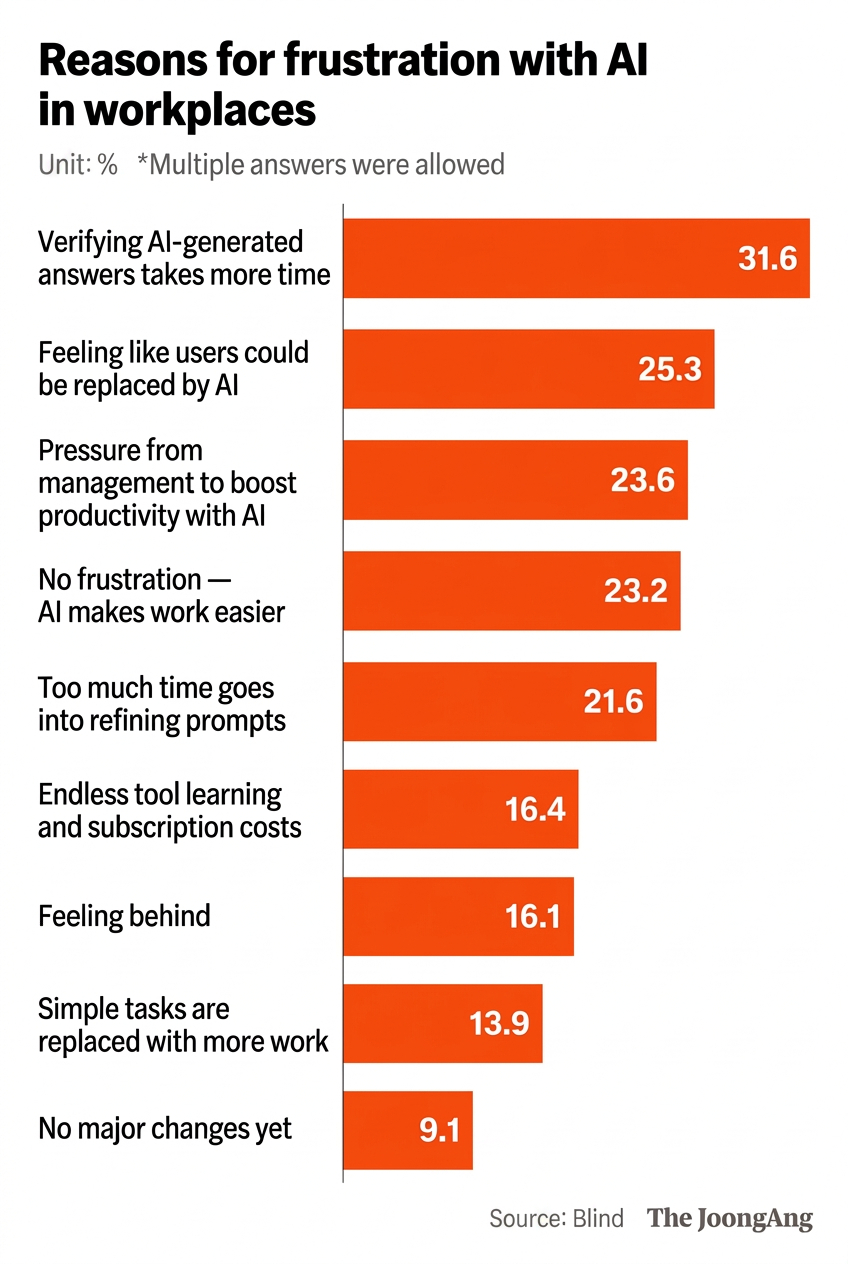
To gauge the mood on the ground, the JoongAng Ilbo ran a survey for one month from April 30 on Blind, a workplace community app popular among Korean office workers, asking users: “When do you feel most drained or get with a reality check while using AI?”
Of the 5,284 respondents, the most commonly selected answer was “when verifying AI outputs takes longer than doing the work myself” at 31.6 percent, followed by “when I feel like I might be replaced by AI” at 25.3 percent and “when the company pressures me to raise productivity through AI” at 23.6 percent.
A person types on a computer keyboard. [AP/YONHAP]
The comments were equally candid. “My KPI is literally one AI transformation case,” wrote one employee at a large conglomerate. “They’re saying that since AI has improved our efficiency, they’re going to cut our headcount. I feel like I’m digging my own grave.”
Another simply wrote that they felt like they were building the instrument of their own redundancy.
A related term has also taken hold in online communities this year. Early in 2025, a startup worker coined the phrase “Claude Blue” to describe the creeping psychological despondency that comes from feeling that AI is eroding the professional value of human workers. The expression spread quickly enough that in April, an event titled “From Claude Blue to Claude Bloom” was held at the Banks Foundation for Young Entrepreneurs, also known as dcamp, in Gangnam District, southern Seoul, sponsored by Anthropic. More than 2,000 people registered to attend in advance.
Experts say companies need to fundamentally rethink how humans and AI work together, rather than simply layering AI tools on top of existing workloads. That approach, they argue, is intensifying the burden on workers and generating psychological resistance that ultimately leads to burnout.
“Many corporate executives try to change everything at once, and that’s where the problems start,” said consultant Park Ju-won, who advises companies on AI strategies. “For an effective AI transformation, you need to identify which parts of the current workflow are the most predictable and the fastest to change, and build up gradually from there.”
This article was originally written in Korean and translated by a bilingual reporter with the help of generative AI tools. It was then edited by a native English-speaking editor. All AI-assisted translations are reviewed and refined by our newsroom.
BY HONG SANG-JI [[email protected]]
Source link