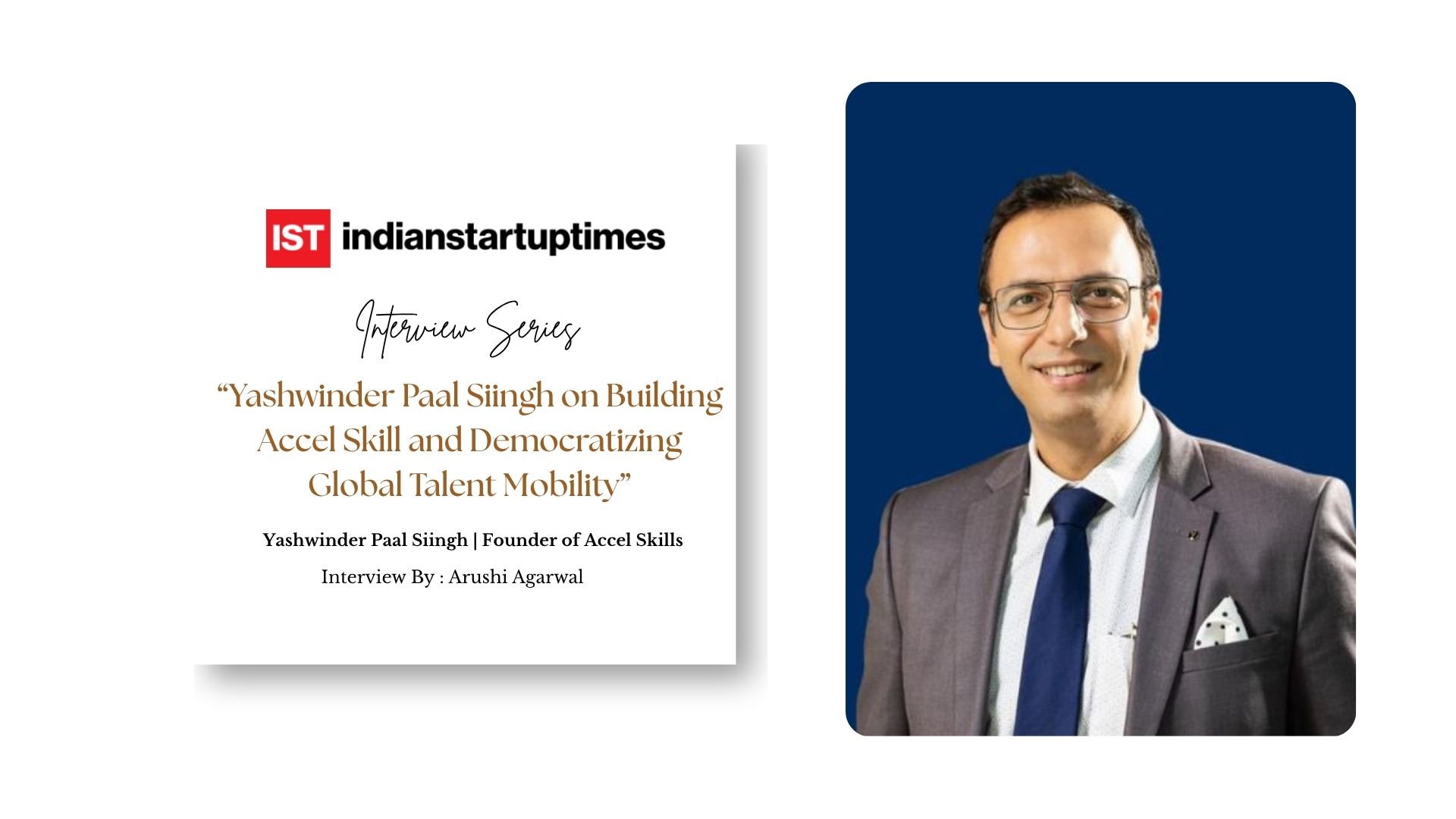
India is entering a defining decade where skill development, employability, and global workforce mobility will shape the country’s economic future. At the center of this transformation is Yashwinder Paal Siingh, co-founder of Accel Skill, a platform focused on preparing Indian talent for international opportunities through technology-driven learning, language training, and industry-aligned programs.
With over two decades of experience in the financial services industry, including leadership roles at HSBC, Yashwinder’s entrepreneurial journey has been driven by one core idea — using technology to solve large-scale systemic challenges.
In a recent conversation with Indian Startup Times, he shared insights into his transition from private banking and wealth advisory role to entrepreneurship, the inspiration behind Accel Skill, and his vision of making India a global skill capital.
From Financial Services to Entrepreneurship
Before entering the startup ecosystem, Yashwinder spent nearly 20 years in financial services, where he worked extensively with institutions and emerging technologies. His entrepreneurial shift began around 2016–17, when he co-founded a blockchain-based platform focused on tokenizing real estate and digitizing land and property records.
The venture worked with multiple state governments to explore blockchain applications in governance and infrastructure. However, through these experiences, Yashwinder identified a much larger opportunity — the growing disconnect between education and employability in India.
He realized that while millions of young Indians graduate every year, many still struggle to access meaningful employment opportunities, especially in international markets.
This insight eventually led to the creation of Accel Skill.
Addressing India’s Employability Gap
According to Yashwinder, India’s biggest challenge is not the lack of talent, but the lack of industry-ready skills and global exposure.
He explained that students often possess academic qualifications but miss out on practical skills, language capabilities, and cultural understanding required for global careers. These gaps become even more visible in sectors like nursing, hospitality, and skilled trades, where international demand is growing rapidly.
Accel Skill was built to bridge this gap.
The platform combines digital learning, AI-driven tools, soft skills, language training, and hands-on preparation to help Indian youth access global job opportunities. The company especially focuses on students and professionals from Tier II and Tier III cities, where access to international pathways is often limited.
Yashwinder believes that by 2030, nearly one billion Indians will be of working age, creating an enormous opportunity for India to emerge as a global talent hub.
Accel Skill’s Focus Areas
Accel Skill currently operates around three major workforce programs:
Nursing
The healthcare sector remains one of the company’s strongest focus areas due to the increasing global demand for nurses. Yashwinder highlighted how Indian nurses have the capability to build highly rewarding international careers, particularly in countries facing healthcare workforce shortages.
The platform supports candidates through technical preparation, language learning, and cultural integration programs that improve global employability.
Hospitality
Accel Skill also works closely with hospitality institutions to prepare students for international placements. The company aligns its training modules with global employer expectations while emphasizing communication and workplace readiness.
Yashwinder noted that migration mobility agreements between countries like India and Germany are creating structured opportunities for Indian professionals in hospitality and healthcare sectors.
Ausbildung (Dual Education) in multiple domains
The third segment focuses on Ausbildung program which is a globally recognised dual education program in Germany. This program is structured pathway to secured career in Germany. Due to shortage of skilled workforce the global demand continues to rise. The company aims to prepare candidates with practical, hands-on capabilities that match international standards.
Building Trust in a Complex Industry
One of the biggest challenges in global recruitment and workforce mobility is trust.
Yashwinder acknowledged that many families remain cautious about overseas opportunities due to misinformation, unethical intermediaries, and lack of transparency in the recruitment ecosystem.
To address this, Accel Skill has adopted a partnership-led approach.
The company collaborates with nursing colleges, hotel management institutes, state government skill development societies, and institutional partners to build credibility and ensure structured pathways for students.
Accel Skill has also received support through Startup India initiatives and maintains compliance with Ministry of External Affairs guidelines for overseas placements.
According to Yashwinder, institutional partnerships play a critical role in creating confidence among students, parents, and employers alike.
Leveraging Technology and AI
Technology sits at the core of Accel Skill’s operating model.
Yashwinder explained that AI and digital learning tools are helping democratize access to quality training, especially for students in smaller cities. Through hybrid learning models, students receive technical education from partner institutions while Accel Skill focuses on soft skills, language development, and global workplace readiness.
He emphasized that future workforce development will increasingly depend on adaptable, tech-enabled learning ecosystems rather than traditional classroom-only education models.
Creating Pathways, Not Just Enrollments
For Yashwinder, the true measure of success lies not in the number of enrollments but in actual career outcomes.
He believes India must move beyond simply training students and instead focus on building sustainable employment pathways that lead to economic mobility and global exposure.
The company’s broader vision also aligns with the United Nations Sustainable Development Goals, particularly around quality education, decent work, and economic growth.
By enabling skilled professionals to access international opportunities, Accel Skill also contributes to increasing foreign remittances and strengthening India’s global workforce reputation.
The Road Ahead
Looking ahead, Accel Skill plans to deepen institutional collaborations, expand its international employer network, and attract long-term investors who believe in impact-driven growth.
Yashwinder’s long-term ambition is to build Accel Skill into one of the most trusted and ethical global talent mobility platforms emerging from India.
He believes the next generation of professionals must invest in continuous learning, language capabilities, and cultural adaptability to succeed in an increasingly interconnected world.
“Degrees alone are no longer enough,” he shared during the conversation. “Young professionals must develop practical skills, communication abilities, and the confidence to step outside their comfort zones.”
As India positions itself as a future global talent powerhouse, startups like Accel Skill are working to ensure that opportunity is not limited by geography, background, or access.
Through technology, partnerships, and ethical workforce development, Yashwinder Paal Siingh is building a platform designed not just to create jobs — but to transform lives.
Interview By : Arushi Agarwal