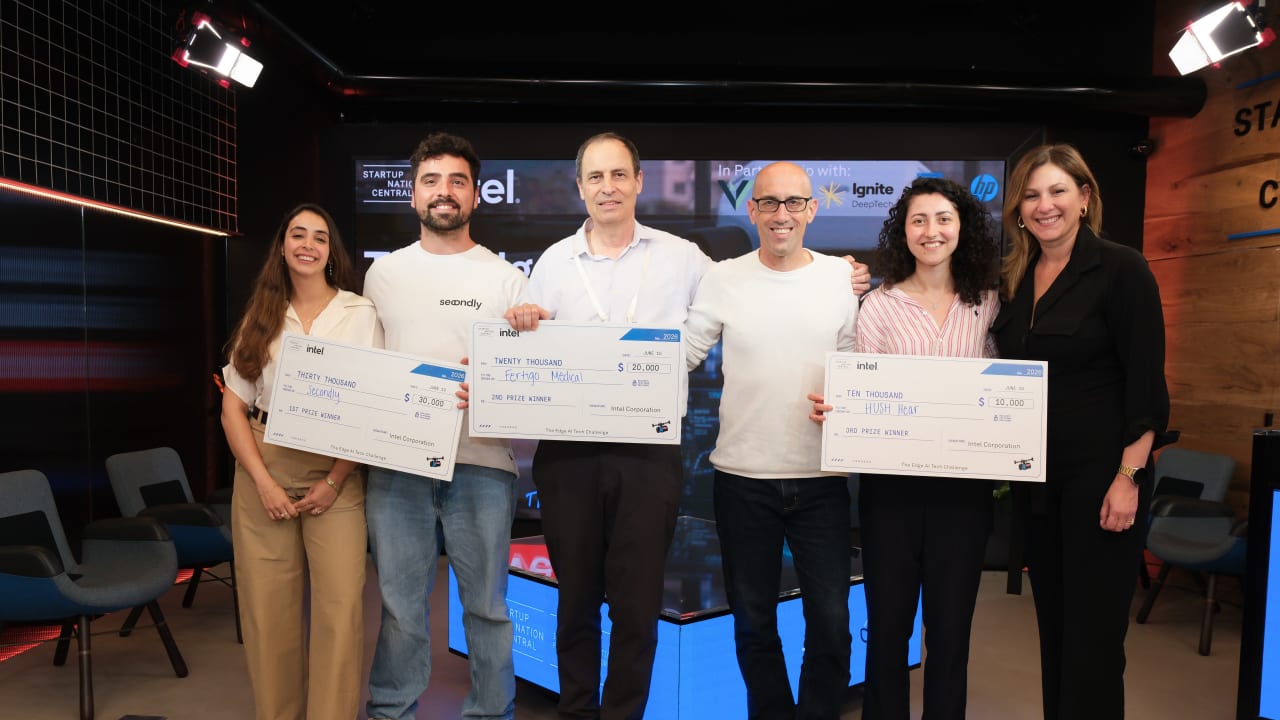
Startup Nation Central and Intel have named three Israeli-linked start-ups as winners of their Edge AI Tech Challenge, highlighting a growing shift toward artificial intelligence that operates directly on devices rather than relying entirely on cloud-based computing.
The competition, which attracted more than 100 start-ups and ventures, sought practical AI applications that can run on personal computers, medical devices, cameras, hearing devices, and other hardware where data is generated and decisions are made in real time.
Taking first place was Secondly, a startup founded by serial entrepreneur Adam Cohen Hillel. The company is developing an AI assistant designed to maintain long-term memory of a user’s preferences, habits, and past interactions while keeping that information under the user’s control.
Unlike most current AI assistants, which largely treat each interaction as a new conversation, Secondly aims to create a continuous personal AI layer that operates across multiple devices.
“Today’s AI models are incredibly smart, but they are missing the context that makes them truly useful for you,” Cohen Hillel said. The company plans to expand its development efforts and begin recruiting users and partners following the competition.
Second place went to Fertigo Medical, led by Dr. Tzafrir Kolatt. The company is developing a system intended to improve IVF outcomes by helping physicians determine the optimal timing for embryo transfer. Its technology combines a miniature endoscope with AI-powered image analysis to assess the condition of the uterine lining in real time, offering what the company describes as a “virtual biopsy” without the need for tissue sampling.
Hush Hear, founded by Almaza Faras, secured third place.
Inspired by Faras’s own experience with hearing loss, the startup has developed a wearable system that enables users to select which speaker they want to hear in noisy environments. The technology processes audio directly on the device, minimizing delays that can disrupt natural conversation.
According to Intel and Startup Nation Central, the winners reflect a broader trend toward “edge AI” – artificial intelligence that operates closer to users and devices, offering faster response times, greater privacy, and reduced dependence on cloud infrastructure.