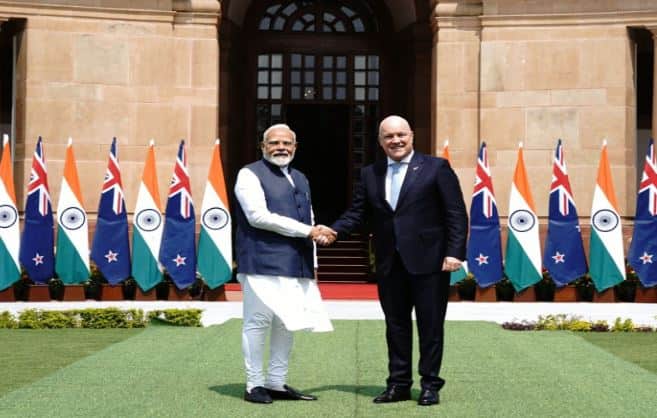
India and New Zealand have set an ambitious target of increasing bilateral trade to NZ$7 billion (Rs 35,000 crore) by 2030 as part of their new Strategic Partnership and the implementation of the bilateral Free Trade Agreement (FTA).
Based on New Zealand’s official statistics, achieving that goal will require bilateral goods and services trade to expand by NZ$3.05 billion, or 77 percent, from the current level of NZ$3.95 billion for the year ended December 2025.
This translates into a compound annual growth rate (CAGR) of about 12 percent over the five years from 2025 to 2030.
A notable feature of the announcement is that the aim for 2030 has been set in the local currencies of both countries rather than US dollar terms, which is more commonly used for bilateral trade targets.
New Zealand exported NZ$2.03 billion of goods and services to India and imported NZ$1.92 billion, resulting in a trade surplus of NZ$105.2 million and total bilateral trade of about NZ$3.95 billion in the year ended December 2025.
India accounted for 1.8 percent of New Zealand’s total exports and 1.7 percent of its imports.
For total goods and services trade, India ranked as New Zealand’s 11th-largest export market, 13th-largest import source, and 11th-largest trading partner overall.
Services already form a significant pillar of the relationship. New Zealand exported NZ$1.21 billion of services to India and imported NZ$468.96 million, generating a services trade surplus of NZ$736.06 million.
India was New Zealand’s 5th-largest services export market, 10th-largest services import source, and 6th-largest services trading partner in the year ended December 2025.
Travel services remain the dominant component of New Zealand’s services exports to India, contributing NZ$1.14 billion, or more than half of New Zealand’s total exports to the Indian market.
Other major New Zealand exports to India included forestry (NZ$399 million), horticulture (NZ$114 million), aluminium (NZ$86 million), iron and steel (NZ$80 million) and wool (NZ$77 million).
Of the NZ$3.95 billion in total India–New Zealand goods and services trade in the year ended December 2025, merchandise trade accounted for NZ$2.27 billion, while services trade contributed NZ$1.67 billion.
India’s exports to New Zealand are concentrated in manufactured goods and industrial products.
New Zealand’s leading imports from India in the year ended December 2025 included travel services (NZ$312.98 million), mineral fuels and oils (NZ$242.06 million), pharmaceutical products (NZ$141.75 million), mechanical machinery (NZ$129.74 million) and made-up textile articles (NZ$80.22 million).
The India–New Zealand Free Trade Agreement, signed in April 2026 in New Delhi, provides the framework for the next phase of economic engagement between the two countries.
During Prime Minister Narendra Modi’s visit to New Zealand in July 2026, both sides reiterated their commitment to advancing implementation of the agreement and announced outcomes aimed at deepening economic cooperation.
The FTA is expected to improve market access, reduce trade barriers and provide greater certainty for businesses.
For New Zealand, the agreement is expected to create opportunities in sectors such as agriculture, food and beverages, horticulture, forestry, education and tourism. For India, improved access is expected to support exports of pharmaceuticals, textiles, engineering goods, machinery and other manufactured products.
Beyond tariffs, the agreement also seeks to strengthen investment, supply-chain integration and cooperation in areas including digital trade, technology and innovation.