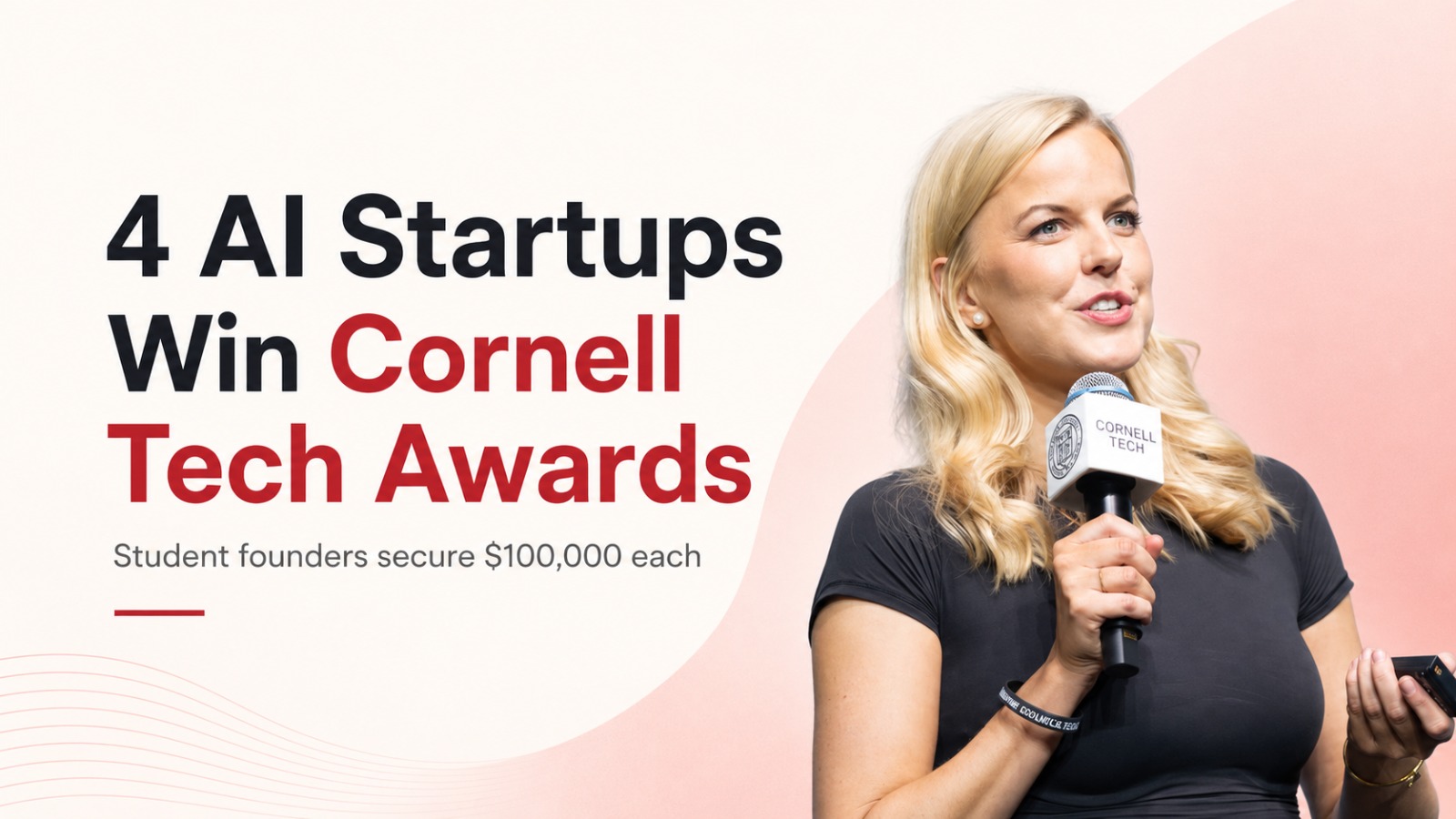
New York: At a time when artificial intelligence is being questioned as much as it is being celebrated, Cornell Tech’s 2026 Startup Awards put the spotlight on a different side of the AI race: student-led companies trying to make the technology safer, more reliable and useful in high-stakes sectors.
Four student-founded AI companies, Aiseptor, Custos, Kindred and Lola, won the university’s annual Startup Awards competition, held on May 14 at the Cornell Tech campus. Each winning team will receive a post-academic investment valued at $100,000, along with studio space and continued mentorship to help turn early-stage ideas into scalable ventures in New York City.
The event drew nearly 600 students, university leaders, entrepreneurs and technology executives. Eleven finalist teams pitched ideas across areas such as AI safety, agentic systems, predictive healthcare, satellite collision risk, legal decision-making and financial automation.
What stood out this year was not just the number of AI startups in the room, but the kind of problems they chose to solve. These were not flashy consumer tools built for quick attention. The winning companies focused on exams, payments, medical device regulation and internal business approvals, four spaces where mistakes can carry real consequences.
Cornell Tech Startup Awards: Four AI startups take home top honours
Aiseptor is working on AI exam security. Instead of catching fraud after it happens, the startup installs a built-in security layer on candidates’ devices to block unauthorized tools during high-stakes exams. The company was founded by master’s degree students Akshay Aggarwal, Sanjay Ram, Divya Kheraj Bhanushali and Sudhakar Padmanaban.
Custos is focused on safer financial transactions in an AI-driven workplace. As companies begin delegating more operational work to AI agents, Custos wraps existing payment infrastructure with programmable spending policies, real-time enforcement and audit trails. The startup was founded by Carlos Guerrero Spota and Chloe Wang.
Kindred addresses the heavy regulatory burden around medical devices. Its AI reasoning engine turns thousands of pages of medical device regulation into structured, traceable checklists. The company was founded by Julia Klingberg and Aagam Bakliwal.
Lola is building for companies that struggle to preserve institutional knowledge. It uses AI to capture past contracts, decisions and policies, then automates routine approvals with consistent judgment. The startup begins with legal workflows and aims to expand across business functions. Lola was founded by Andrea Solano Abello, Björn Langer and Zane Mroue.
Together, the winners show where student entrepreneurship in AI is moving: toward trust, traceability and decision-making systems that can function inside regulated or complex environments.
Runners-up point to AI’s healthcare momentum
Two runners-up, CoagHealth and MedComm, were also selected. Both will receive office space and mentorship through the Runway program at the Jacobs Technion-Cornell Institute.
CoagHealth, founded by master’s degree student Medi Tolou, predicts blood clot risk in cancer patients up to nine days in advance using routine lab work already collected during care. MedComm, founded by Royi Rozen, conducts automated follow-up calls and messages with heart failure patients during the 30 days after discharge, helping reinforce care plans and alert clinical teams when patient responses suggest deterioration.
The presence of both healthcare-focused runners-up also gives this year’s awards a clear pattern. Many teams are not simply asking what AI can automate. They are asking where earlier warnings, clearer checklists or more consistent follow-ups could change outcomes.
A record year for student founders
Cornell Tech’s Startup Awards are part of the Studio program, a core component of the Cornell Tech master’s degree. In their final semester, students can form teams and join Startup Studio, where they develop, test and refine startup ideas in an academic setting.
Greg Morrisett, the Jack and Rilla Neafsey Dean and Vice Provost of Cornell Tech, said the awards bring together students from law, engineering, computer science, design, health tech and business. He described the work as the result of an interdisciplinary approach, with students using AI to take on problems that do not fit neatly into one field.
This year also marked a record for the competition. More than 30 teams competed in the Startup Awards, a milestone highlighted by Josh Hartmann, Cornell Tech’s Chief Practice Officer. Hartmann said the moment shows that students are not just building with AI tools, but rethinking how industries work.
The winners were announced by Andrew Ross Sorkin ’99, the award-winning journalist, founder and editor-at-large of The New York Times DealBook, co-anchor of CNBC’s Squawk Box, author of 1929 and Too Big to Fail, co-creator of Showtime’s Billions and a member of the Cornell Tech council.
The 2026 Cornell Tech Startup Awards arrive at a moment when AI is moving from experimentation into sensitive areas of daily work. Exams, payments, medical compliance and company approvals all depend on trust. That makes this cohort notable.
Aiseptor is trying to protect the credibility of exams. Custos is focused on financial guardrails for AI agents. Kindred is working to make regulation more navigable. Lola is addressing consistency in internal decision-making. None of these problems are abstract. They sit inside institutions that already face pressure to move faster without losing control.
That is what gives the winning batch its sharper edge. The story is not only that four student-founded AI companies won funding. The bigger story is that student founders are now building AI around accountability, not just capability.
Since the launch of the Startup Awards, more than 128 startups have been founded at Cornell Tech through Studio and the Runway program. These companies have collectively reached a valuation of more than $1.3 billion and raised over $500 million in venture capital across sectors including AI, digital health, fintech, legal tech, sustainability and media.
Other finalist teams in the 2026 Startup Awards included Daunt, Ephemeris, NYX Labs, PaShield and TMoM.
Also Read: Kartik Sharma Net Worth: The Story Behind CSK’s ₹14.2 Crore Young Star
![[Korean Startup Weekly News #126] Physical AI Takes Center Stage - WOWTALE](https://newsx.io/wp-content/uploads/2026/07/Korean-Startup-Weekly-News-126-Physical-AI-Takes-Center-Stage.jpg)