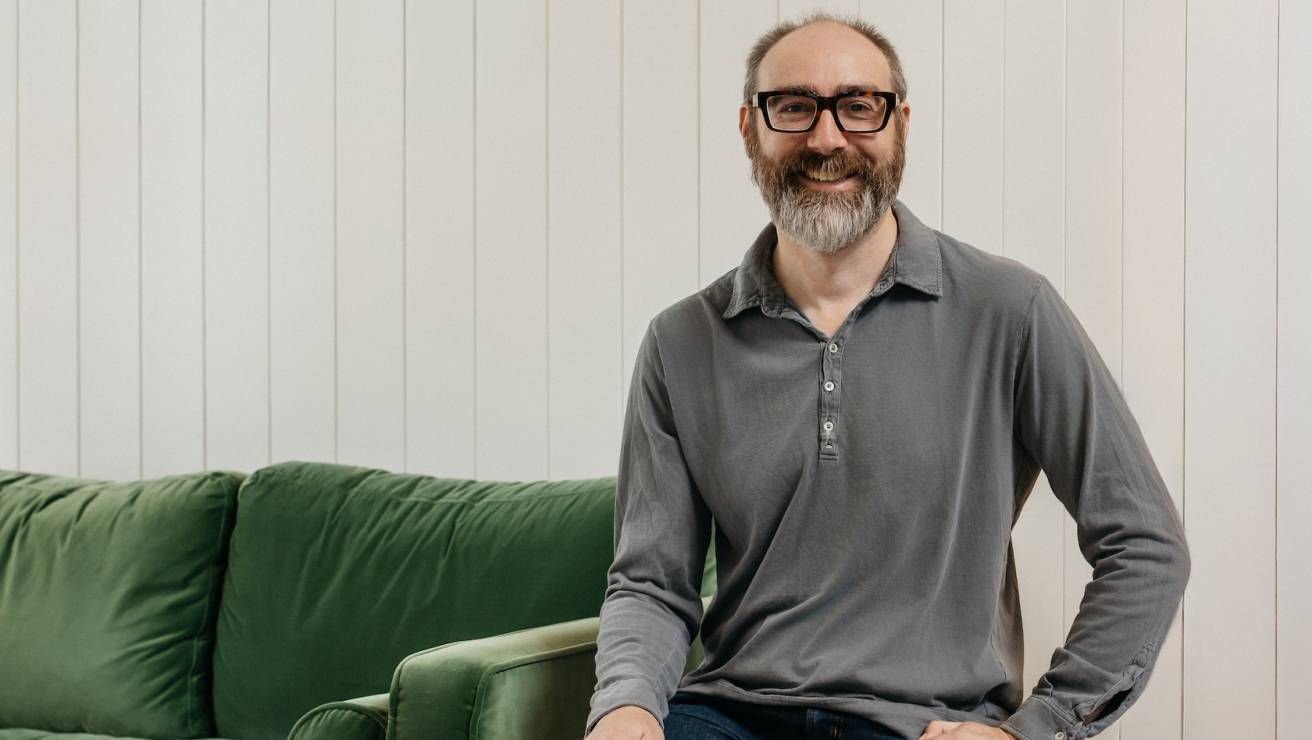
My conversation with Dom Pym was only supposed to go for an hour.
We wrapped up almost 90 minutes later, and I immediately knew my decision to start a podcast was a good one. Even if the last thing this content-saturated world apparently needs is another content creator.
I interviewed Dom because I wanted to understand how he built Up bank, one of Australia’s most dynamic fintech startups. But the more he talked, the less it sounded like a fintech story and the more it sounded like the culmination of decades of maverick thinking about how to build a category-reshaping business.
In fact, key to the success of Up was that Dom never told himself he was building a bank. The story he told himself was instead about using technology to change people’s relationship with money.
Dom is the first guest on StoryWork, my new podcast that explores the role story plays in building businesses, leading organisations and making change happen.
He describes himself as a “30-year overnight success”, which is a good line but also a useful reminder about the way we tend to misunderstand entrepreneurship.
Cursed with survivor bias, we focus on the company that worked, the funding round that succeeded and the exit that cemented the dream. We rarely see the decades of relationships, experiments, odd diversions and divergent capabilities that eventually collide at exactly the right moment.
Fintech before fintech
Dom had been at the forefront of successive waves of technology long before fintech became fintech. He built enterprise software, worked in financial markets and built some of the earliest apps in Apple’s App Store. But he also spent years around music and creative culture and, crucially, kept working with many of the same people.
When Dom and his team decided to build Up, they made a decision I haven’t stopped thinking about since our conversation.
As I see it, if you or I were setting out to build a new banking business, a startup in one of the world’s most heavily regulated industries, the conventional wisdom would be to fill the room with banking people. We’d hire people who understood banking products, regulation, technology and risk, and who could reassure everyone involved (especially investors) that we knew how banks worked.
Dom and his team took a different path. They recognised that Up didn’t need to reinvent every part of banking to reinvent the experience of it. The partnership with Bendigo Bank provided the institutional capability, regulatory infrastructure and trust required to operate, freeing Dom and his team to concentrate their energy where they could create the greatest distinctive advantage.
That strikes me as a seriously underappreciated form of strategy. We celebrate founders who want to own everything, control everything and take credit for everything. But sometimes the more powerful question is: what are we uniquely good at, and who is already better than us at everything else?
Not bank ingredients
In Up’s case, that also meant building a team from a wildly divergent collection of worlds.
As Dom described it, Up brought together “multimedia, graphic designers, product people, engineers, user experience designers, video production, special effects” and drew on cultural influences including “surfing and skateboarding and music and anti-culture”.
Again, not the obvious ingredients for a bank. But that was precisely the point. The team had deep technological fluency without being trapped by a lifetime of banking assumptions. They understood what technology could do but were equally fascinated by how things looked, felt and made people feel.
Dom himself had repeatedly been early to technological change, yet he doesn’t talk like someone besotted with technology for its own sake. He talks about people, experiences, design, emotion, culture and even love.
Bringing back feeling
One tiny story from our conversation captures this beautifully.
Dom talked about how, as money has become digital, we have lost much of our physical relationship with it. A $10 note once had weight. You held it in your hand and felt yourself handing it over. Spending money involved a physical act that made its value tangible in a way that tapping a screen often doesn’t.
So the Up team became obsessed with how technology could restore some of that feeling. One of the details they created was haptic feedback that made it feel as though coins were moving around inside your phone like a digital piggy bank. It’s a tiny feature, but it tells you an enormous amount about the business they were trying to build. They weren’t simply digitising banking. They were thinking about people’s relationship with money, then using technology, design and a little playfulness to change how that relationship felt.
The innovation wasn’t the technology itself. It was the imagination to ask what a bank could do with it.
Up emerged from a collision of technological possibility, institutional expertise and a deeply human sensibility. Bendigo Bank provided capabilities that would have taken years, enormous amounts of capital and considerable risk to recreate, while Dom and his team concentrated on reimagining what the experience of money and banking could actually feel like. And that led to perhaps the biggest strategic shift in the whole story. Up stopped benchmarking itself against banks.
Instead of comparing the Up experience to those provided by CommBank, ANZ, Westpac or NAB, Dom’s team looked to apps from other categories that people actively chose to put on the home screen of their phones.
In the process, they stopped asking how to build a better bank and started asking how to build something people might actually love.
And the love for Up is real, with Dom telling me that more than 80% of Up’s growth came through word of mouth.
Telling stories backwards
I started our conversation wanting to understand how Dom Pym built Up. I finished it thinking about how badly we tell founder stories.
We tell them backwards. Once someone succeeds, every previous step becomes evidence of inevitable progress towards the thing we now know they built. But real careers and real founder stories aren’t that neat. Perhaps that is what makes “30-year overnight success” more than a good line.
We notice entrepreneurial success when its financial value suddenly becomes visible. But by then, the more interesting forms of capital (like taste, culture, knowledge, experience and relationships) may have been compounding for decades. Dom eventually turned all of that into Up.
There is so much more to his story than I’ve shared here.
Not least how Dom has now invested over $100m of his own money into Australia’s innovation economy (while helping to unlock billions more).
I hope you’ll join me and Dom on the podcast to listen to the whole conversation for yourself. And, if my instincts are right, you’ll agree that maybe the world did need another podcast after all.
- The StoryWork podcast with Matt Jones, exploring the role of story in building brands, businesses, movements, and ideas, is available on Spotify, Apple, Youtube and Substack.
Matt Jones is a keynote speaker and brand growth adviser at Think Story Experience.